A sidebar for the accounts you repeat
Shift’s official app directory says it integrates web apps and Chrome extensions. Its pages use both 1,500+ and 4,500+ counts; treat them as changing marketing counts, not an independently audited catalog.
EDITORIAL REVIEW FILE · AUGUST 2026
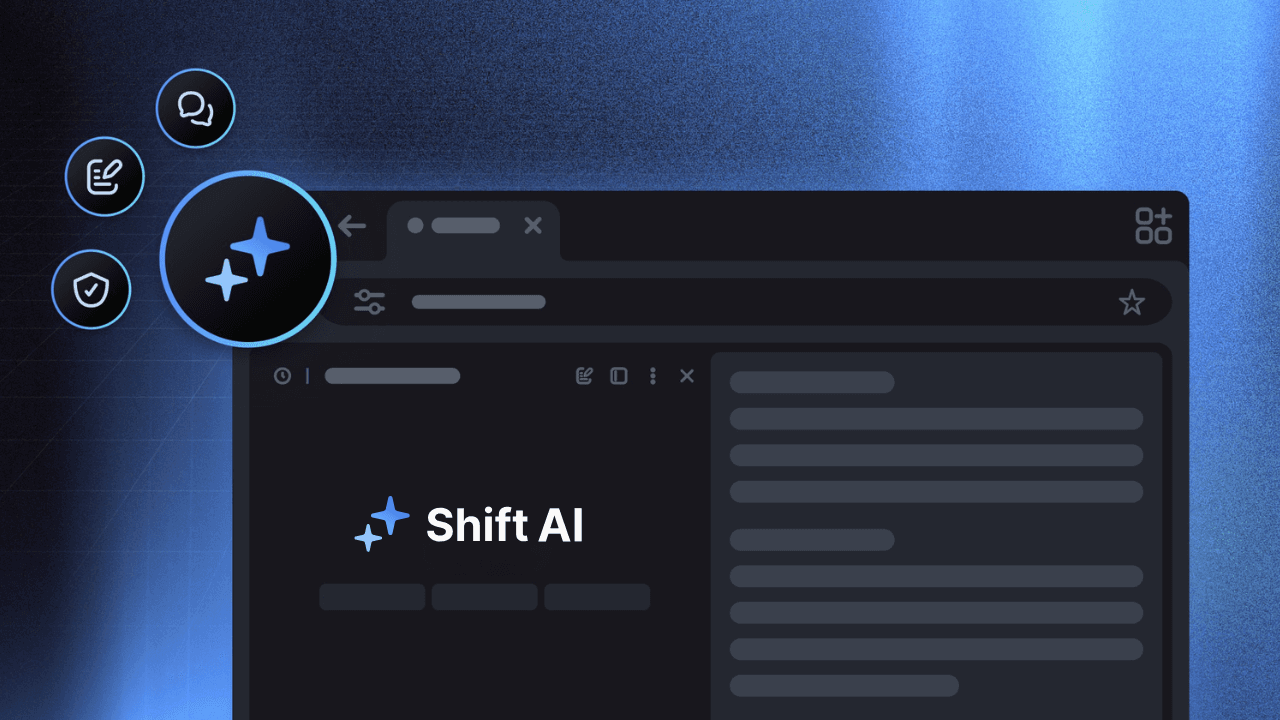
Shift is a Chromium desktop browser built around app integrations, Spaces and a configurable Builder. This review separates Shift’s official product claims from independent reports, then asks the useful question: do you need a tidy app hub, or a browser that helps you research and act?

THE EDITOR’S LEDGER
This is a scoped comparison, not a universal ranking. Shift documents a customizable desktop shell for apps and Spaces; Tabbit is built around page-aware AI, research and visible agent work. “Strong” here means the product’s documented focus, not a lab result.
| Decision signal | Shift | Tabbit |
|---|---|---|
| 01Core promise | Keep accounts, apps and projects in one customizable desktop browser | Turn browser context into research, answers and finished actions |
| 02Multiple accounts | Official pages describe switching accounts in one app without signing out | Keep relevant pages and accounts in a visible task context |
| 03App ecosystem | Official pages cite 1,500+ and 4,500+ integrations plus Chrome extensions | Open the web, inspect pages and ask across selected context |
| 04Spaces and layout | Spaces, app stacks, templates and drag-and-drop Builder | Groups, vertical tabs, saved context and task workspaces |
| 05AI and execution | Shift AI summarizes, drafts and answers; no independent benchmark claimed here | Deep Research, multi-model chat, summaries and reviewable Agent Mode |
| 06Privacy boundary | Local-content claims sit beside telemetry and third-party AI disclosures | Workflow privacy controls; not an anonymity network or VPN |
FEATURE DOSSIER
The value proposition is not “a faster Chrome.” It is fewer logins and fewer windows when your day is already split across inboxes, calendars, docs and client accounts.
Shift’s official app directory says it integrates web apps and Chrome extensions. Its pages use both 1,500+ and 4,500+ counts; treat them as changing marketing counts, not an independently audited catalog.
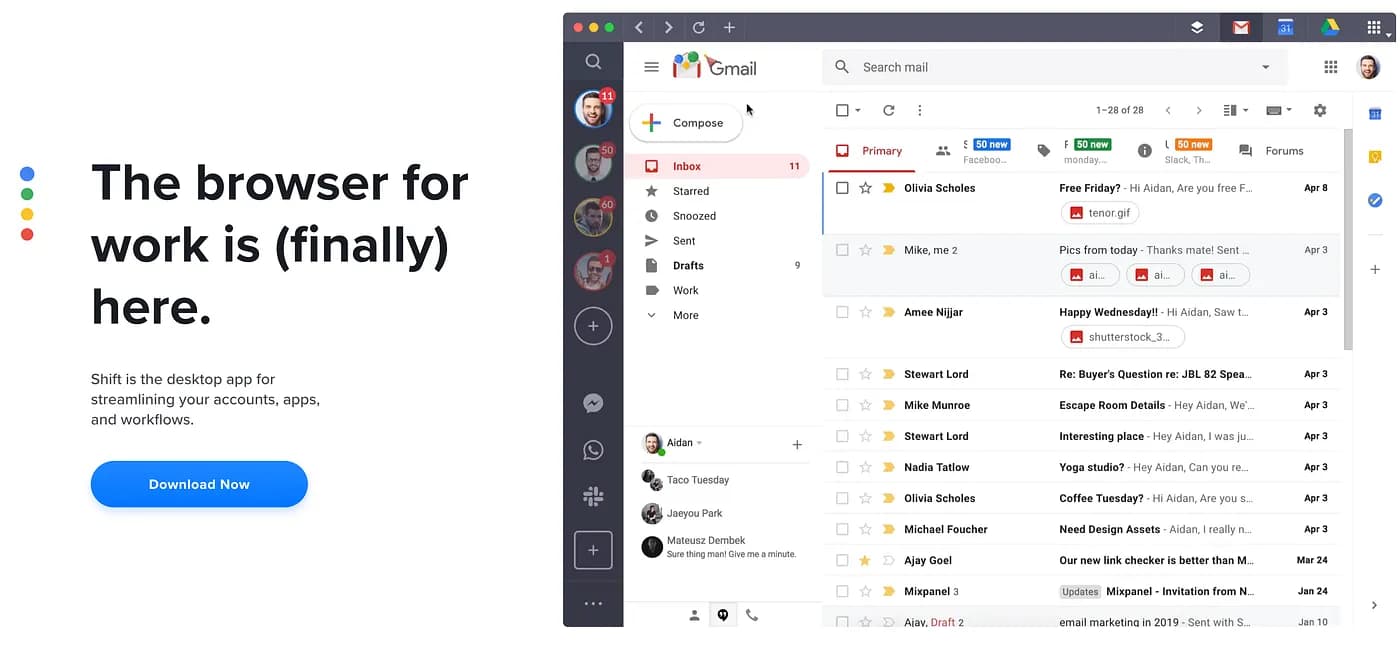
Spaces can separate work, hobbies and projects, with their own apps and extensions. The Free plan lists five Spaces; Advanced removes that limit.
Builder starts from a template, then lets you drag apps, bars and controls into a custom layout. Useful for navigation friction, but it adds setup work when you want a browser ready immediately.
Shift says you can add Chrome extensions. An independent Efficient review notes that support improved over time but was historically incomplete; test the extensions your work cannot lose.
FEEL, NOT A SCORE
No controlled same-device benchmark was available for this review. A Chromium foundation and a tidy app switcher do not prove lower memory use or faster page loads. Tabs, extensions, device and account mix will shape the experience.
01 · Responsiveness
The familiar Chromium model lowers the learning curve. It does not justify a speed ranking without the same device, pages, extensions and test method.
02 · Cognitive load
Pinned apps and Spaces can reduce visual hunting. Builder choices, notifications and many app icons can also create another layer to maintain.
03 · Heavy multitasking
Shift support recommends at least 8 GB of RAM and calls 16 GB ideal for heavy multitasking. That is a vendor recommendation, not a measured threshold.
04 · Stability signal
A 2020 Medium review reported lag, reloads and repeated re-authentication with many integrated accounts. It is a dated personal account, useful as a test risk—not proof of today’s build.
Method note: this page reports current documented behavior plus clearly dated independent observations. It does not publish a benchmark score, memory figure or speed promise.
SOURCE WALL
The hero and first card use official Shift material. The second card is a dated independent review. Product pages describe intended capability; independent writing describes observed friction and should be read with its date and setup in mind.

The official Builder page describes templates and drag-and-drop placement for apps, bars and controls. It also frames themes and Spaces as reasons to download the desktop app.
Shift Builder
In a March 2020 Medium review, Jeremy M. Williams described using several Google accounts plus Asana, Slack and other apps, then reported lag, reloads and repeated re-authentication. This is one old personal test, not a current benchmark or a verdict on every user.
Jeremy M. Williams on MediumSource boundary: official claims, independent observations and this editorial interpretation are labeled separately. The older review’s price and behavior should not be read as current product facts.
PRIVACY & TRUST
Shift’s security and AI pages emphasize local password storage, Chromium protections and Cloudflare Privacy Proxy. Its privacy policy also describes application data collection and third-party processing. Both sides belong in the decision.
Practical read: Shift can reduce the number of separate app windows, but privacy-sensitive teams should review permissions, AI settings, extensions, sync and the current policy before centralizing work.
WHEN THE WORK BECOMES RESEARCH
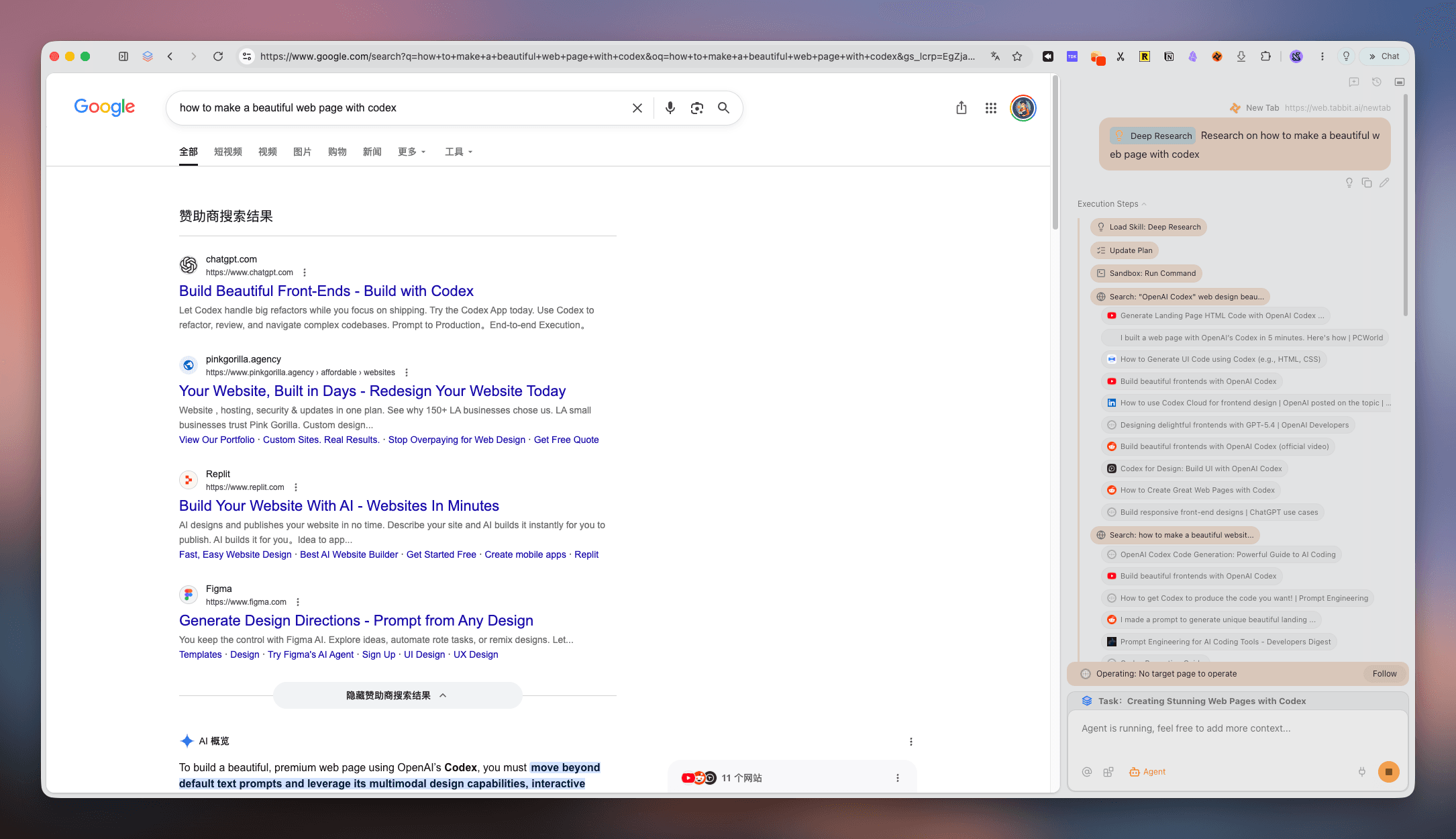
This is not a claim that Tabbit replaces Shift’s app directory, account switcher or Builder. The difference is the work layer: when sources need to be opened, compared, summarized and acted on, Tabbit keeps those steps in one visible workflow.
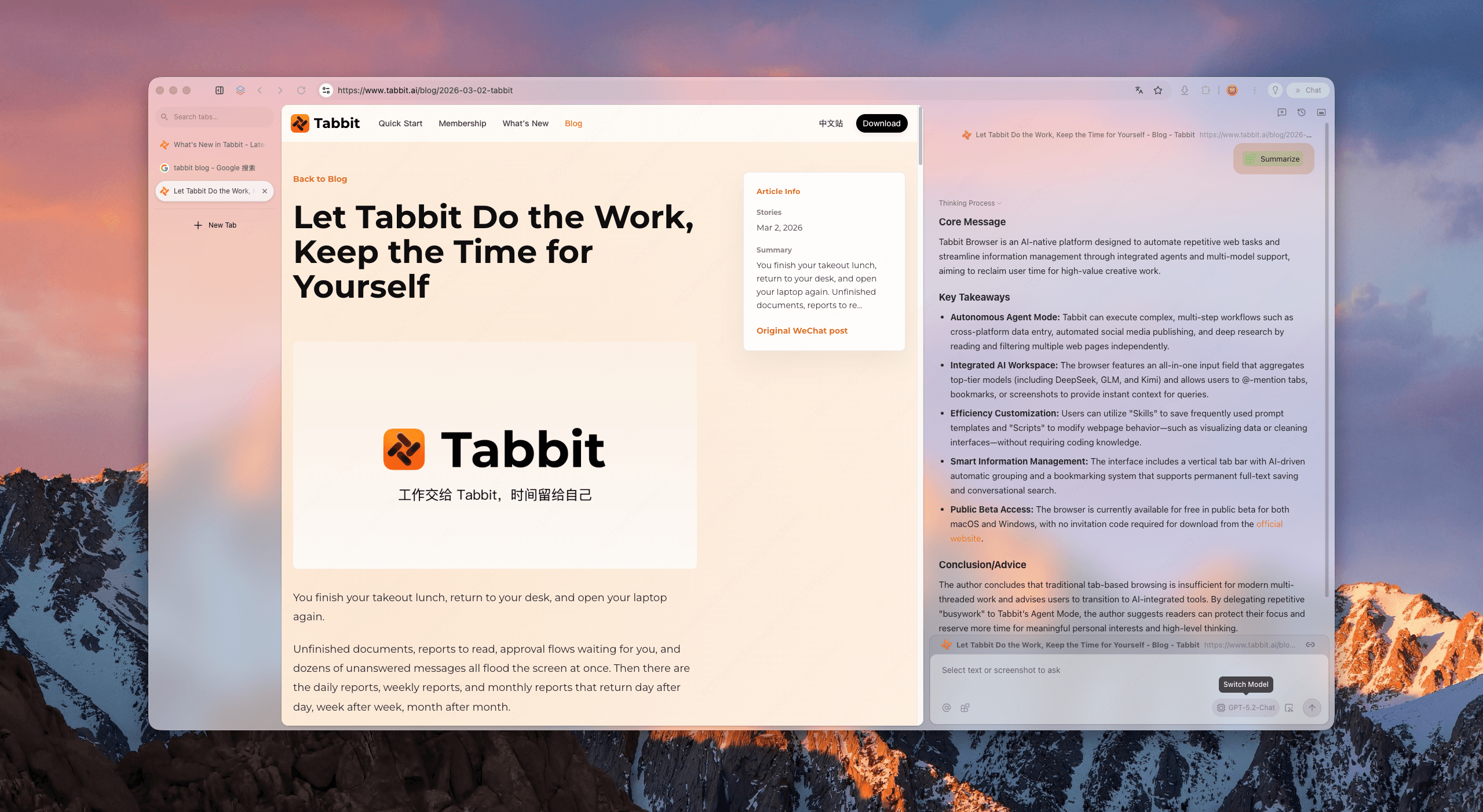
Ask about the active page, a group of tabs, a screenshot, bookmarks or a local file without rebuilding the prompt from scratch.
Deep Research can search and organize a multi-source task; the sidebar can turn a long page into a brief while the source stays visible.
Agent Mode is designed for visible multi-step browser work—reading, navigating, filling and collecting—with a person reviewing the flow.
Use the model that fits the task and save repeatable instructions or workflows as Skills. That is a different center of gravity from Shift’s app container.
Tabbit is a desktop AI browser for macOS and Windows. It is not a VPN, Tor client or promise of anonymity.


CHOICE BY WORK HABIT
A useful review ends with a testable choice. Start from the bottleneck in your day, not from a universal “best browser” label.
Start with Shift
You repeatedly move among several inboxes, calendars or client accounts and want them pinned in one desktop shell.
Start with Shift Builder
You enjoy choosing templates, placing controls and maintaining a layout that matches each project.
Test before migrating
Shift says Chrome extensions are supported, but an independent review records historical gaps. Verify password managers, capture tools and work-critical add-ons.
Try Tabbit first
Your hard part is not opening apps; it is comparing sources, producing a brief and keeping a web task moving.
Do not assume Shift fits
The reviewed official support pages describe a desktop product and explicitly exclude mobile, tablets and Chrome OS.
BALANCED READ
Shift is a thoughtful account-and-app organizer. Choose it for a customizable command center; choose Tabbit when the browser should help you investigate, synthesize and complete the next action.
QUESTIONS AT THE MARGIN
Shift’s current pricing page lists a Free plan at $0 forever with five Spaces, ten apps per Space, Builder/templates and limited Shift AI. Advanced is listed at $199.99 USD billed annually with unlimited Spaces/apps and expanded AI. Verify the live page before subscribing.
Official support pages describe Windows 10 or later and macOS 11 Big Sur or later, with at least 8 GB of RAM recommended. They say Chrome OS, phones, tablets and laptops in tablet mode are unsupported.
Shift’s app pages say you can add any Chrome extension. An independent Efficient review says support improved over time but was historically incomplete. Treat critical extensions as a pre-migration test.
Shift’s security pages describe local password storage, Chromium protections and Cloudflare Privacy Proxy for Shift AI. The privacy policy also describes application data collection and possible third-party AI processing. Read those claims together; Shift is not an anonymity service.
This review does not claim that. No controlled same-device benchmark was available, and performance depends on tabs, extensions, accounts, hardware and settings. Test your actual setup instead of trusting a generic speed label.
Shift is a strong fit when the problem is account switching and app organization. Tabbit is aimed at page-aware research, multi-model answers, summaries and reviewable browser actions. The better choice follows the task you need to finish.
Download Tabbit when the task is more than arranging apps: compare a source set, turn open pages into a brief or complete a repetitive web flow with review in the loop.
Available for macOS and Windows · Start with a page, a group or a question