Aside vs Codex
 vs
vs +
+
Aside is a YC-backed agent browser: you install the browser and the agent works inside your logged-in sites, with local memory, a benchmark-topping browser agent, and an agent password manager. OpenAI Codex is an AI coding agent that now also controls browsers — through Computer use, a built-in app browser, and a Chrome extension on macOS and Windows. Tabbit is an AI-native browser with free multi-model Agent Mode and reusable Skills on Mac and Windows.
Opens tabbit.ai or tabbit.com based on your language.
30-second verdict
Choose Aside if your work happens in the browser and you want an agent that signs into your real accounts and finishes multi-step web tasks. Choose Codex if your work is software engineering — code, PRs, and CI/CD — and you want an agent across your editor, terminal, and now browser. Choose Tabbit for a browser-native agent that runs on both Windows and macOS with free multi-model Agent Mode.
The third option
You do not have to pick between “browser-native” and “already-in-your-stack.” Tabbit is a browser-native agent that runs on the Windows and macOS machines your team already uses, with free multi-model Agent Mode and reusable Skills.
At a glance
Aside vs Codex vs Tabbit scoreboard
These are two different routes into the same agent era: a browser you install, or an agent that plugs into your existing tools. Plans and platforms change, so confirm details on each official site before switching.
| Dimension | Aside | Codex | Tabbit |
|---|---|---|---|
| Core form | Standalone agent browser | Coding agent + Chrome extension | AI-native browser with Agent Mode |
| Best at | Multi-step work in logged-in web apps | Code, PRs, CI/CD, debugging | Web research, forms, multi-tab tasks |
| Browser control | Native — the browser is the agent | Chrome extension + Computer use | Native agent across tabs and sites |
| Sign-in model | Agent password manager, credentials hidden from AI | Uses your live Chrome profile; 2FA pauses | You provide task context explicitly |
| Platforms | Public download leans macOS | macOS + Windows desktop and extension | macOS and Windows |
| Models | BYO ChatGPT/Claude or API key | OpenAI GPT-5.x line | GPT, Claude, Gemini, DeepSeek, Qwen and more |
| Pricing | Free 500 credits/mo; Pro $20; Max $200 | Free trial; Plus $20; Pro $100; Pro $200 | Free public beta incl. Agent Mode |
The real axis
Where the agent lives: a new browser or your existing stack
Aside and Codex are both powerful AI agents, but they enter your workflow from opposite directions. Aside is a browser you install — the agent is the browser. Codex is an agent that lives in your ChatGPT app, IDE, and terminal — and now reaches into the browser through Computer use and a Chrome extension.
Install a new browser
Aside: the agent is the browser
You open Aside the way you open Chrome, and every tab is a place where the agent can work: research, forms, payments, communications, and docs. Logged-in sessions are managed for the agent, and sensitive actions wait for your approval.
Add to what you already use
Codex: the agent is in your stack
$ codex cloud --parallel 4
▸ writing feature + tests
▸ reviewing PR #128 · CI/CD green
█
You keep ChatGPT, your IDE, and your terminal. Codex writes, reviews, and runs code in cloud workspaces, then extends into your computer and browser through Computer use and a Chrome extension.
Job fit
What each agent is actually for
The honest question is not “which agent is smarter.” It is whether your day is mostly browser work or mostly engineering work — and how much of each.
Browser work: research, forms, payments, communications, docs
- Multi-step research across many sites, then a structured summary
- Filling forms, moving data between web apps, and posting updates
- Managing email, docs, and dashboards inside logged-in accounts
- Reusable routines for work you repeat every week
Engineering work: code, PRs, CI/CD, debugging
- Writing features, refactors, and migrations in a real codebase
- Running cloud tasks in workspace trees with parallel agents
- Reviewing pull requests and catching issues before they ship
- Long-running automation: issue triage, alerts, and CI/CD
Most teams need a bit of both. The question is where the agent should live natively — and what you are willing to install or pay for.
The 2026 overlap
When Codex starts to look like a browser agent
OpenAI has been expanding Codex beyond code. As of 2026, Codex can operate your computer and reach into the browser, so the line between “coding agent” and “browser agent” is blurring. The difference is now about depth, defaults, and where the agent lives — not a hard feature wall.
Chrome extension (May 2026)
Codex now ships a Chrome extension for macOS and Windows that works on any site, runs across tabs in parallel, and uses your live Chrome profile. It pauses at 2FA and login screens rather than managing credentials itself.
Computer use and a built-in app browser
Codex can see and click your desktop like a human (macOS first) and has an in-app browser for annotating pages during frontend and game development. It is aimed at engineering iteration today, with plans to broaden browser control.
Where the depth still differs
Aside is built for browser-native depth: local memory, agent password management, benchmark-leading browser agents, and multi-step work inside logged-in accounts. Codex is built for engineering depth: cloud workspaces, PR review, plugins, and the software lifecycle.
The default habit matters
With Codex you keep your existing browser and IDE. With Aside (or Tabbit) the agent is the browser. If your work already lives in the browser, an agent-native browser usually needs fewer workarounds.
Which one for you
Pick Aside, Codex, or Tabbit by your job
Aside and Codex are both credible AI agents in 2026. The better fit depends on whether your work is browser-first or engineering-first — and whether you can run a Mac-only browser, a Chrome extension workflow, or a free multi-model desktop agent.
Browser-first, on a Mac
Your work is research, forms, and multi-step tasks inside logged-in web apps, and you can run a macOS-first product. Verify current Windows support on Aside’s site before a team rollout.
Pick AsideEngineering-first
You spend your day in repositories, pull requests, and CI/CD. You want an agent across your editor, terminal, and cloud workspaces — with browser control as a bonus.
Pick CodexBrowser-native on both desktops
You want a browser-native agent on Windows and macOS without a coding-agent subscription, with free multi-model Agent Mode and reusable Skills.
Pick TabbitThe honest part
Trade-offs worth knowing first
Aside trade-offs
- ✕The public download leans macOS, so verify Windows availability before a team rollout.
- ✕Agent depth is measured in credits; heavy use moves you from Free (500 credits/mo) to Pro ($20/mo) or Max ($200/mo).
- ✕It is an earlier product with a fast-moving feature set; reviews and benchmarks date quickly.
- ✕It does not emphasize coding, PR review, or CI/CD — that is Codex’s territory.
Codex trade-offs
- ✕It is a coding agent first; browser control is an add-on, not a native browser you can live in.
- ✕Browser work is credit-limited: Plus gives roughly 10–60 cloud tasks per 5h; serious scale needs Pro 5x ($100/mo) or Pro 20x ($200/mo).
- ✕It leans into the OpenAI model line; you are not choosing among Gemini, Claude, DeepSeek, or Qwen.
- ✕Computer use launched macOS-first, and the Chrome extension is macOS/Windows only — no Linux listed.
Why Tabbit
What you get beyond the Aside–Codex binary
Keep the browser-native agent idea, but avoid the macOS-only download and the coding-agent subscription. Tabbit is for people who want an agent that does browser work without switching ecosystems.

Windows and macOS today
Run a browser-native agent on the two desktop systems most teams depend on, instead of waiting for a Mac-first browser or bolting a coding agent into Chrome.
Free multi-model Agent Mode
Choose GPT, Claude, Gemini, DeepSeek, Qwen, and more by task — research, drafting, forms, and multi-tab execution — without a paid agent plan or credits gate.
Reusable Skills
Turn recurring instructions and browser routines into Skills, so your best workflows do not start from a blank prompt every time.
Chromium habits, no lock-in
Keep Chrome-compatible extensions and test multi-model Agent Mode before committing to a single provider or a new browser-only ecosystem.
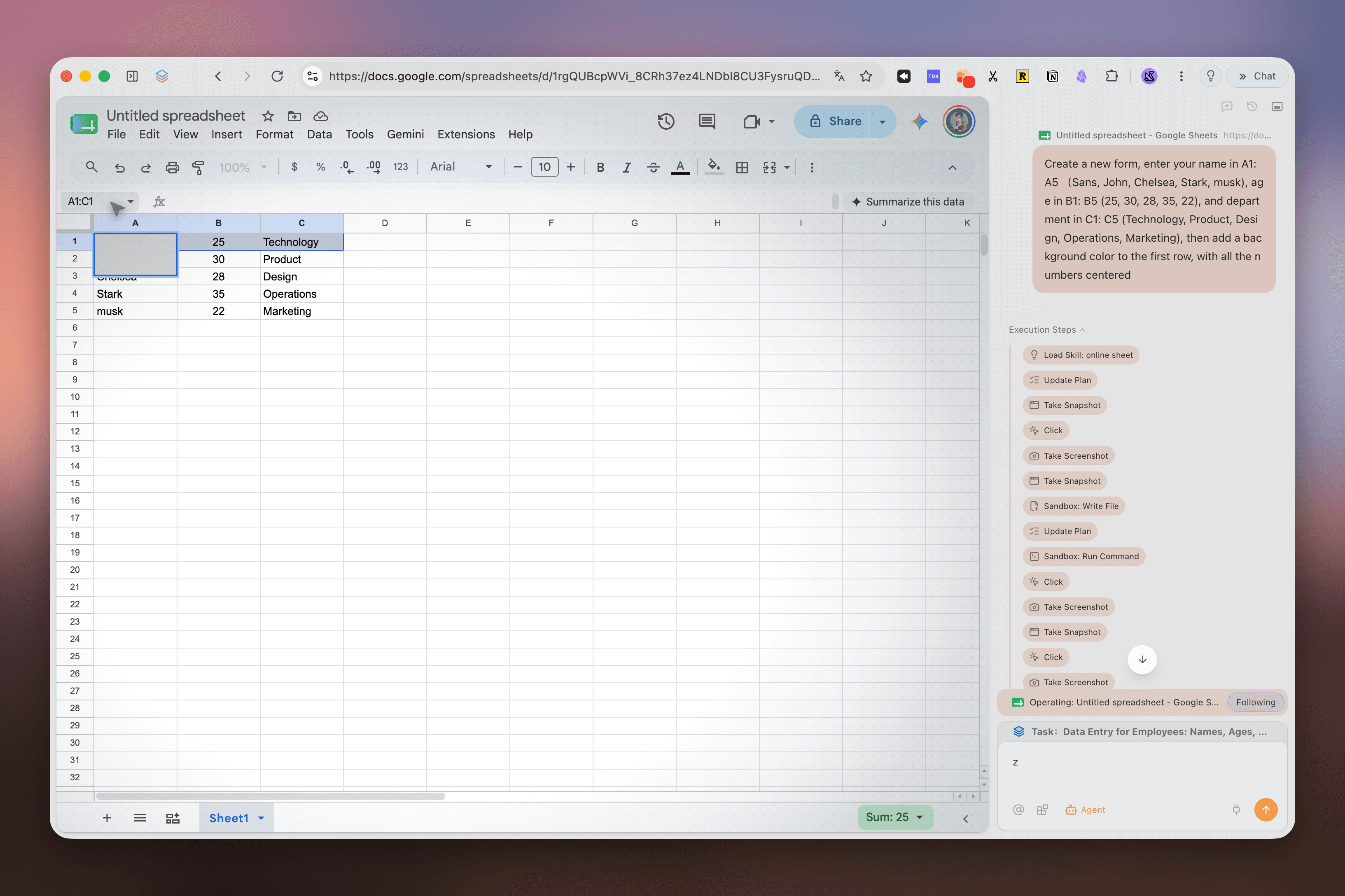
Browser-Native Agent Execution
Cross-tab workflows and automated task completion without complex coding setups.
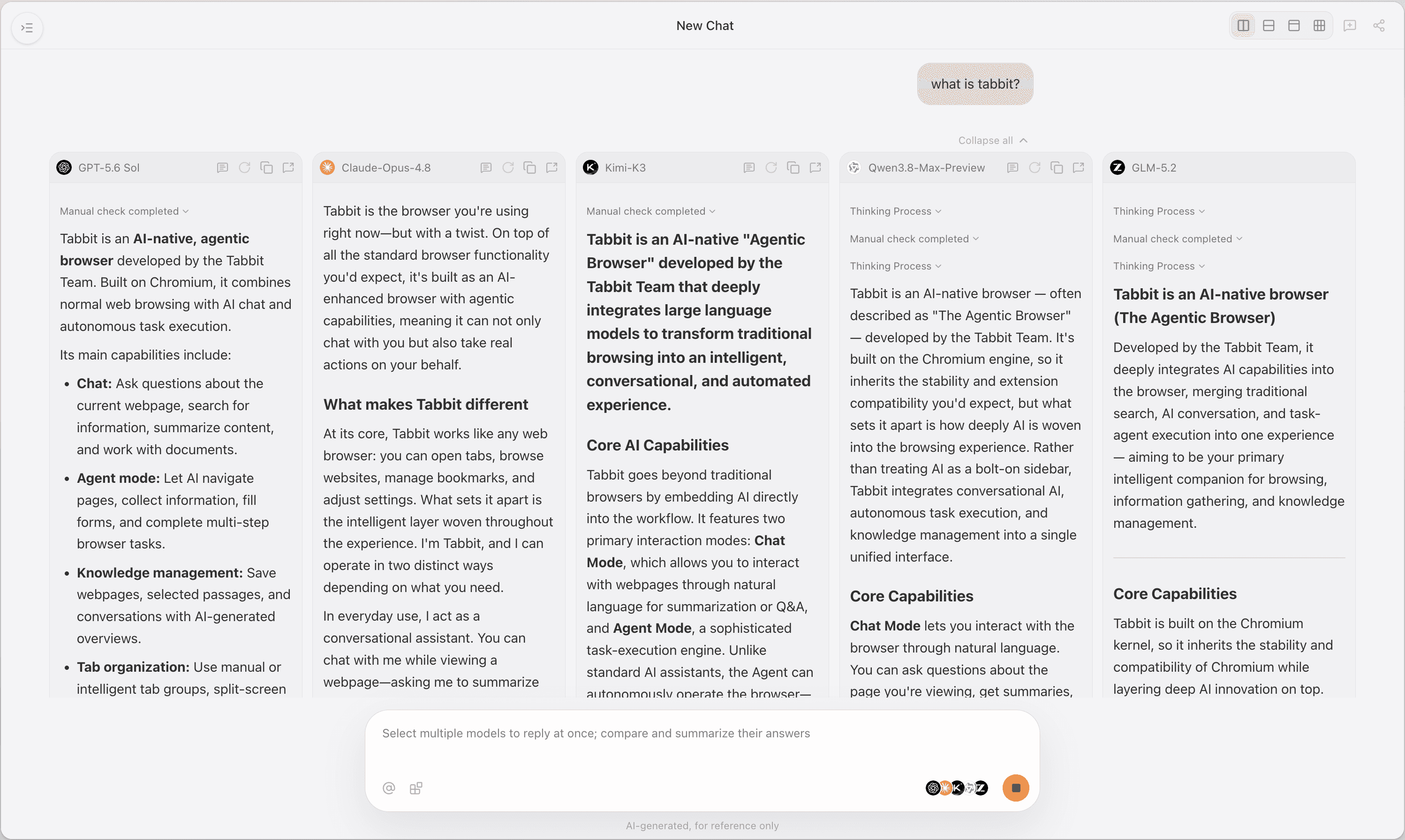
Multi-Model Orchestration
Switch freely between GPT, Claude, Gemini, and DeepSeek based on task requirements.
FAQ
Aside vs Codex: common questions
What is the difference between Aside and Codex?+
Aside is a browser-native agent: you install a browser and the agent works inside your logged-in sites, with local memory, an agent password manager, and a benchmark-leading browser agent. Codex is OpenAI’s AI coding agent that lives in ChatGPT, your IDE, and the terminal, and now extends into the browser through Computer use and a Chrome extension.
Can Codex browse websites like Aside?+
Since May 2026, Codex has a Chrome extension for macOS and Windows that works on any site, runs across tabs, and uses your live Chrome profile. It also has Computer use and a built-in app browser. But it is an add-on to a coding agent, not a browser you live in. Aside (or Tabbit) makes the browser itself the agent.
Is Aside a coding tool like Codex?+
No. Aside is focused on browser work — research, forms, payments, communications, and docs inside logged-in accounts. Codex is the stronger choice for software engineering: writing code, reviewing PRs, and running CI/CD. If you need both, you can pair a browser-native agent with a coding agent, or use Tabbit for web tasks and Codex for engineering.
Does Aside work on Windows?+
Aside’s public download has leaned macOS. Check aside.com for current Windows support. Codex’s Chrome extension and desktop app cover macOS and Windows. Tabbit is available on Windows and macOS.
Which is more expensive, Aside or Codex?+
Both are plan-and-credit based. Aside: Free 500 credits/mo, Pro $20/mo, Max $200/mo. Codex: free trial, ChatGPT Plus $20/mo, Pro 5x $100/mo, Pro 20x $200/mo. Confirm the latest plans on each official site — pricing moves fast.
Do I need a browser agent or a coding agent?+
If your day is research, forms, and multi-step web tasks, a browser-native agent (Aside or Tabbit) fits. If your day is code, PRs, and CI/CD, Codex fits. Many people end up with one of each; Tabbit’s free multi-model Agent Mode is a low-cost way to cover the browser side first.

Need a browser agent, not just a coding subscription?
Download Tabbit free for multi-model Agent Mode and reusable Skills on macOS and Windows.