TabbitBlog

Dia Browser for Windows Isn’t Here Yet: Try Tabbit

Dia is still on a Windows beta waitlist. See how Tabbit brings Dia-like calm design, page summaries, multi-tab context, and browser agents to Windows now.

In this article
  1. Key takeaways
  2. Dia, Arc, and Tabbit at a glance
  3. Why Dia and Arc users keep looking for another browser
  4. Tabbit gets the first part right: it looks calm
  5. The AI starts with something ordinary: summarize this page
  6. Several tabs can become one piece of context
  7. Agent Mode is where Tabbit stops feeling like a chat sidebar
  8. Four tasks worth trying
  9. 1. Turn a long discussion into a useful brief
  10. 2. Compare products without losing the evidence
  11. 3. Move public web data into a sheet
  12. 4. Reuse the routine as a Skill
  13. What if you already use Arc on Windows?
  14. Where Dia and Arc still have an edge
  15. How to try Tabbit without moving your whole life
  16. Choose by scenario
  17. The practical verdict

If you are waiting for Dia Browser on Windows, here is the short answer: you still cannot download a public Windows build. Dia’s official Windows page now says it is coming “this fall,” but as of July 30, 2026, the only option is a beta waitlist.

You do not have to spend the next few months refreshing that page. Tabbit Browser already runs on Windows 10 and later. It has the part of Dia and Arc that people tend to miss in ordinary browsers: a quiet interface, vertical tabs, soft transparent surfaces, and very little junk around the page. Then it adds page summaries, context from several tabs or files, and an Agent that can work through a browser task.

If you like how Dia looks, miss how Arc organizes work, and want AI to do more than sit in a chatbot sidebar, Tabbit is worth an afternoon. Keep your current browser installed and give it one real task.

Dia Browser logo pointing to the Tabbit Browser logo with the message Dia for Windows? Tabbit!
Waiting for Dia on Windows? Tabbit is available on Windows now.

Key takeaways

  • Dia says it is coming to Windows in fall 2026, but there is no public Windows download yet.

  • Arc works on Windows, though its own site says Arc now receives Chromium updates only and points users toward Dia for active security patches.

  • Tabbit is available on Windows now and shares the low-noise, vertical-tab feel that attracts people to Dia and Arc.

  • Its AI can summarize the current page, use tabs and local files as context, or switch into Agent Mode for browser actions.

  • Dia still has its own strengths, especially connected work tools and polished reports. Tabbit is the better fit when Windows access and browser automation matter today.

Dia, Arc, and Tabbit at a glance

CapabilityDiaArcTabbit
Windows availabilityBeta waitlist; planned for fall 2026Public Windows downloadPublic Windows download
Current desktop supportApple Silicon Macs on macOS 14+macOS and WindowsmacOS 12+ and Windows 10+
Interface styleCalm, minimal, AI-firstPlayful, highly designed workspaceCalm, translucent, AI-first workspace
Tab organizationOrganized Tabs and ProfilesSpaces, Profiles, vertical tabsVertical tabs and tab groups
Split browsingSplitsSplit ViewStandard Chromium window and tab workflows
Page summaryBuilt into the AI workflowArc Max features, but Arc is no longer the AI focusAvailable in the AI sidebar
Context beyond one pageTabs plus connected work toolsMore limited as an active AI productTabs, groups, screenshots, bookmarks, highlights, and files
Browser actionsSkills and newer connected workflowsNo comparable active agent directionAgent Mode can navigate, read, click, and fill fields
ExtensionsChromium ecosystemChromium ecosystemChromium ecosystem
Best reason to choose itConnected work context and polished outputs on MacMature Arc workspace and visual personalityWindows access, broad context, model choice, and browser agents

Platform details were checked on July 30, 2026. Dia’s Windows timing and all three products’ AI features can change quickly, so check the linked official pages before making a company-wide move.

Why Dia and Arc users keep looking for another browser

People rarely want “a Dia alternative” because of one button. They want a browser that feels considered.

Chrome and Edge are capable, but their interfaces carry years of accumulated furniture. Shrinking tabs, toolbars, news panels, shopping prompts, account nudges: together they can make the browser feel like a busy airport concourse.

Arc changed that mood. It moved tabs into a sidebar, separated projects into Spaces, and treated color and motion as part of the product. The Arc website still calls the result clean and calm.

Dia put AI close to the material in that workspace. Its current site highlights a Morning Brief, answers drawn from tabs and connected tools, and reports built from services such as Slack and Notion. It kept the tasteful shell, but made context the main event.

The awkward bit is platform support. Arc has a Windows build, but The Browser Company now calls Dia “the next evolution of Arc.” The same Arc homepage says Arc receives Chromium updates only and recommends Dia for active security patches. Dia, meanwhile, is still limited to Apple Silicon Macs while Windows users wait for the beta.

That leaves an oddly specific gap: a Windows browser with Arc’s sense of space, Dia’s AI direction, and something more capable than chat. The Dia Browser for Windows guide tracks the direct download question. This article is about what to use while you wait.

Tabbit gets the first part right: it looks calm

Open Tabbit and the resemblance is not subtle. Tabs run vertically down the left. The new tab page is mostly empty, with one input box instead of a feed of headlines and “recommended” links. The frame picks up the colors behind it, giving the window a soft glass look.

AI browsers have a habit of turning into control rooms. Tabbit keeps the page as the largest object in the window. The sidebar appears when it has a job to do.

It does not copy every Arc behavior. Spaces and Split View have years of product thinking behind them, and Dia’s typography is its own. Tabbit feels familiar because it follows the same rule: keep attention on the page.

If “like Arc” means deep workspace customization above everything else, read the broader browser like Arc guide. If it means “clean, vertical, and less noisy than Chrome,” Tabbit lands much closer.

The AI starts with something ordinary: summarize this page

The easiest AI feature to judge is a summary. Open an article or long discussion and ask Tabbit to condense it in the sidebar.

It is basic, and useful. The source stays in view, so you can check whether the summary flattened a caveat or invented a confident conclusion.

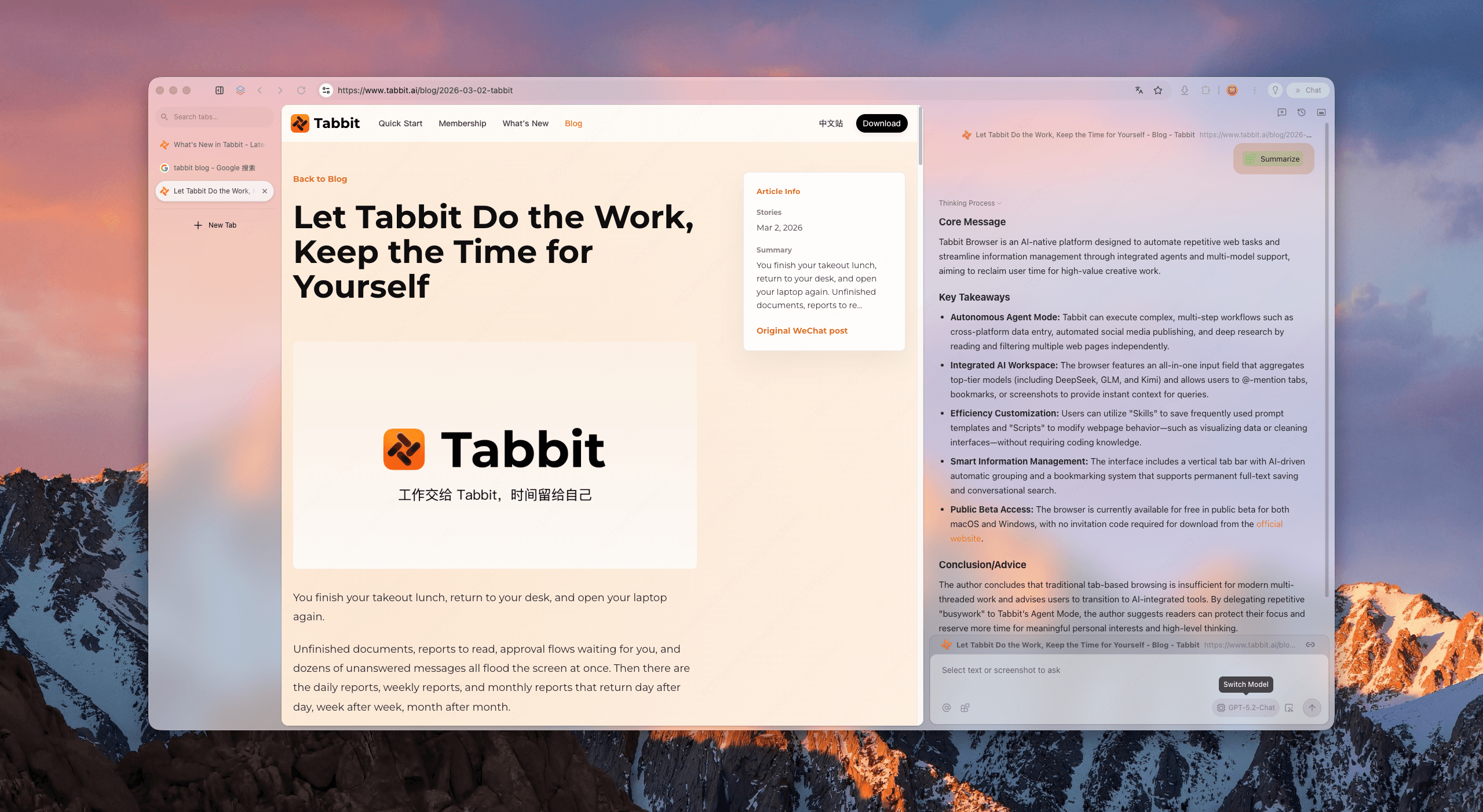
Tabbit Browser summarizing the open webpage in a right-hand AI sidebar while the full source remains visible
A summary is easier to trust when the source page stays beside it.

The default “summarize” button is fine for a quick scan. For work, give the answer a shape:

Summarize this page in five bullets.
Separate facts from the author's opinions.
List every number or date used in the argument.
Finish with two questions the page does not answer.

That prompt is less glamorous than “analyze this deeply,” but it gives you obvious checkpoints and a reason to keep reading.

The summary lives beside the page instead of replacing it. You can scroll the source and ask a follow-up without rebuilding the context in another chatbot.

Several tabs can become one piece of context

Type @ in Tabbit’s input box and you can point to an open tab, a tab group, a screenshot, a highlight, bookmarks, or a local file. The Tabbit AI browser guide covers the full context model. In everyday use, the benefit is simpler: less copying, fewer mystery links, and less explaining which source is which.

Imagine you are choosing a project management tool. You have four pricing pages, two help documents, and a spreadsheet of requirements. In a normal chat tool, preparing that material becomes its own little project.

In Tabbit, put the relevant pages in a group, attach the requirements file, and ask:

Compare the products in this tab group against the attached requirements.
Use only official pricing and help pages for factual claims.
Create a table for price, guest access, automation, export, and SSO.
Write "Not verified" when a source does not answer the question.

The prompt draws a fence around the source set and tells the model what to do with missing information. Both reduce plausible guesses.

Dia’s connected-tool approach may be better when your work already lives in supported services such as Slack, Notion, and Calendar. Tabbit is more flexible when the context is a temporary pile of web pages, screenshots, and local files. Neither approach is universally better. They fit different messes.

Agent Mode is where Tabbit stops feeling like a chat sidebar

A summary gives you an answer. An agent can use the browser.

Tabbit’s Agent Mode can navigate pages, read them, click controls, and fill fields. Tasks run with visible execution steps, and they can use a separate tab group so the pages opened by the agent do not take over the tabs you are using yourself.

The distinction is simple. A chatbot can tell you which vendors meet your criteria. A browser agent can open their sites, collect the fields, and enter the result into a sheet. Its mistakes have more consequences.

A wrong sentence in a summary is annoying. A wrong value entered into a live system may become someone else’s problem. Do not hand an agent a vague instruction and disappear. Define the sources, the fields, and the stopping point. Review anything that sends, submits, buys, deletes, or changes access.

The longer explanation is in what an agentic browser is. The practical test is whether the browser can leave you with a draft or structured result you can check.

Four tasks worth trying

You do not learn much by asking an AI browser who won the World Cup. Give it browser-shaped work.

1. Turn a long discussion into a useful brief

Open a long Reddit thread, product forum, or comment-heavy launch post. Ask for the recurring arguments, not an average of everything people said.

Read this discussion and group the comments by viewpoint.
For each viewpoint, include one representative example and the main objection.
Ignore jokes and duplicate comments.
Do not treat upvotes as proof that a claim is true.

This works well as a normal sidebar task. The source stays visible, and you can open the original comment when a summary sounds too neat. Tabbit’s own site uses the example of producing a TL;DR for a 287-comment Reddit thread. It is a good test because long discussions punish shallow summaries.

2. Compare products without losing the evidence

Put the official product pages in a tab group and compare only those first. If something is missing, let Agent Mode search the official help centers before widening the task to the whole web.

Compare the four products in this group for a 25-person design team.
Check collaboration limits, version history, guest access, and export.
Link each table cell to the source page.
If the official documentation conflicts with a pricing page, flag it.

The final table is not the only output. The agent’s source trail saves you from reopening twelve pages when someone asks, “Where did that limit come from?”

3. Move public web data into a sheet

This is the point where Agent Mode becomes more than a research assistant. Give it a small sheet and a deliberately limited job.

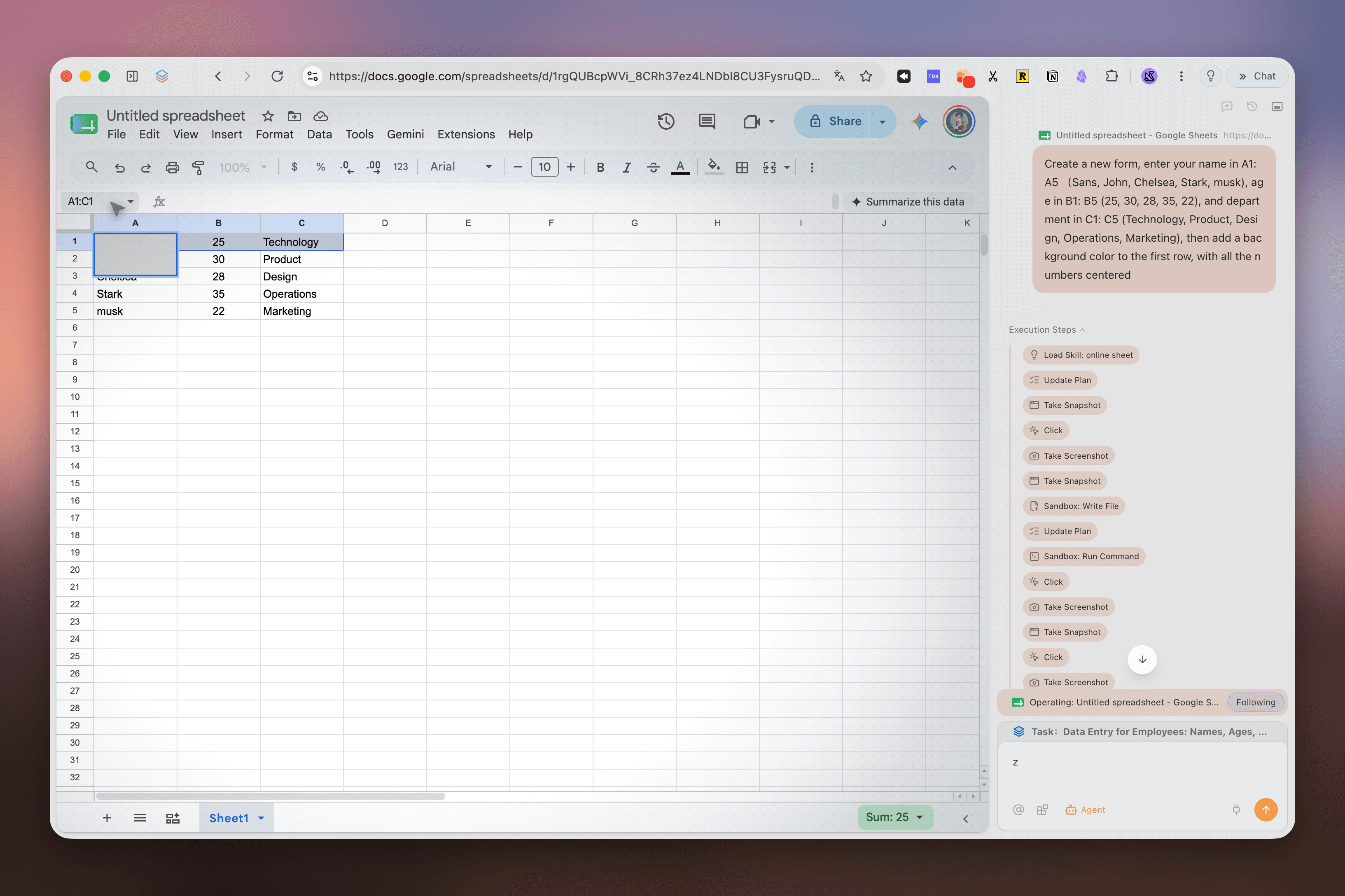
Tabbit Agent Mode entering structured data into Google Sheets while its browser actions remain visible in the sidebar
The task, spreadsheet, and execution steps stay visible while the agent works.
For each company in rows 2 through 15, use its official website to find
the pricing URL, supported desktop platforms, and contact page.
Fill columns B through D.
If a value is not stated, write "Not verified."
Do not open or submit any contact form.
Stop after row 15 and show the source URLs.

Notice how much of the prompt is about boundaries. Official sites only. A fixed row range. No form submission. A clear fallback for missing data. That is the difference between a task you can review and an agent wandering around the web trying to be helpful.

4. Reuse the routine as a Skill

Once the sheet workflow behaves well, save the successful pattern as a Skill. Replace the company list, fields, row range, and approved sources with variables. The next run starts from a known process instead of a half-remembered prompt.

Skills are most valuable for boring work. A weekly competitor check, a recurring reading brief, collecting references from videos, or turning release notes into a fixed internal format are better candidates than a one-off creative task.

Dia also has Skills, and its connected workflows may suit teams centered on supported apps. In Tabbit, a Skill can begin with browser context, call an agent, and leave a draft where the work needs to continue.

What if you already use Arc on Windows?

If Spaces, Profiles, and Split View are the reason Arc works for you, switching browsers may create more friction than it removes.

The reason to test Tabbit is narrower. Arc’s own website now presents Dia as its next evolution and says Arc receives Chromium updates only. Dia is not publicly available on Windows yet. If you want an actively developing AI workflow on Windows, Tabbit gives you something concrete to compare instead of waiting on a roadmap.

Run both for a week. Keep Arc for the workspace you trust and use Tabbit for one research project and one controlled Agent job. The better fit will become obvious.

For a direct feature comparison, see Dia Browser vs Arc. The point here is not that either browser suddenly became bad. The product direction moved, and Windows users are stuck between the old product and the next one.

Where Dia and Arc still have an edge

Tabbit is not “Dia for Windows” with a different icon.

Dia’s current product is unusually focused on connected work. Its Morning Brief pulls together the day before it begins. Reports can draw from tools such as Slack, Notion, and Calendar, then turn that material into something designed to share. If those integrations match your company’s stack, a beta wait may be reasonable.

Arc remains the more mature choice for people who built their entire browsing life around Spaces, Profiles, Split View, and its particular approach to pinned tabs. Muscle memory matters. A feature checklist does not capture the cost of rebuilding a workspace that already works.

Tabbit has limits too. It currently supports macOS and Windows, not Linux or mobile. Agent tasks can be slower than doing a tiny job yourself, and websites can change in ways that break an automated path. AI usage has a free allowance rather than being infinite, with a paid plan for heavier use. The official Tabbit site has the current platform and plan details.

Choose it because the combination fits, not because every row in a comparison table says “AI.”

How to try Tabbit without moving your whole life

Do not start by importing everything and changing your default browser. Start with a task that exposes whether the product’s main idea works for you.

Download Tabbit for Windows and put three to five sources for a real project in one tab group. Ask for a comparison with citations, then check it against the pages. If that goes well, try a task that writes into a test sheet.

Only after those checks should you import bookmarks, history, extensions, and settings from Chrome or Edge. Tabbit supports that migration, but a clean import is not the same as a useful daily workflow.

During the trial, watch for four things:

  • Did Tabbit use the pages and files you intended?

  • Could you trace important claims back to a source?

  • Did the agent respect the stopping point?

  • Did the interface stay quiet once several tasks were open?

Those answers tell you more than a model leaderboard. Pretty software is pleasant. Pretty software that removes two hours of copying every week earns a place on the taskbar.

Choose by scenario

Your situationBest next stepWhy
You need Dia itself on WindowsJoin the Dia beta waitlistDia says the Windows launch is coming in fall 2026
You want a calm AI browser on Windows todayTry TabbitIt is downloadable now and combines vertical tabs, summaries, context, and Agent Mode
You rely on Slack, Notion, and Calendar synthesisKeep watching DiaConnected work context and polished reports are central to Dia
You live in Arc Spaces and Split ViewKeep Arc, test Tabbit beside itArc’s workspace habits are expensive to replace; test AI separately
You want page summaries with the source visibleTry TabbitThe sidebar keeps the page next to the answer
You compare several tabs and local filesTry TabbitBoth web and local context can enter the same request
You need repeatable browser data entryTest Tabbit Agent Mode carefullyIt can navigate and fill fields, with review and stopping rules
You need Linux or mobileChoose another browser for nowTabbit currently lists both as roadmap items
You handle sensitive or irreversible actionsKeep a person at the last stepNo browser agent should be the final approver

The practical verdict

Dia Browser for Windows is finally on the calendar, but it is not on the download page yet. Waiting makes sense if Dia’s connected apps, Morning Brief, and report design are exactly what you want.

For everyone else, the useful question is not “Can Tabbit imitate Dia?” It is “Can I get the calm browser, quick AI help, and less manual web work on Windows now?” Tabbit can make a credible case on all three.

It looks closer to Dia and Arc than a conventional browser does. It can summarize the page without hiding it, bring several tabs and files into one conversation, and let an Agent handle a bounded browser task. It will not replace good judgment, and it will not reproduce every Arc workspace detail. That is fine.

Keep Arc if it still fits. Join the Dia waitlist if you are curious. Then try Tabbit on Windows with one task you already dislike doing. If it turns fifteen minutes of copying into three minutes of checking, you have your answer.

Take the next step

Let Tabbit work alongside you.

Research across tabs, automate repetitive browser work, and keep every piece of context within reach.