
GPT-6.2 Sol costs $2 per million uncached input tokens, $0.10 per million cached input tokens and $10 per million output tokens. Those are OpenAI's Standard API prices when a request has up to 272,000 input tokens. The same short-context request on Batch costs half as much. Cache writes have separate rates. OpenAI's API pricing
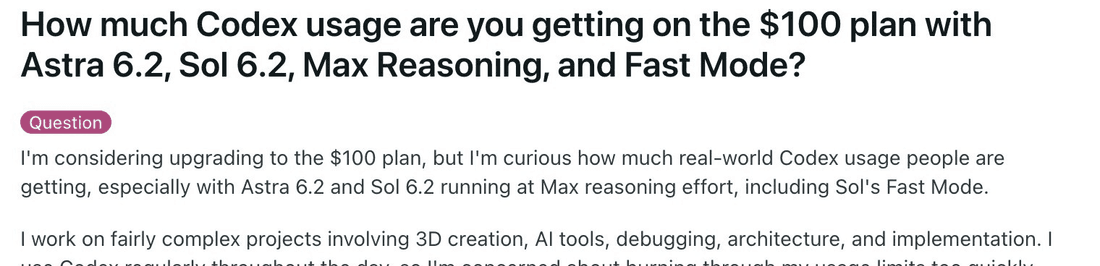
The launch price that changed is Ultrafast at 3× Standard, versus 6× for GPT-6.1 Sol. The offer runs through February 28, 2027 Pacific time. Standard prices stayed put. A developer in r/codex asked how much work a $100 subscription would cover when switching between Sol, Astra and higher effort. That requires checking the Codex meter, which can consume included usage at 6× even while the API runs its 3× promotion. Developer's question · Codex pricing
If you're budgeting a browser workflow, use the calculator to price a request and then test how many requests and corrections you need to deliver one usable result. The Tabbit example below uses a price-page check with a fixed answer format.
Key takeaways
The five Standard charges are the same as on GPT-6.1 Sol. A lower bill after switching requires a different mix of tokens, calls or service tiers.
Ultrafast short-context input and output cost $6 and $30 per million through February 28, 2027 PT. OpenAI lists $12 and $60 starting March 1 PT.
More than 272,000 input tokens move the whole request to the long-context rate. Cached tokens count toward that threshold.
Cache reads cost 5% of uncached input. Price cache writes and reasoning output from the actual usage record.
Compare costs per accepted result when choosing among Sol, Astra, Terra and Luna. For ChatGPT Work or Codex, check the applicable usage or credit meter.
GPT-6.2 Sol API rates at a glance
Prices are in USD per million tokens, checked November 19, 2026. Standard short-context rates match GPT-6.1 Sol in all five columns. Apply the multiplier to the correct context band. The Ultrafast rows use OpenAI's Pacific time dates. Official rate card · Sol model card
| API tier | Input context | Uncached input | Cache read | 30m write | 12h write | Output |
|---|---|---|---|---|---|---|
| Standard | ≤272K | $2 | $0.10 | $2.50 | $5 | $10 |
| Standard | >272K | $4 | $0.20 | $5 | $10 | $15 |
| Batch | ≤272K | $1 | $0.05 | $1.25 | $2.50 | $5 |
| Batch | >272K | $2 | $0.10 | $2.50 | $5 | $7.50 |
| Fast | ≤272K | $4 | $0.20 | $5 | $10 | $20 |
| Fast | >272K | $8 | $0.40 | $10 | $20 | $30 |
| Ultrafast through Feb 28 | ≤272K | $6 | $0.30 | $7.50 | $15 | $30 |
| Ultrafast through Feb 28 | >272K | $12 | $0.60 | $15 | $30 | $45 |
| Ultrafast from Mar 1 | ≤272K | $12 | $0.60 | $15 | $30 | $60 |
| Ultrafast from Mar 1 | >272K | $24 | $1.20 | $30 | $60 | $90 |
What the 3× Ultrafast price buys
At the launch rate, Ultrafast Sol costs 1.5 times as much as Fast Sol at the same token counts. After the promotion, it costs three times as much as Fast. A workflow that uses $100 of Standard model tokens per month would cost $200 on Fast, $300 on promotional Ultrafast or $600 at the scheduled Ultrafast rate. Budget each period separately if the project crosses March 1. Ultrafast guide
A Codex user who tried Ultrafast described a clear speed gain and questioned whether it justified the usage trade-off. Their impression came from a brief trial. The multipliers in this article come from OpenAI. Original discussion

Pay for the faster tier when an operator is waiting and the time saved justifies the premium. Record elapsed time until the result passes review, including tool waits and corrections. A faster response can leave the total time unchanged when most of the delay comes from a browser, build or external tool. OpenAI's launch results come from its named evaluation workloads. Use them to decide what to test on your own workload. OpenAI launch results
For queued work, Batch is the first price to check if your jobs fit its asynchronous interface. If you need an individual Responses API result, the public beta also lists 2-hour and 8-hour completion windows at 30% and 40% below Standard model rates respectively. Discounted windows use separate prompt-cache pools from ordinary Standard requests. OpenAI's Flex table on the check date lists GPT-6.1 Sol, with no GPT-6.2 Sol row. Regional processing can add 10%, and Ultrafast's residency availability is limited to the US. Check the actual endpoint and the tier logged for the response. Background completion windows · Data residency
How caching and reasoning change the bill
Treat ordinary input, cache reads and the two kinds of cache writes as mutually exclusive buckets. The write rates replace ordinary input pricing for tokens in those buckets. A stable prefix that costs $2.50 per million to write for 30 minutes costs $0.10 per million on a hit. If a 12-hour write is read just once, the two accesses cost $5.10 per million prefix tokens, compared with $4 for two ordinary inputs. A second full hit brings that comparison to $5.20 versus $6. Those break-even figures assume full reads at the same context band and no expiry before use. OpenAI prompt caching
When migrating from GPT-6.1 Sol, check where you send reusable instructions. The Responses API appends top-level instructions after the cacheable input for GPT-6.2. OpenAI recommends putting stable instructions in an initial developer message inside input. A cache hit can still leave a meaningful amount of input uncached. Compare usage records after the move. GPT-6.2 migration guide · Reducing browser agent token usage
At 272,000 input tokens the short rates still apply. At 272,001 the input and cache rates double, and the output rate rises by 50% across the whole request. Cached input still counts as input. The model card lists a 922,000-token input maximum and a 128,000-token output maximum. Track the context band for each request before aggregating monthly usage. A monthly average can hide the small number of requests that incur most of the long-context spend. Sol model card
Output includes reasoning tokens. If the usage record reports 6,000 output tokens including 4,000 reasoning tokens, price 6,000 once. Start with medium effort for a new integration, then compare the first-pass acceptance rate and the cost of correction at other settings. Lower effort can save output on each call and still cost more across a task that takes extra attempts. Effort and migrations · Measuring browser agent cost per success
GPT family price comparison
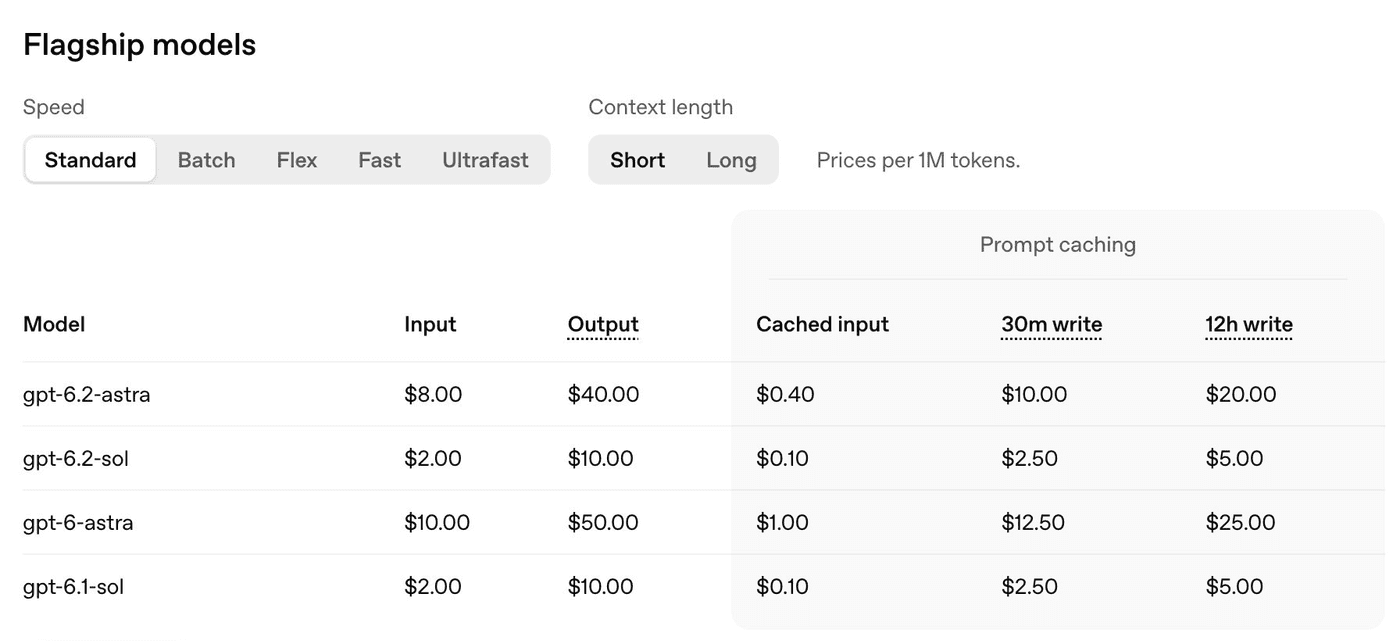
These are Standard short-context API rates per million tokens. Try Terra or Luna on a sample of narrower cases, and include the cost of routed retries when comparing them with Sol. Use Astra on difficult cases when its higher acceptance rate or lower rework pays for the greater token rates. Equal token counts cost four times as much on GPT-6.2 Astra in this band. Official price comparison
| Model | Uncached input | Cache read | 30m write | 12h write | Output | First workload to test |
|---|---|---|---|---|---|---|
| GPT-6.2 Astra | $8 | $0.40 | $10 | $20 | $40 | Difficult cases that keep failing review |
| GPT-6.2 Sol | $2 | $0.10 | $2.50 | $5 | $10 | Daily multi-step work with an acceptance check |
| GPT-6.1 Sol | $2 | $0.10 | $2.50 | $5 | $10 | Same-price baseline for a migration |
| GPT-6.1 Terra | $1 | $0.05 | $1.25 | $2.50 | $5 | Repeated work with constrained output |
| GPT-6 Luna | $0.10 | $0.01 | $0.125 | $0.25 | $0.50 | Narrow extraction or routing with sampled review |
Compare the original GPT-6 Sol rates, GPT-6.1 Terra rates, GPT-6 Luna rates and the previous GPT-6 Astra rate card. The Sol 6.2 model hub has links to model-specific configurations and evaluations.
What the token estimate includes
The estimates below charge reasoning once as output and charge cache-write tokens at their write rate. Built-in tools can bring fees of their own. OpenAI lists ordinary web search at $10 per 1,000 calls plus model rates on search content tokens. Add applicable tool and container fees, regional uplift, taxes and the billable usage from failed attempts or retries. OpenAI's API rate card does not document a blanket refund for refusals. Use your project's actual usage and billing records. Tool pricing
ChatGPT Work and Codex pricing
OpenAI lists Sol 6.2 in Work and Codex on Plus, Pro, Business, Enterprise and Edu, with workspace controls applying to managed plans. Check the model picker and usage dashboard for access. The published Standard Codex credit rates are 50 credits for input, 2.5 for cached input and 250 for output per million tokens. Codex credit billing has no separate cache-write charge. OpenAI lists a 6× multiplier for included usage on Ultrafast. Eligible purchased credits and eligible Enterprise pay-as-you-go usage use the 3× promotion through February 28 PT and 6× from March 1 PT. API-key calls have separate billing. OpenAI's plan and credit details
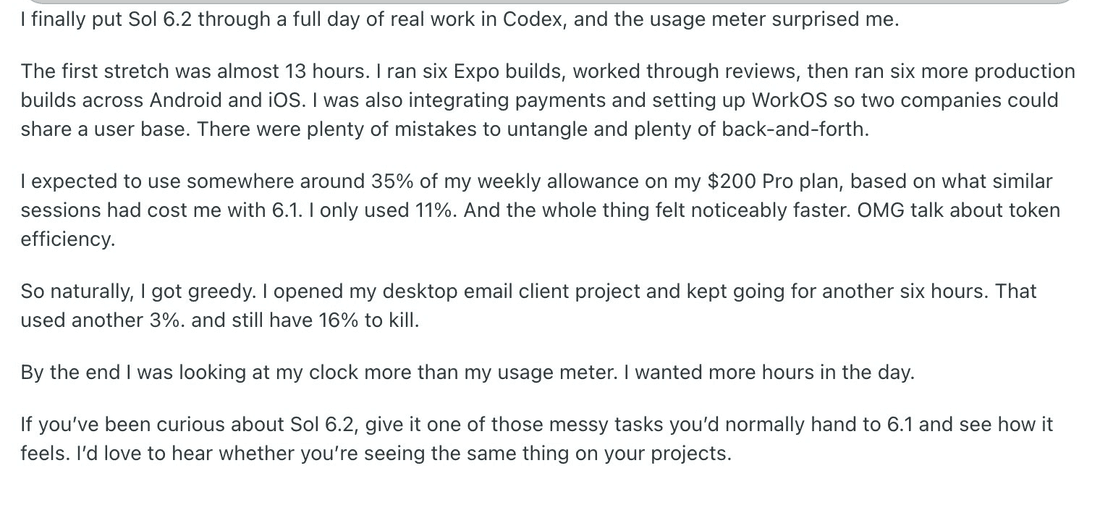
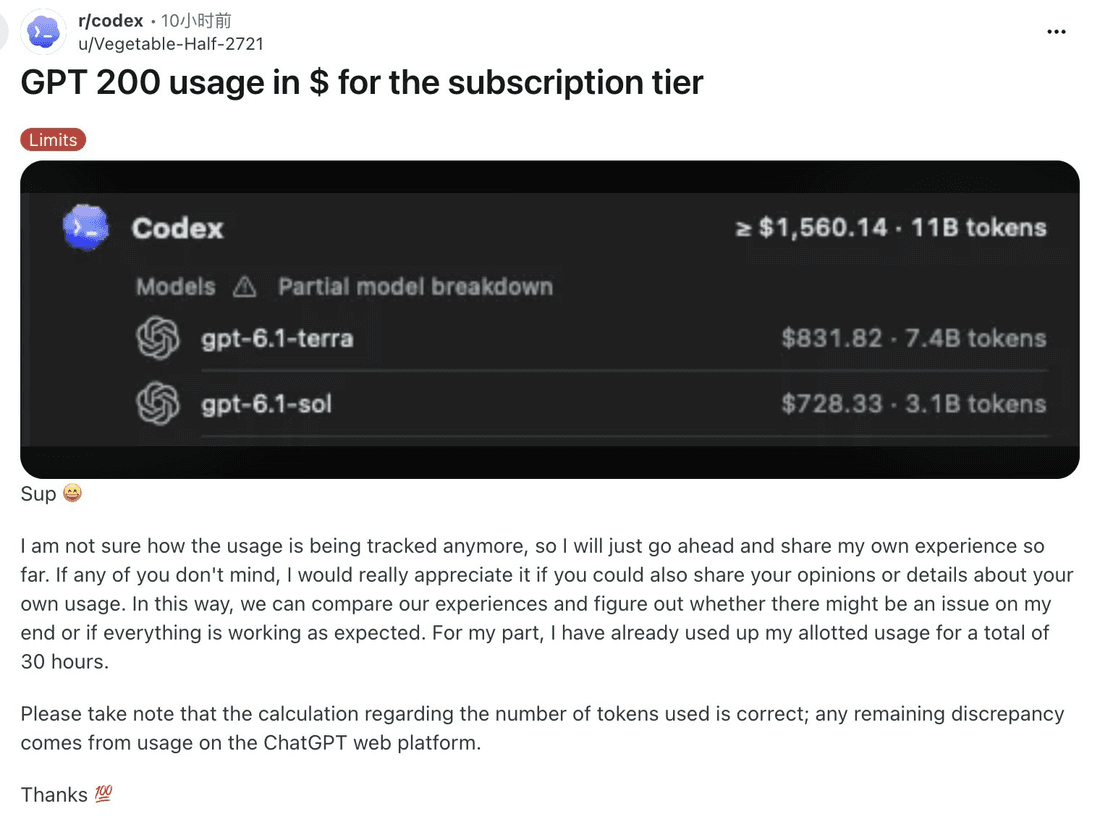
One Codex user reported that a day involving Expo builds, payment integration and reviews consumed 14% of their weekly allowance on a $200 plan. Another asked how to interpret the usage dashboard after reaching their allowance. Both describe their own workloads and meters. They give you a reason to trial Sol against a representative day of your work before sizing a subscription. Build workflow report · Usage dashboard discussion
Calculate GPT-6.2 Sol API cost
Use counts for a representative request, including the full output count. Enter total input and the subset assigned to reads and each write category. The calculator subtracts all three cache buckets from ordinary input, applies the long-context threshold and multiplies by the number of comparable requests. Estimates stay in the browser.
Estimate your token bill
Use the counts from one request. The estimate runs in this browser.
USD estimate. Tool fees, retries, regional processing and taxes are excluded. Current OpenAI rates
Example 1. A repeated request at Standard. A request has 100,000 input tokens, including 80,000 reads, and 2,000 billed output tokens. With zero writes, the cost is (20,000 × $2 + 80,000 × $0.10 + 2,000 × $10) / 1,000,000 = $0.068. One thousand requests with that exact usage cost $68. A cold request that writes the 80,000-token prefix for 30 minutes costs $0.26 instead of $0.068. Charge it once wherever the workload actually reports a write.
Example 2. A long document review. With 300,000 ordinary input tokens and 8,000 billed output tokens, the Standard total is (300,000 × $4 + 8,000 × $15) / 1,000,000 = $1.32. The equivalent Batch request costs $0.66. If splitting the document, include the extra input and output from the synthesis pass before comparing. Look at the cost of the complete review, including any missed findings you have to recover later.
Test a price-check workflow in Tabbit
For a small browser acceptance task, open the official pricing page and reference it in Tabbit. Ask for the five Standard short-context rates, the threshold and both Ultrafast prices with their Pacific time dates. Give it the target table columns and ask for a source link. Check the answer against the live table before accepting it. The Tabbit Browser guide explains how to reference the current tab. The browser-use guide for the original GPT-6 Sol covers what changes when a task needs browser interaction.
Read the official rate card attached to this chat. List the five Standard short-context rates for GPT-6.2 Sol. Verify the long-context threshold and both Ultrafast multipliers, including the cutover date and time zone. Cite the official source.Start on Standard Sol for interactive API work. Use Batch when results can wait, and reserve Ultrafast for tasks whose turnaround has a measurable cost. For a browser workflow, compare how many runs meet the same acceptance criteria before you compare model bills. Use GPT-6.2 Sol in Tabbit Browser for the price-page task. Tabbit accounts have their own usage terms.
 Tabbit Browser

FAQ
How much does GPT-6.2 Sol cost per million tokens?
OpenAI charges $2 for uncached input, $0.10 for cached input, $2.50 for 30-minute cache writes, $5 for 12-hour cache writes and $10 for output on Standard requests with up to 272,000 input tokens.
Is GPT-6.2 Sol cheaper than GPT-6.1 Sol?
The Standard rates match in both context bands. GPT-6.2 Sol Ultrafast costs 3 times its Standard rate through February 28, 2027 Pacific time, versus 6 times for GPT-6.1 Sol. The listed GPT-6.2 Sol multiplier rises to 6 on March 1.
What happens above 272,000 input tokens?
The whole request switches to long-context rates. At Standard speed, input is $4, cached input $0.20, 30-minute writes $5, 12-hour writes $10, and output $15 per million tokens.
Does GPT-6.2 Sol charge for reasoning tokens?
Yes. OpenAI includes reasoning tokens in billed output. Use the full output count from the usage record, which already includes reasoning, to estimate cost.
Does a ChatGPT or Codex subscription include GPT-6.2 Sol API calls?
OpenAI bills API-key calls separately. Access to Sol in ChatGPT Work and Codex depends on plan and workspace settings. Included usage and eligible purchased credits have their own meters.
Does GPT-6.2 Sol support Batch or Flex pricing?
OpenAI lists Batch at half the Standard token rates for the same context band. The November 19, 2026 API price table does not list Sol 6.2 under Flex. The Responses API separately offers discounted background completion windows in public beta.