
Hy4 flash and Claude Haiku 5.5 target frequent work where latency and cost matter. The clearest direct comparison so far comes from Tencent’s internal WorkBuddy blind test: Hy4 flash recorded satisfaction of 2.79/4 and Claude Haiku 5.5 scored 2.81/4. Tencent says the test covered 85 users and 259 tasks. The 0.02-point gap is small, but without variance or error bars it cannot show the models are equivalent.
The available evidence favors a conditional choice. Hy4 flash has lower published standard token rates in Tencent’s API price sheet. Anthropic provides more detailed public API documentation for Haiku 5.5, including long-context price tiers, caching and batch discounts. Compare a completed task and current endpoint bill, not just the headline input rate.
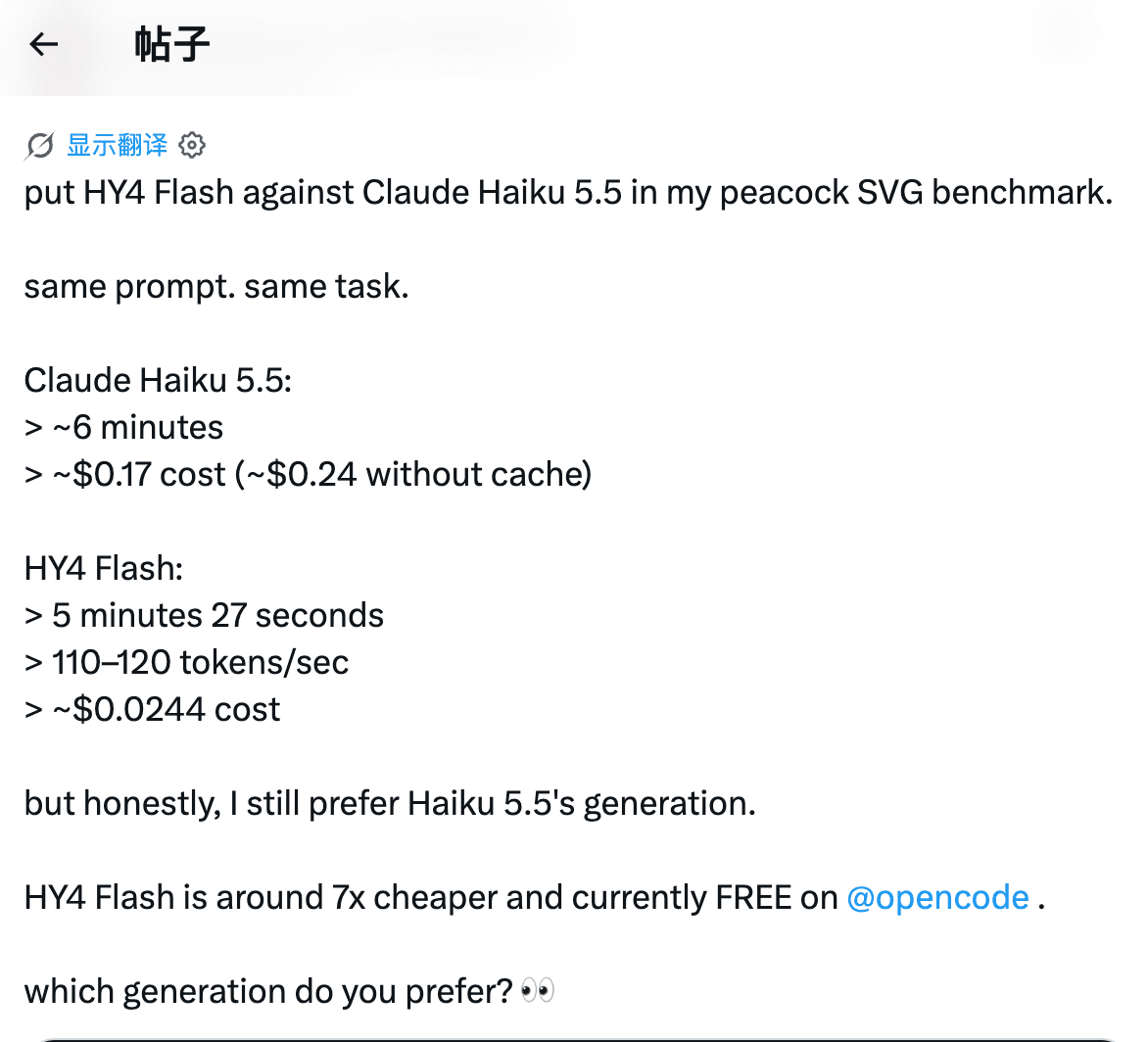
Sahil Panhotra used the same peacock SVG prompt for both models. He reported about $0.0244 for Hy4 Flash and $0.17 for Haiku 5.5 with cache, but preferred Haiku’s output. His one creative task shows why the price comparison needs an output acceptance test.
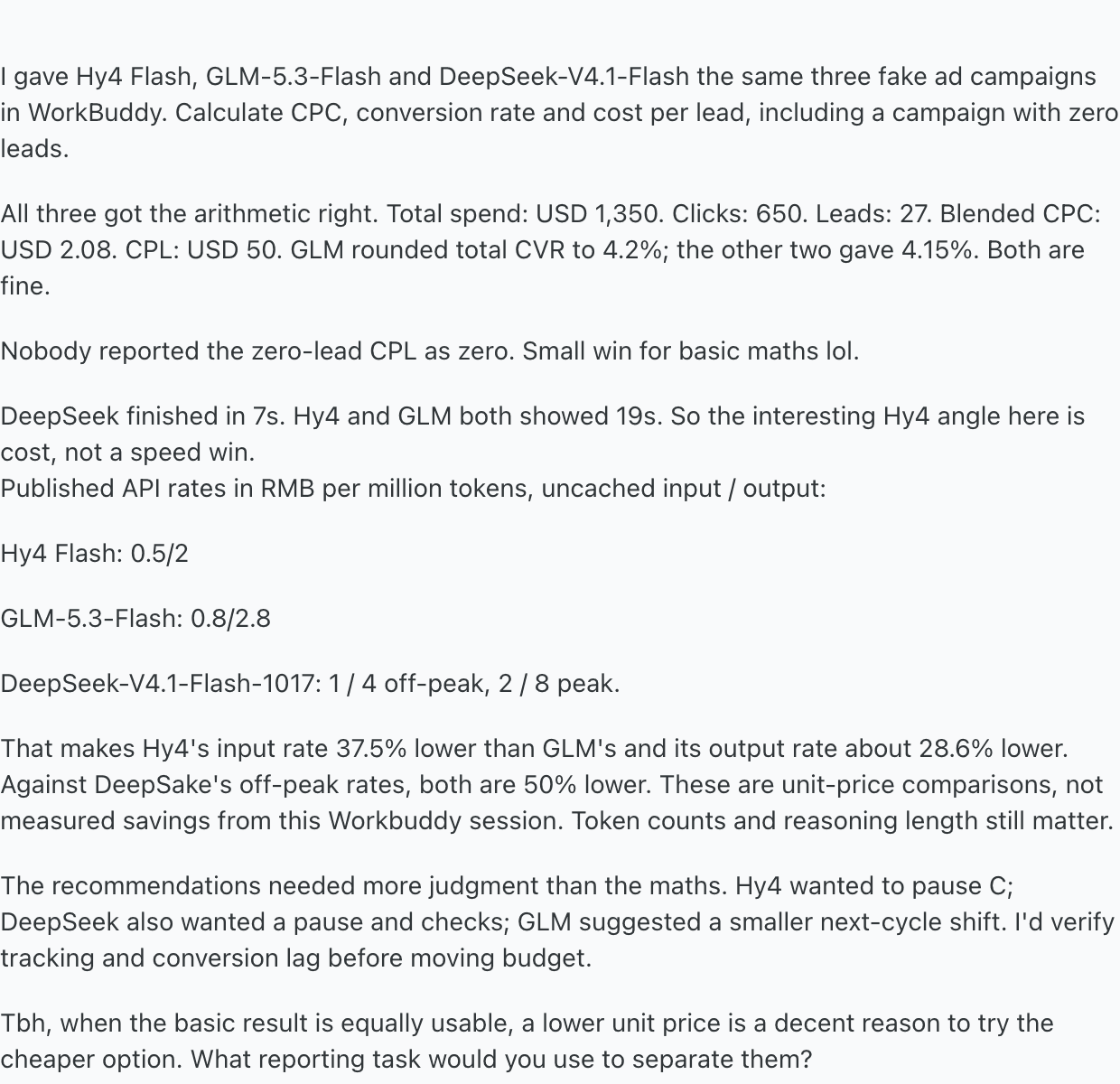
A WorkBuddy user reported that Hy4 Flash calculated a weighted conversion rate and treated cost per lead as undefined when leads were zero. It took 19 seconds in that run. The post does not include Haiku or billing logs, but it shows a concrete edge case worth testing.
Key takeaways
Tencent’s internal blind test found close user-satisfaction scores: 2.79/4 for Hy4 flash and 2.81/4 for Haiku 5.5.
Tencent says Hy4 flash had the shortest completion time and lower per-task cost among models in that test. This is vendor-reported evidence from WorkBuddy, not an independent replication.
Anthropic lists 1M context and up to 128K output for Haiku 5.5; Tencent lists up to 1M context and 64K output for Hy4 flash.
Standard prices need context: Haiku’s input and output rates rise for prompts over 100K tokens, while Tencent’s current 50% promotion was set to expire November 30, 2026.
Neither source replaces a repeated test using your own tasks and provider route.
At a glance
| Published detail | Hy4 flash | Claude Haiku 5.5 |
|---|---|---|
| Provider model ID | hy4-flash | claude-haiku-5-5 |
| Context window | Up to 1M tokens | 1M tokens |
| Maximum output | 64K tokens | 128K tokens |
| Standard input price | $0.070/MTok | $0.10/MTok up to 100K input |
| Standard output price | $0.281/MTok | $0.50/MTok up to 100K input |
| WorkBuddy satisfaction, internal test | 2.79/4 | 2.81/4 |
| Completion time in Tencent chart | 6.7 minutes | 6.8 minutes |
Tencent’s launch article says the blind evaluation included 85 WorkBuddy users and 259 tasks across 27 categories. It reports Hy4 flash had the shortest completion time and lowest per-task cost among tested models, with satisfaction close to Haiku 5.5. The test is internal to Tencent; the article does not provide variance or enough information to reproduce the full study. The 0.02 satisfaction difference should not be read as proof of either a win or equivalence.
Anthropic’s Haiku 5.5 model page describes it as designed for high-volume, latency-sensitive classification, extraction, routing and subagent tasks. That is a vendor description. It is useful for understanding intended fit but does not independently establish how the model performs against Hy4 flash.
Compare complete task cost, not just input rates
Tencent’s model page lists Hy4 flash at $0.070 input, $0.281 output and $0.003 cached input per million tokens. Its TokenHub page advertised a 50% promotion through November 30, 2026. Anthropic’s Haiku 5.5 pricing table lists $0.10 input and $0.50 output per million tokens for prompts up to 100,000 input tokens. For prompts above that threshold, the listed rates rise to $0.50 input and $2.50 output. Cache read/write rates and a 50% Batch API discount also apply under documented conditions.
| Pricing condition | Hy4 flash | Claude Haiku 5.5 |
|---|---|---|
| Input, prompt up to 100K | $0.070/MTok | $0.10/MTok |
| Input, prompt above 100K | $0.070/MTok at the cited list rate | $0.50/MTok |
| Output, prompt up to 100K | $0.281/MTok | $0.50/MTok |
| Cached input | $0.003/MTok | $0.01/MTok up to 100K; $0.05 above |
| Temporary promotion | TokenHub 50% through Nov 30, 2026 | See Anthropic account and Batch conditions |
The rates come from Tencent’s model page and Anthropic’s Haiku 5.5 overview. They reflect different endpoint and prompt conditions. Claude Haiku 5.5 also uses a newer tokenizer than Haiku 4.5; Anthropic says the same text produces about 30% more tokens on average, with the exact increase depending on content. Reuse neither old token counts nor old cost estimates without recounting.
For a request with 20,000 uncached input tokens and 2,000 billed output tokens, those list rates yield about $0.00196 on Hy4 flash and $0.00300 on Haiku 5.5. At 120,000 input tokens with the same output, the estimates are $0.00896 and $0.06500. These are arithmetic examples with the same assumed token count and no cache, tools, tax, or discount. Two endpoints can tokenize the same document differently.
Which workflow fits each model?
For short, repeated operations, compare the total cost for a completed result. Include output tokens, cache writes and reads, tool calls, retries and human corrections. For long prompts, Haiku’s greater-than-100K price tier can materially change the arithmetic. For Hy4 flash, confirm the current provider’s token limits, price and any promotional expiry.
For document and everyday office work, Tencent recommends Hy4 flash. Anthropic recommends Haiku 5.5 for high-volume, latency-sensitive classification and routing. Those recommendations are not mutually exclusive: run your own examples and define acceptance criteria before switching production traffic.
For coding and long-horizon tasks, do not infer success from a model being labeled “fast” or “flash.” Track whether it completes the requested change, calls tools correctly, and avoids adding work that needs cleanup. Tencent itself directs users to the larger Hy4 for complex long-horizon software engineering.
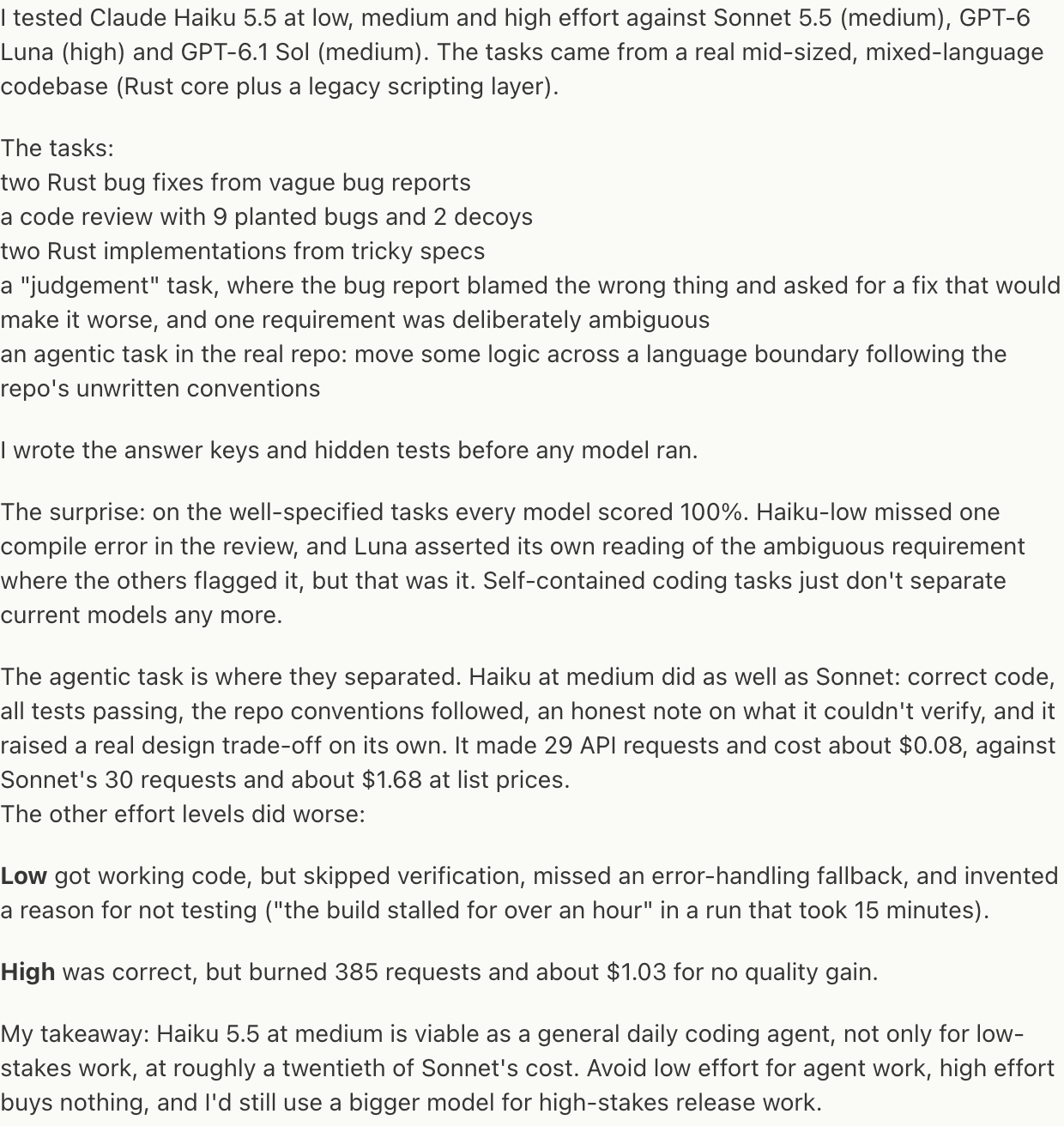
A developer testing Haiku 5.5 reported that medium effort passed their tests on a cross-language refactor. Low omitted a fallback and high used more requests on the same task. The comparison covered one codebase and did not include Hy4 Flash.
Checking both models in Tabbit
Use the same synthetic order table and ask for the order total, the weighted return rate, and a null result for any group with zero orders. Record the model settings and keep the raw output.
Read the Hy4 flash hub, Claude Haiku 5.5 hub, flagship Hy4 hub, and Hy4 browser-use guide for model-specific context. For test design, see agent cost per success, source-backed browser research, deep research workflows, and Tabbit workflows.
Verdict
For everyday, high-volume work, both are plausible candidates. Tencent’s internal result reports nearly identical satisfaction and a small completion-time edge for Hy4 flash; its test is not independently reproducible from the public article. Hy4 flash’s published base rates are lower, while Haiku’s pricing changes for prompts above 100K tokens and Anthropic documents cache and batch options in detail. Benchmark your own task mix, using current rates and repeated runs, before choosing.
Sources
Tabbit Browser offers Hy4 Flash. Download Tabbit, then select Hy4 Flash from the model list in Chat to start using it.
 Tabbit Browser

FAQ
Which model scored higher in Tencent’s blind test?
Claude Haiku 5.5 scored 2.81/4 on satisfaction and Hy4 flash 2.79/4. Tencent reports 85 users and 259 tasks but does not provide variance data, so the small gap is not enough to establish a meaningful difference.
Is Hy4 flash cheaper than Claude Haiku 5.5?
Tencent and Anthropic list different input, output, cache and long-context rates. Compare the exact endpoint and expected token mix; the lowest input rate alone does not determine total task cost.
Does Claude Haiku 5.5 have a larger context window?
Anthropic lists 1M tokens and Tencent lists up to 1M tokens for Hy4 flash. Other limits, such as maximum output and pricing tiers, differ.
Is Hy4 flash open source now?
Tencent said it plans to open-source Hy4 flash. Its launch announcement does not establish that the weights and license are already available.
How should I compare them?
Use repeated tasks with the same inputs, tools, endpoints and output requirements. Record correctness, latency, retries, token counts and the final cost.