
LongCat 2.5 is worth a controlled pilot for agentic coding and visual tasks, but there is not enough evidence here to recommend it for unattended production work. The model's November release is new, and real-world reports about the earlier Preview do not establish how the released version behaves.
The central number is 88.4 versus 70.8 on Terminal Bench v2.1 for LongCat 2.5 and 2.0, respectively, in the vendor's November 1 evaluation. That is a useful signal of a change under a specified test setup, not the probability that your own coding task will succeed. In two small Tabbit Browser chat tasks, the selected model produced a correct arithmetic table and a useful code fix, but misstated what the original code would return in two cases. The next section shows the limits of that result.
Key takeaways
LongCat describes 2.5 as a native multimodal model for long-horizon agents, with 1.6 trillion total parameters and about 48 billion active per token.
Its reported gains over 2.0 vary by benchmark and depend on the harness. They are vendor results, not independent replication.
Preview users reported both useful project-context handling and repeated tool loops. Their experiences cannot be assigned to the November model.
The official launch page still said the GitHub and Hugging Face releases were coming soon when checked on November 3, 2026.
LongCat-2.5 appeared in our test account; availability and terms can vary. Verify the model, data policy and cost before sending sensitive files or giving an agent write access.
LongCat 2.5 at a glance
| Decision | Evidence checked on November 3, 2026 | What it does not establish |
|---|---|---|
| Model | LongCat describes a 1.6T-parameter mixture of experts with about 48B active per token | Your inference latency or hardware bill |
| Agent work | The official table reports gains over 2.0 on coding and research benchmarks | An independently reproduced production success rate |
| Visual input | The publisher describes a shared text and visual-token representation | Performance on your screenshots or generated UI |
| Weights | GitHub and Hugging Face links say coming soon on the launch page | A release date, license or deployable checkpoint |
| Tabbit | The test account selected LongCat-2.5 for two small chat tasks | Availability, price, or quota in another account |
For the prior generation's access and trade-offs, see the LongCat 2.0 overview. A model's ability to call tools is only one part of the workflow; the agentic browser guide explains the client layer.
Two small Tabbit tests before the leaderboard
On November 3 we selected LongCat-2.5 in Tabbit Browser Dev's test account. We wrote the prompts and acceptance checks before running them, used chat mode, and gave the model no write-capable tools. Both tasks ran once in the same conversation. The precise model snapshot, provider route, reasoning setting, token usage and cost were not exposed, so these examples cannot establish reliability, speed or availability in another account.
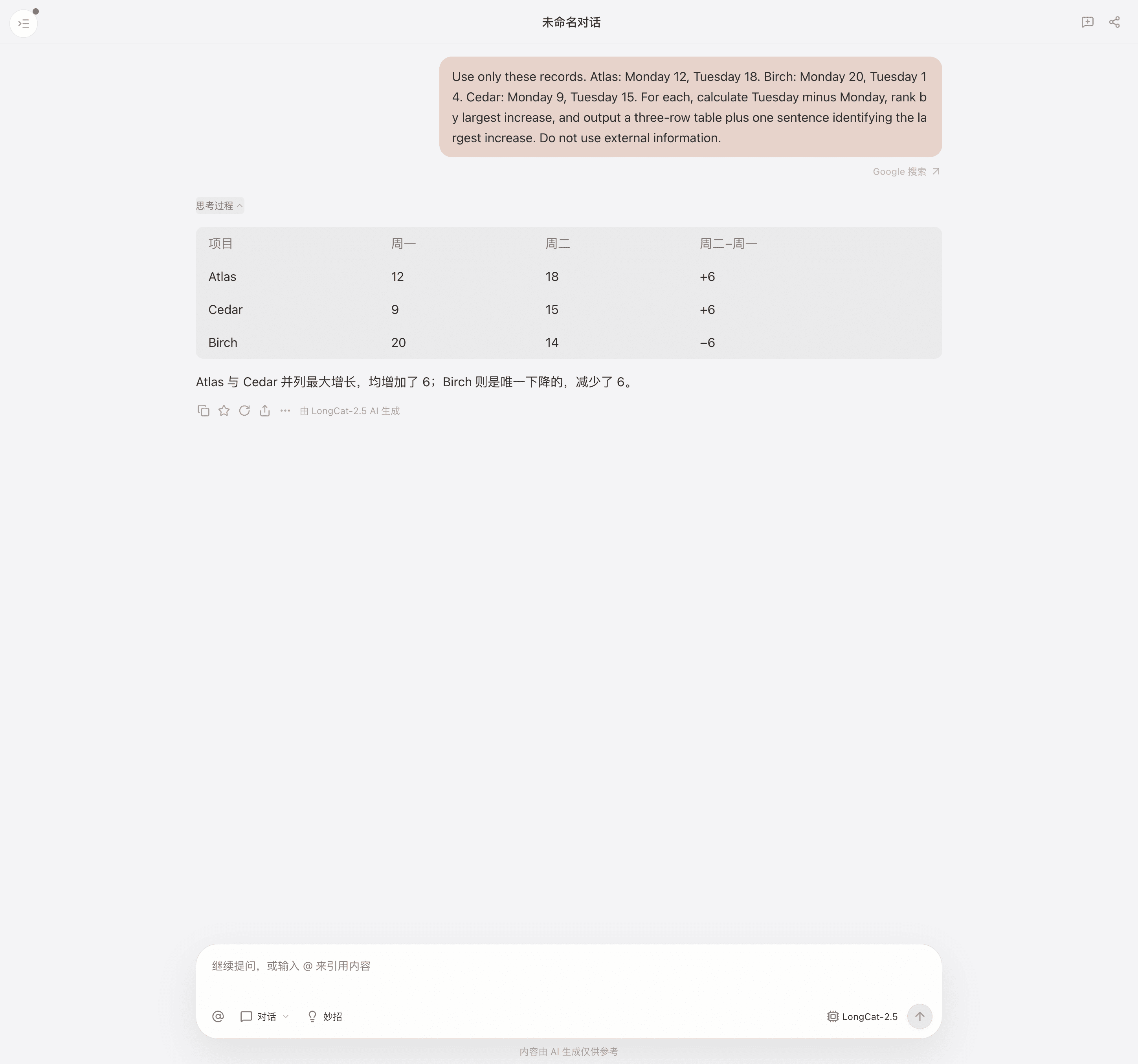
For a table built from three invented records, the model correctly calculated +6, +6 and −6 and identified the tie. It answered in Chinese in the Chinese-language test environment; the English prompt did not explicitly request an output language.
In the second task we asked for a JavaScript function review. The proposed fix filtered for non-negative finite numbers and returned null for an empty set; executing that fix locally produced the expected results on all five requested cases. But its explanation of the original function was wrong twice: [NaN, 4] returns 4, not NaN, and [0] throws TypeError, not NaN. We verified those outcomes in Node. The model supplied tests; it did not demonstrate executing them.
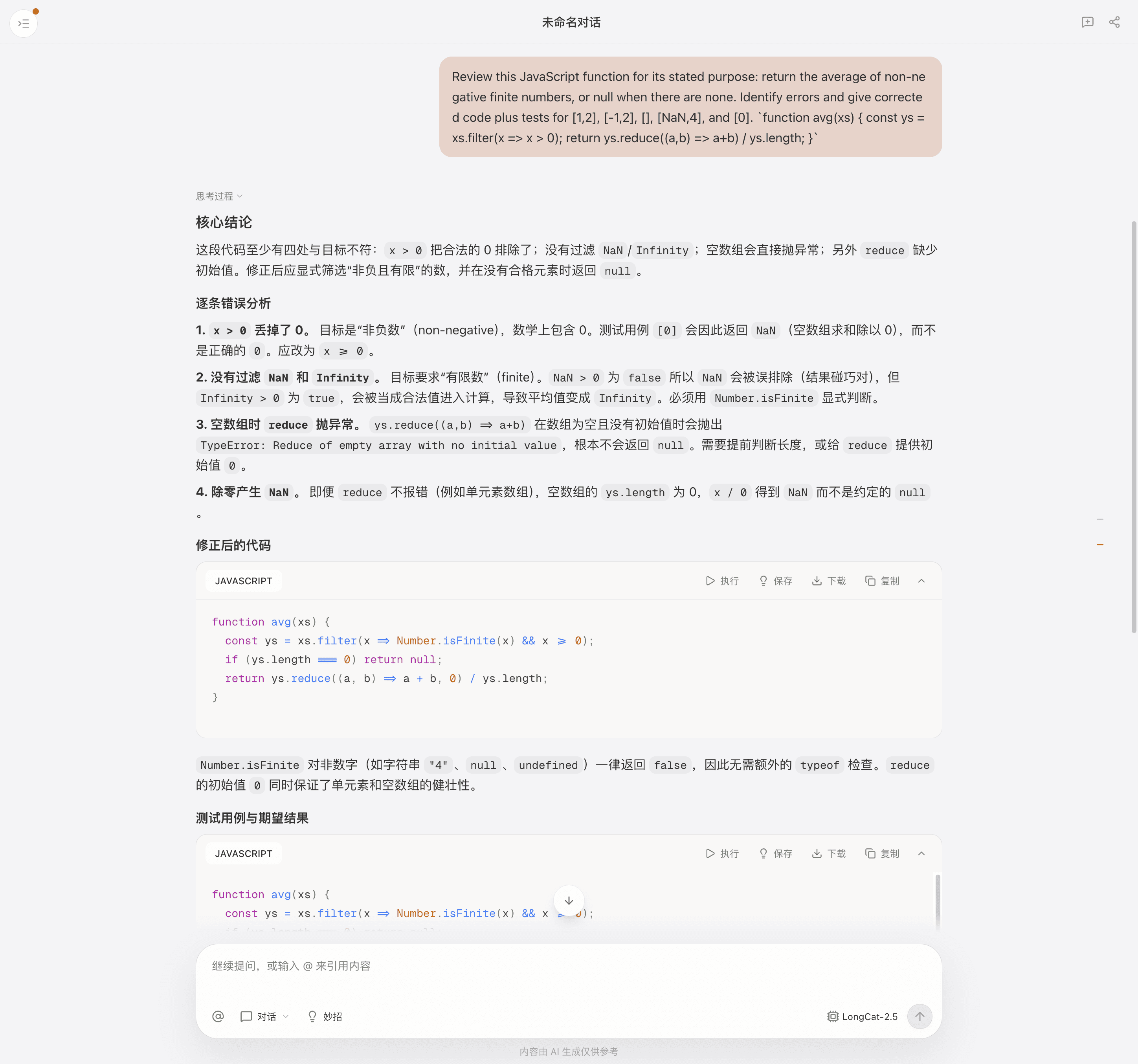
This is the practical verdict of the test: use the answer to draft a fix, then run the code and check the explanation. It says nothing about autonomous repository edits or long-running browser agents. For larger evaluations, organizing multi-model research helps keep tasks and outputs comparable.
What people saw before the benchmark table
The following Reddit task reports describe LongCat 2.5 Preview, not the November 2.5 release. They are useful for designing a test, not for scoring the new model.
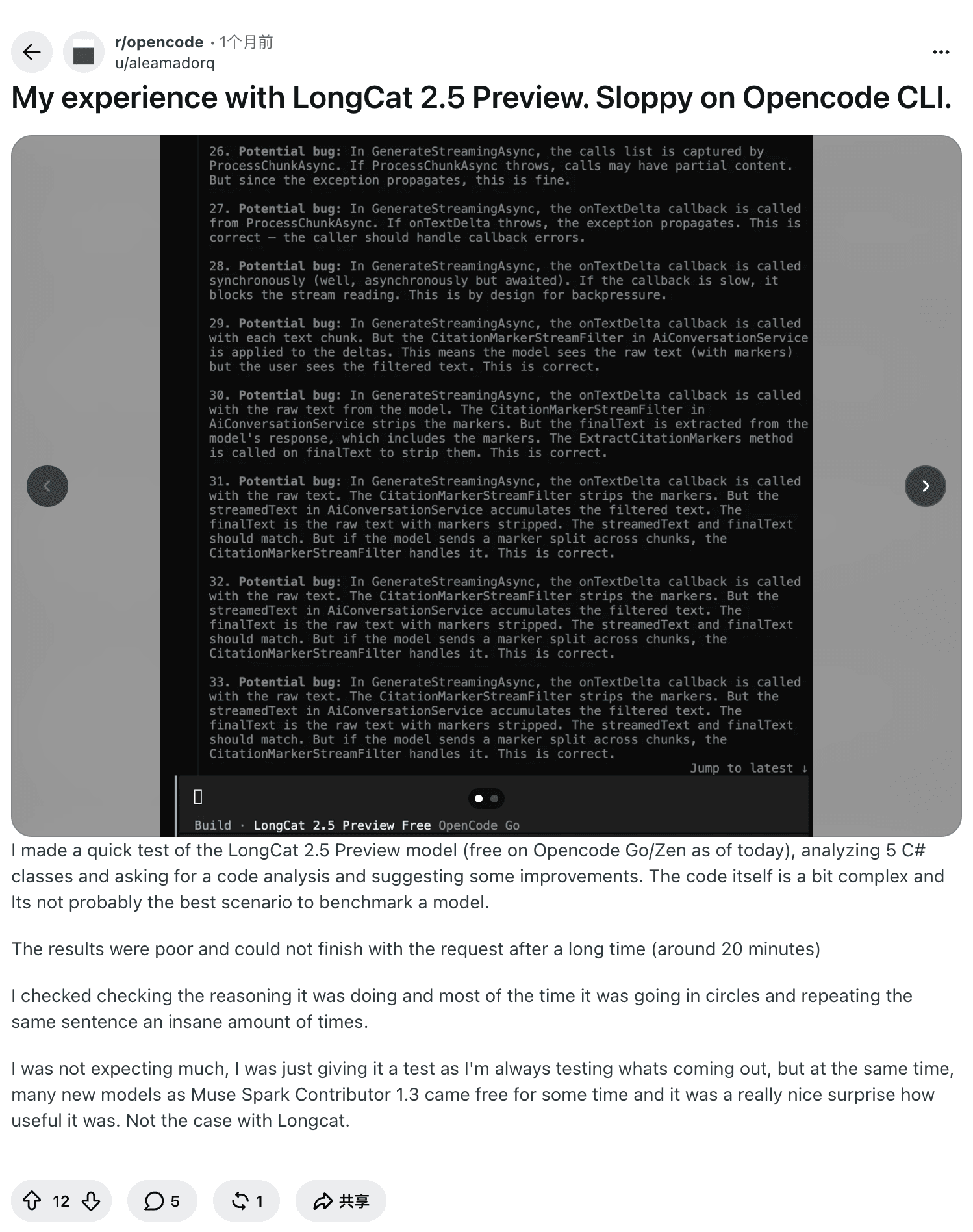
A developer asked Preview in OpenCode to analyze five C# classes and suggest improvements. The author reported that it was “going in circles and repeating the same sentence” and had not finished after roughly 20 minutes. The code, complete prompt, provider settings and repeated trials were not published. Read the original account.
Another developer's Terminal Bench v2.1 post reports three runs of 89 tasks per model. The table labels the tested model Preview and reports 48.7% pass@1 and 64.0% pass@3. The author also says a local device failed consistently on one task. Do not compare that number directly with the publisher's 88.4 for the later model: version, environment and harness are not established as equivalent.
A separate DEV Community account favored Preview's context handling and tool orchestration across several projects. It supplies no complete prompts or controlled run logs. Together these accounts justify checking loops, scope of edits and tool choices; they do not tell us how frequently failures occur.
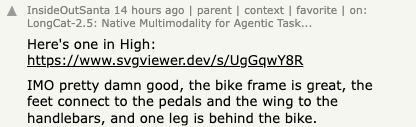
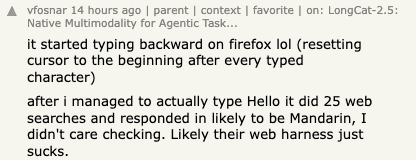
A Hacker News commenter shared a pelican-on-a-bicycle result in a launch thread and liked the rendering, but did not publish a full prompt and client setup in the comment. Another commenter reported a Firefox input problem and repeated searches after a greeting, tentatively blaming the web harness. Both are individual reports; neither isolates the model from the client.
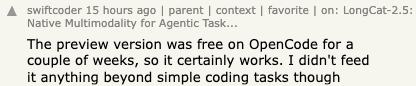
A third comment describes Preview handling simple coding tasks in OpenCode. It gives no task details and does not test the later release.
Independent hands-on work is more informative than a launch score when the tasks and outputs are public. TOKRACE's November 2 evaluation describes 15 creative tasks using LongCat 2.5 through Claude Code. Its bookshelf met stated dimensions, while a planetary-reducer scene used 140 metres for a 140-millimetre specification and missed the requested video. A dashboard invented a year, units and source. These are that evaluator's results under its own settings, not our Tabbit test.
The official benchmarks and their limits
| Test reported by LongCat | LongCat 2.5 | LongCat 2.0 | What it probes |
|---|---|---|---|
| Terminal Bench v2.1 | 88.4 | 70.8 | Terminal-based agent tasks |
| Terminal Bench v4.0 | 38.5 | 3.0 | A different terminal benchmark version |
| BrowseComp | 91.9 | 79.9 | Research with search and browsing tools |
| AutomationBench public v1.0.6 | 51.8 | 15.8 | The 600-question public automation set |
| Vision2Web | 78.6 | Not reported | Visual-to-web work |
Source: LongCat's technical launch, checked November 3, 2026. Unless otherwise noted, the 2.5 configuration uses thinking on, temperature 1 and top-p 0.95. Terminal Bench v2.1 used Claude Code v2.1.280 with a 512K maximum sequence length and averaged three independent runs. BrowseComp used a custom harness, only search and browse_with_goal, and up to 1,024 turns. Vision2Web used a different Claude Code version and a 256K sequence length.
The vendor draws starred competitor numbers from published reports and runs other comparator scores itself; it calls those self-run comparisons indicative. A score is conditional on the tasks, version, scaffold and settings. In particular, compare v2.1 with v2.1, not with v4.0. The table does not show a full distribution of run times, costs or real-project outcomes.
Three reasons to consider a pilot
Multi-step coding is the stated target
The official release describes training on longer trajectories, synthesized tasks and failures from agent runs. It reports a substantial improvement over 2.0 on its terminal tests. For a team with an existing test suite, that is a reason to try a bounded issue in a disposable branch. It is not evidence that the model will preserve all unrelated behavior.
Research tasks have a concrete, if narrow, signal
The reported BrowseComp result uses a defined search-and-browse harness. That supports testing retrieval and synthesis, but a browser workflow often has authentication, interactive pages and tool permissions absent from that evaluation. Start with public sources and verify citations. The browser automation guide covers the surrounding workflow rather than model quality.
Visual input can change the task you give it
LongCat describes converting visual signals into discrete tokens handled alongside text, and reports a Vision2Web result. This creates a plausible use for inspecting a screenshot before changing a layout. It does not guarantee pixel accuracy, accessibility or working code. Compare the output with the original image and test the page at the intended viewport.
Three reasons to keep a human in the loop
A score does not transfer automatically to your tools
An agent can choose the wrong tool, repeat commands or make edits outside the requested scope. The Preview anecdotes show why these are useful failure modes to inspect, even though they cannot quantify the released model's risk. Set a time or tool-call budget and inspect every changed file. Tabbit best practices are a useful starting point for review habits.
Self-hosting is not yet established for 2.5
The official launch showed both weight destinations as coming soon at the time of research. LongCat 2.0's published weights do not prove that 2.5 weights are already downloadable or carry the same license. If deployment inside your infrastructure is mandatory, wait for the actual checkpoint and terms.
Price and data handling need direct confirmation
The official LongCat pricing page showed limited-time rates of ¥2 per million uncached input tokens, ¥0.04 cached input and ¥8 output on November 3, 2026. Rates and currency views can change; the platform bill governs. We have not verified complete retention, training or residency terms. Obtain those terms for your actual route before uploading private code. API charges, any subscription and Tabbit account terms are separate decisions. For a different cost structure see the dated DeepSeek V4 Flash pricing guide.
A practical browser workflow in Tabbit
The two tests above used text only. For a more realistic next trial, open a public technical article, ask for five claims with links, then check each claim against the source. Record the visible model name, date, prompt, result and corrections. Avoid private documents and write permissions until the actual account and provider terms meet your needs.
Tabbit's test edition offered LongCat-2.5 in our account; that observation does not establish availability or the same terms elsewhere. The DeepSeek harness guide illustrates why the client and its tools matter separately from model choice. Compare with the DeepSeek V4.1 Flash overview only using the same tasks and conditions.
 Tabbit Browser
Downloading Tabbit does not run the model; check the selector and account terms first.
Verdict by workload
| Your workload | Recommendation | Why |
|---|---|---|
| Public, reviewable coding task with tests | Pilot on a disposable branch | Vendor scores justify a trial; review protects against scope and logic errors. |
| Visual-to-web prototype | Try a small screenshot task | Official visual claims are relevant; inspect the rendered result and accessibility. |
| Sensitive repository or regulated documents | Wait for verified data terms | The actual provider and client govern retention and access. |
| Mandatory local deployment | Wait for published weights and license | The launch page still marked both weight links as coming soon. |
| Unattended production agent | Do not assume readiness | The two small chat tasks do not establish long-running agent reliability. |
The next useful step is to run the same small, checked task in the actual client and provider you intend to use. Keep version, settings, retries, cost and corrections with the result; a single successful run is an example, not a reliability estimate.

FAQ
Is LongCat 2.5 worth trying?
It is a reasonable candidate for a controlled coding or visual-workflow pilot based on the vendor's reported results. Two small Tabbit chat tasks produced one correct table and one code review with an error in its explanation. They do not establish reliability on longer agent tasks.
How is LongCat 2.5 different from 2.5 Preview?
LongCat announced 2.5 on November 1, 2026, after an earlier Preview. Reports explicitly about Preview describe that earlier version and should not be treated as direct tests of the November release.
Are LongCat 2.5 weights available?
On November 3, 2026, the official launch page still labeled its GitHub and Hugging Face links as coming soon. Check the publisher's current pages for a release and license before planning a self-hosted deployment.
How good is LongCat 2.5 at coding?
LongCat reports 88.4 on Terminal Bench v2.1 using Claude Code and an average of three runs. That vendor result does not establish performance on your repository, client, or provider, so run a small task with tests and review the diff.
Can I use LongCat 2.5 in Tabbit?
LongCat-2.5 appeared in a Tabbit Browser Dev test account on November 3, 2026, and was used for two chat tasks. Availability and terms can differ by account and edition; check your own selector and quota.
How much does LongCat 2.5 cost?
The official LongCat pricing page showed promotional yuan rates of ¥2 per million uncached input tokens, ¥0.04 cached input and ¥8 output on November 3, 2026. Prices may change, and API billing is separate from Tabbit account terms.