TabbitBlog

Safari With AI: Meet Tabbit

Love Safari's clean, light feel but want page-aware AI and browser agents? See how Tabbit handles research, summaries, and routine web work.

In this article
  1. Key takeaways
  2. Safari and Tabbit at a glance
  3. The other "Safari AI" products
  4. Why Safari feels better than an ordinary browser
  5. Where Safari and Tabbit part ways
  6. Where Tabbit will feel familiar to a Safari user
  7. What Tabbit adds
  8. The input box can point at real browser context
  9. Agent Mode can use the browser
  10. Skills make a good workflow reusable
  11. Four examples that show the difference
  12. 1. Compare a research tab group without rebuilding the prompt
  13. 2. Read a long page without turning it into another tab
  14. 3. Turn web research into a structured sheet
  15. 4. Save the routine instead of saving another prompt document
  16. What Safari still does better
  17. What Tabbit does better
  18. Choose by scenario
  19. How to try Tabbit without moving everything
  20. Which browser should you choose?

Safari makes a busy web feel light. It ships with every Mac, opens fast, and keeps the interface out of the way. Tabbit starts from a similar place, with a clean workspace that lets pages stay the main event, and then adds AI that can use what is already open and act on it.

If you searched for Safari with AI, you will quickly notice two problems. First, Apple Intelligence inside Safari is narrower than it sounds: page summaries, Highlights, and Writing Tools, with hardware and region limits. Second, the phrase "Safari AI" also points to unrelated products, including a computer-vision company and an Android app that borrows the Safari name. The useful comparison is Apple Safari versus Tabbit Browser.

Tabbit is a macOS and Windows browser that can use pages, tab groups, screenshots, bookmarks, and local files as context. Its Agent Mode can move through websites and carry out a task, with the steps left visible for review.

That makes the choice fairly concrete. Stay in Safari when the Apple ecosystem, battery life, and a browser that stays out of the way matter most. Look at Tabbit when the harder problem is carrying context between pages and doing something with what you find.

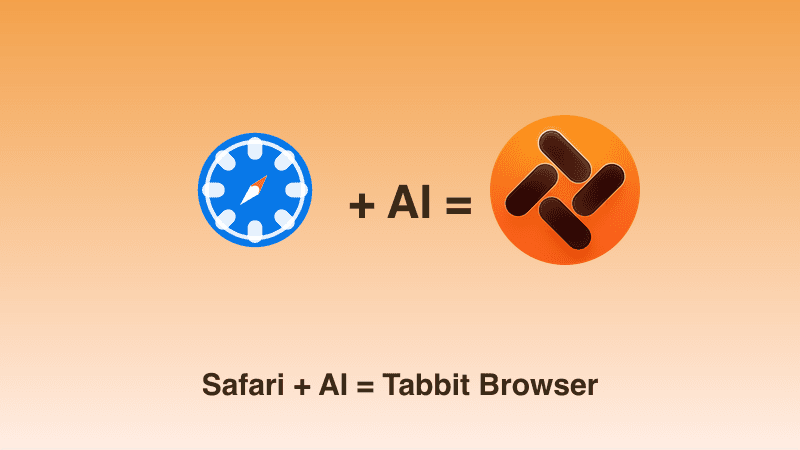
Safari compass symbol plus AI equals the Tabbit Browser logo
Tabbit pairs a Safari-like clean browsing experience with page-aware AI and browser agents.

Key takeaways

  • Apple Intelligence in Safari covers page summaries, Highlights, and Writing Tools, not browser actions.

  • Apple Intelligence requires an M1 or newer Mac (or an iPhone 15 Pro or later). Intel Macs and older iPhones are left out.

  • Tabbit connects AI to tabs, groups, screenshots, bookmarks, and local files, and its Agent Mode can navigate and fill pages.

  • Some results for "Safari AI" are unrelated products. Apple's Safari and Tabbit are the two browsers worth comparing.

  • Both keep a quiet interface, but they solve different problems.

Safari and Tabbit at a glance

CapabilitySafariTabbit Browser
Main ideaApple's default, low-noise browserCalm browser workspace built around context and actions
EngineWebKitChromium
Desktop platformsmacOS onlymacOS, Windows
Tab organizationTab Groups, Profiles, iCloud TabsVertical tabs, groups, and separate groups for agent tasks
AI contextSingle-page summaries, Highlights, Writing ToolsPages, tab groups, screenshots, bookmarks, and local files
Browser actionsNo native agent layerAgent Mode can navigate, read, click, and fill fields
Reusable routinesShortcuts and extensionsSkills can save prompts, scripts, and agent workflows
Best fitPeople anchored in the Apple ecosystemPeople who want AI to work with browser context

Platform and feature details were checked on August 4, 2026. Apple and Tabbit both move quickly, so confirm the current download and release pages before changing your main browser.

The other "Safari AI" products

The exact phrase "safari ai" does not point cleanly at Apple. The first results include Safari AI from getsafari.ai, an enterprise computer-vision company, and Safari.ai from trysafariai.com, an Android browser app developed by a third party that embeds ChatGPT and Claude. Neither is Apple, and neither is the browser that ships with your Mac. When people ask "how do I get AI in Safari," the answer on Apple's side lives in Apple Intelligence, not in a separate app called Safari AI.

Why Safari feels better than an ordinary browser

Safari is the browser most Apple users start with and often never leave. It has a clean toolbar, Reader strips a page down to its article, Private Browsing is a click away, and Tab Groups plus Profiles keep work and personal browsing apart. Because Apple controls the OS and the web engine, the browser tends to feel fast and to use battery gently on Apple silicon.

Its identity is also deliberately quiet. Apple Intelligence in Safari adds a small set of helpers: generate a summary of the current page, see Highlights for some pages, and use Writing Tools to rewrite or condense text. These are page-level features. There is no way to point Apple Intelligence at several open tabs at once, no way to have it keep researching across new sources, and no agent that clicks or fills forms.

The hardware gate is worth spelling out. Apple's system requirements list Mac computers with Apple silicon (M1 or newer), iPhone 15 Pro models and later, and iPads with M1 or newer or the A17 Pro chip. An Intel Mac, an iPhone 14, or an older iPad gets none of it. Apple Intelligence also started as a beta with a limited language list, and it is not available in mainland China on devices purchased there. If you are on an Intel Mac or an older iPhone, "Safari with AI" has a short answer today: it is not available to you in Safari.

Tabbit does not need to replace that side of Safari. It uses Chromium and runs on both Apple silicon and Intel Macs. The resemblance is in the layout: a vertical, uncluttered workspace with transparency and color. Our guide to the best browsers for Mac covers the broader category, while the top browsers for Mac ranking puts Safari and Tabbit in one list.

Where Safari and Tabbit part ways

The word "AI" covers too many products to be useful by itself. In this comparison, the practical question is whether the browser can use the material already open and then take action.

What you want to doSafariTabbit Browser
Read with fewer distractionsStrong fit with ReaderStrong fit
Keep passwords, tabs, and tabs in sync across Apple devicesStrong fit with iCloudRequires a browser profile sync
Summarize the current pageApple Intelligence Summarize and HighlightsAvailable in the sidebar
Compare several open sourcesContext must be moved manuallyA tab group can be used as context
Use AI on an Intel Mac or older iPhoneNot availableAvailable; Tabbit runs on Intel Macs too
Find details and enter them in a sheetYou do the browser stepsAgent Mode can navigate and fill the sheet, with review
Repeat the same browser routineUse Shortcuts, extensions, or a manual processSave the routine as a Skill
Keep an automated task away from your active tabsNo native agent task spaceThe task can run in a separate tab group

An agent is not automatically smarter. It simply has more actions available, so its mistakes can matter more. A bad summary is annoying. A wrong value in a live form is worse. This is why the execution steps, the context you selected, and the final review all matter.

Tabbit's Agent Mode shows its steps and keeps the task in its own tab group. You can continue reading or writing while it researches, then inspect the pages it opened. The setup gives the model room to work without hiding what happened.

For a deeper definition, read what an agentic browser is. If you mainly want a broad market comparison, our browser AI feature guide covers more products, and the AI browser for Mac overview focuses on the Mac side.

Where Tabbit will feel familiar to a Safari user

The resemblance is obvious before you type a prompt. Tabbit has a vertical tab rail, soft surfaces, rounded panels, and a frame that can blend into the desktop. You can adjust the transparency and colors. A new tab is mostly empty, with one input box instead of a wall of news and shopping shortcuts. Our guide to browsers with vertical tabs covers that broader category.

The privacy stance also reads like Safari's. Apple has long positioned Safari around not tracking you. Tabbit's home page makes a similar promise: highlights, chats, and saved pages stay on your machine, and the browser does not sell your data or train on your reading. If the Safari value proposition always mattered to you, that part transfers cleanly.

The more useful similarity is how both browsers treat tabs. In Safari, tabs belong to a Tab Group and travel with your iCloud account. Tabbit also groups tabs, but those groups can become context for a question. Agent tasks get their own groups, which keeps their pages away from the work you are doing yourself.

The resemblance goes past transparent panels. Tabbit uses the tab structure as part of the AI workflow.

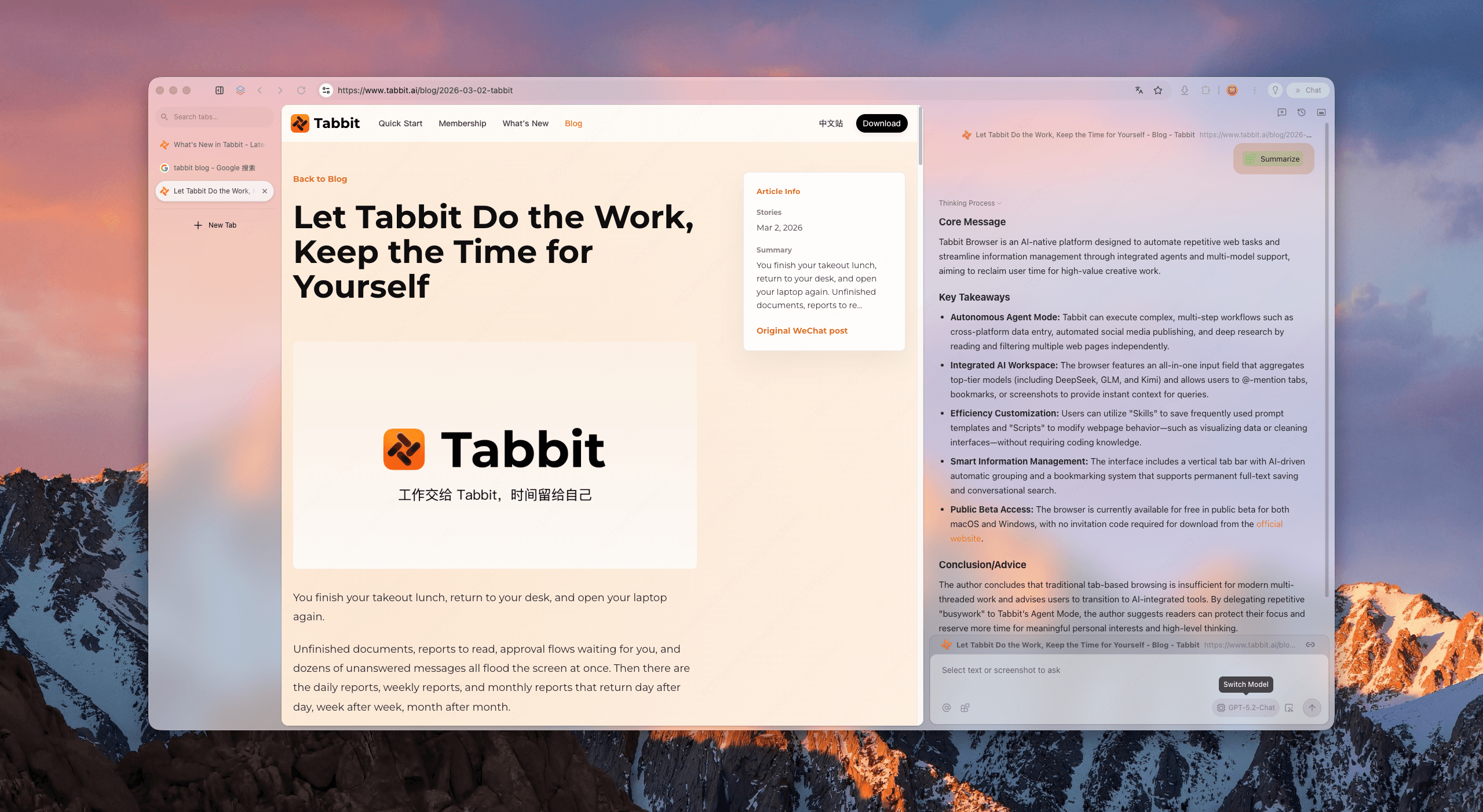
Tabbit Browser showing a transparent vertical-tab workspace and an AI summary in the right sidebar
The source stays visible while Tabbit summarizes it in the sidebar.

What Tabbit adds

Tabbit's main addition is a shared place for browser context and actions.

The input box can point at real browser context

Type @ in Tabbit's Omnibox to reference an open page, a tab group, a screenshot, bookmarks, or a local file. There is no need to paste six links into another chat and explain what each one contains. You can point to the material already arranged in the browser.

That becomes handy during follow-up questions because you do not have to rebuild the context each time.

Agent Mode can use the browser

Agent Mode can read pages, navigate, click, and fill fields. A typical task might gather details from several sources and move the result into a document or form.

The browser keeps those steps available for inspection. Review outputs before submitting a form, sending a message, making a purchase, or changing important data. Tabbit's own workflow guide says Agent Mode still has speed and stability limits. Not every website will cooperate.

Skills make a good workflow reusable

A good one-off prompt is easy to lose. Skills let you save a prompt, script, or agent process and call it again.

A product manager, for example, could save the format used to turn release notes into a summary of changes, affected users, and open questions. The useful Skills are usually the boring routines that keep coming back.

Four examples that show the difference

The differences are easier to see in actual browser work.

1. Compare a research tab group without rebuilding the prompt

Suppose you are comparing four project management tools. You have each pricing page open, two review articles, and a notes document. Safari is good at keeping those sources organized in a Tab Group. To have an AI compare them, however, you still need to move the links or excerpts into another tool and explain the criteria.

In Tabbit, put the sources in one tab group and reference the group from the Omnibox. A useful prompt is:

Compare the pages in this tab group by price, guest access,
automation, data export, and the main limitation for a 20-person team.
For every claim, name the source page. Mark anything you cannot verify.

The source boundary matters here. The prompt tells Tabbit which pages belong to the job and asks it to call out missing evidence.

If the initial pages are not enough, Agent Mode can search for official documentation and collect it in a separate task group. Review the source set and final comparison before using it.

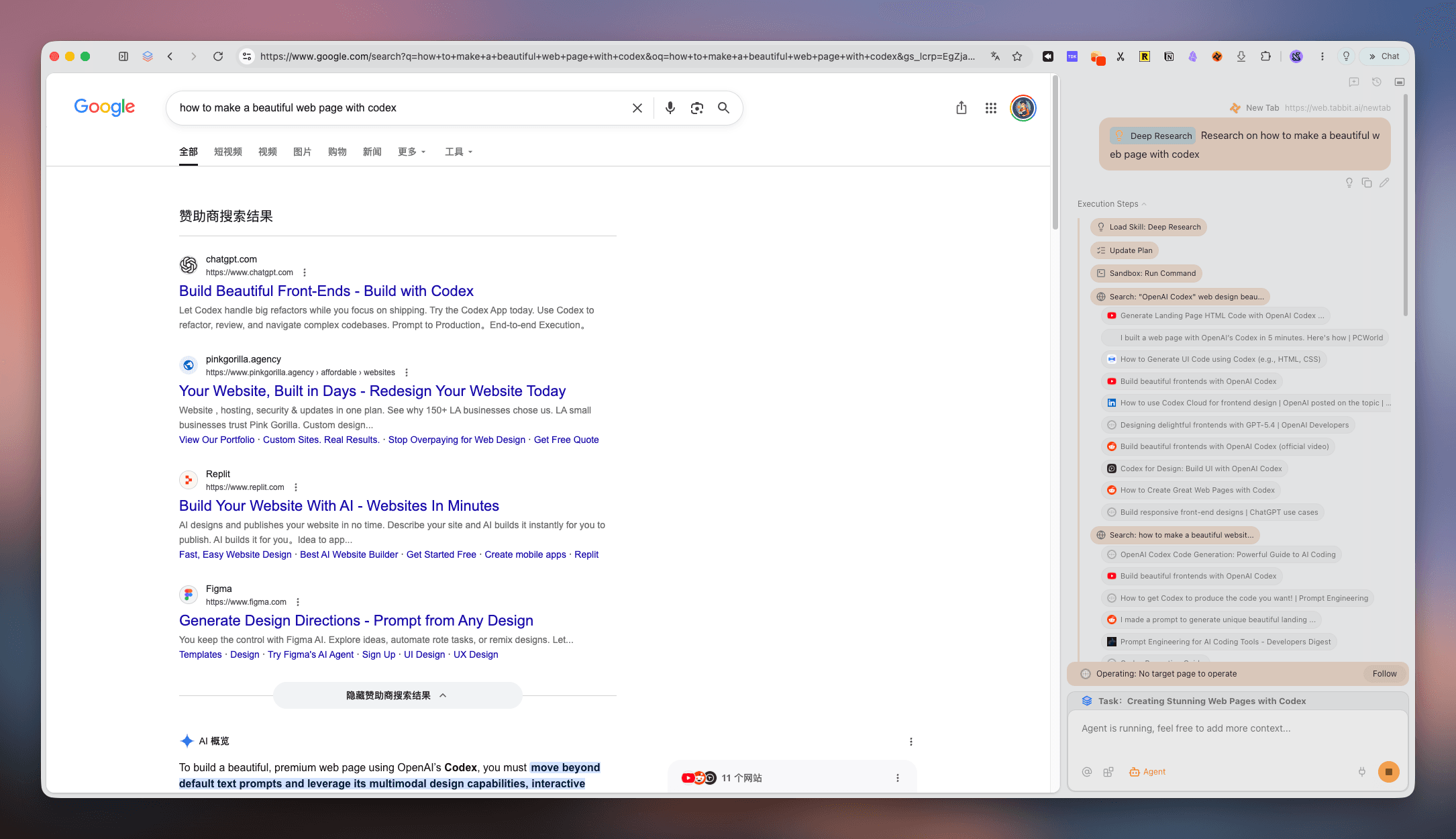
Tabbit Agent Mode conducting deep web research in the sidebar while search results remain visible
A deep research task runs beside the source pages and exposes the sequence of steps.

2. Read a long page without turning it into another tab

Safari gives the page plenty of room with Reader, and Apple Intelligence can summarize it. Tabbit adds a summary you can question. You can interrogate the argument, compare another open page, or bring in a local PDF without moving the conversation elsewhere. The source stays visible, so the summary is easier to check.

Try a prompt with a shape that forces a useful answer:

Summarize this page in five bullets.
Then list the claims that depend on data, the source cited for each claim,
and one question the page does not answer.

Generic summaries often hide uncertainty. Asking what the page does not answer gives you something concrete to check.

3. Turn web research into a structured sheet

Imagine collecting public details about a list of vendors in a spreadsheet. In Safari, you would open the sources and enter the details yourself, possibly using Apple Intelligence to summarize one page at a time. Tabbit can take on the browser steps.

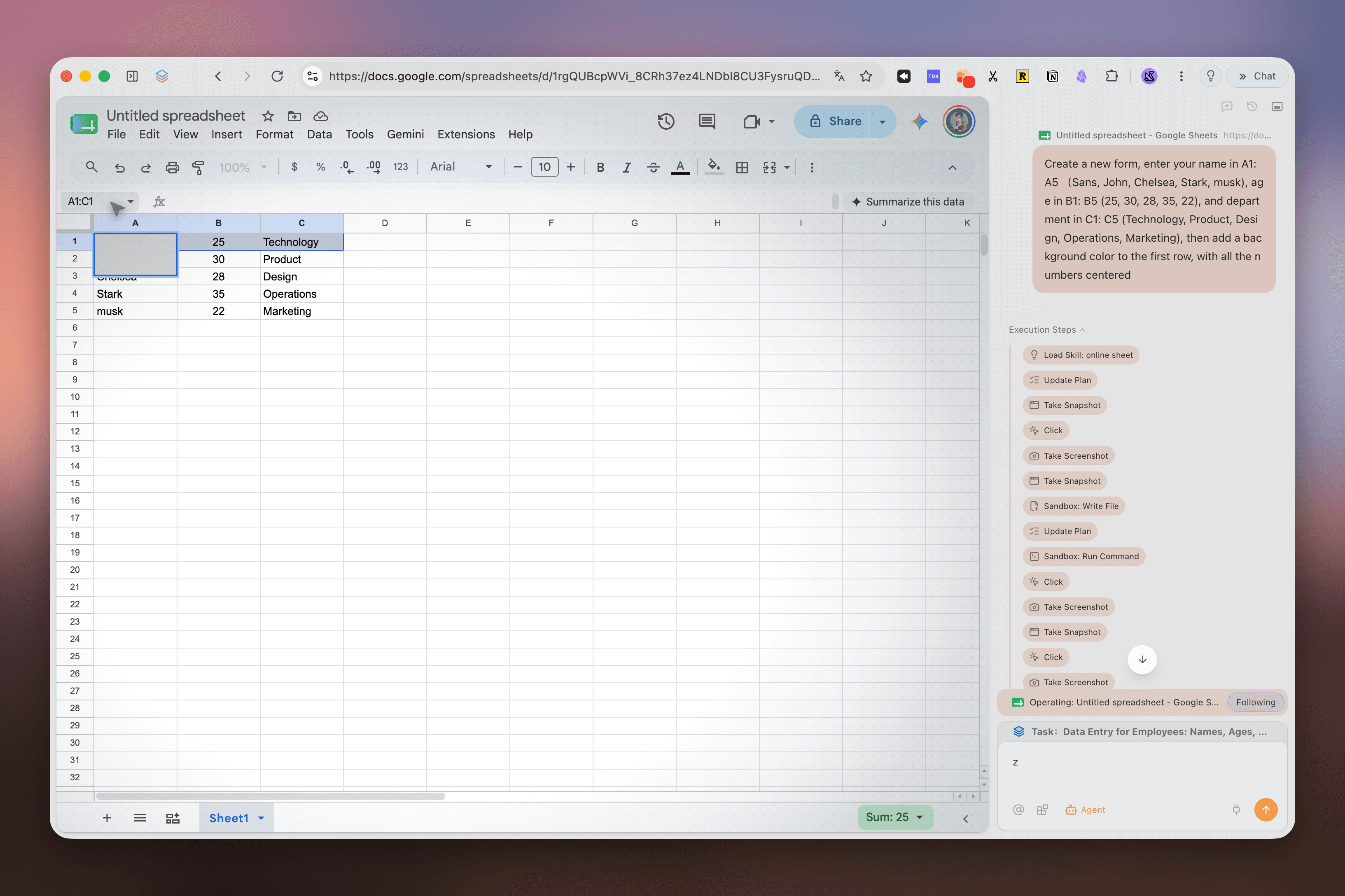
Agent Mode can handle the browser part: open the sources, find the required fields, and enter them into the sheet. The screenshot below shows a simple version of that pattern, with the task request and execution steps visible beside Google Sheets.

Tabbit Agent Mode entering structured information into Google Sheets with execution steps visible in the sidebar
Agent Mode can move from an instruction to browser actions, while the sheet and execution history remain visible.

The prompt should define both the fields and the stopping rule:

For each company in column A, use its official website to find
the pricing page, supported desktop platforms, and contact URL.
Fill columns B to D. If a value is not stated on the official site,
write "Not verified." Do not submit any contact form.
Stop after row 20 and show me the sources used.

The instruction limits Tabbit to official sources, tells it what to do when a value is missing, and stops it from submitting a form. You still need to spot-check the rows.

4. Save the routine instead of saving another prompt document

Once the vendor workflow works, turn it into a Skill. Replace fixed details with variables such as the sheet, row range, fields, and approved sources. Next time, fill in those variables instead of rebuilding the prompt.

The same pattern works for weekly competitor checks, video references, reading lists, or release notes. Save a Skill when the steps are stable and you run them often. If the job changes every time, a normal conversation is simpler.

The routine gets a name and stays out of sight until you call it again. That suits a browser trying to keep its interface minimal.

What Safari still does better

Choose Safari if your life is on Apple devices. iCloud Keychain, Handoff, iCloud Tabs, Apple Pay, and the Passwords app all work because the browser is part of the OS. Battery life on Apple silicon is a genuine advantage, and the browser needs almost no setup because it is already there.

Safari is also the easier recommendation for someone who does not want AI woven into everyday browsing. Apple Intelligence is opt-in and page-level, so it is easy to ignore. That matches a real segment of users: one widely shared Medium account of trying AI browsers and going back to Safari describes Arc as a product whose development stalled, and praises Safari for being dependable and light. There is a reasonable preference for a browser that simply stays out of the way.

What Tabbit does better

Choose Tabbit when the browser has become a work environment. It is most useful when an answer depends on several open pages, when the result must go into a sheet or form, or when the same browser routine returns every week.

Tabbit also fills the gaps Apple leaves. It runs on Windows as well as macOS, so it is not stranded in a Mac-only shop. It runs on Intel Macs, where Apple Intelligence does not. And it gives you a choice of models (GPT, Claude, Gemini, DeepSeek, Kimi, Qwen, and others), instead of a single on-device pipeline.

The transparent interface and vertical tabs make the move from Safari less jarring. The practical gain is having fewer handoffs between browsing, explaining, copying, and acting.

Choose by scenario

Your priorityBetter fitWhy
Apple ecosystem across iPhone, iPad, and MacSafariKeychain, Handoff, iCloud Tabs, and Passwords are built in
Battery life on Apple siliconSafariFirst-party engine and OS integration are hard to beat
A deliberately AI-free browsing experienceSafariApple Intelligence is opt-in and page-level
Intel Mac or older iPhoneTabbitApple Intelligence skips those devices; Tabbit runs on Intel Macs
A Mac plus Windows work environmentTabbitSafari has no Windows version
A calm browser with cross-tab AI contextTabbitTab groups, pages, screenshots, bookmarks, and files can enter one prompt
Research that continues across new sourcesTabbitAgent Mode can search and work in a separate task group
Repetitive browser data entryTabbitThe agent can navigate and fill fields with visible steps and user review
Reusing a successful workflowTabbitSkills save prompts, scripts, and agent routines
Sensitive or irreversible actionManual browsing, with either browserKeep a person at the final checkpoint
Unsure which philosophy fitsKeep both for one weekUse the same real project in each and compare the friction

How to try Tabbit without moving everything

Keep Safari installed at first. Tabbit's first launch offers to import bookmarks and history, so the move does not have to start from zero. Pick one task that usually involves too much copying between tabs and run it in Tabbit. Research is a sensible test because you can inspect the output without submitting a form.

Create a small tab group, ask Tabbit to compare the pages, and check every cited claim. Then let Agent Mode find one missing source. If the result is useful, save the process as a Skill. Only then test a workflow that writes into a document or sheet.

While you test it, check three things:

  • Did the browser understand the context you intended, or did you include too much?

  • Could you see where each important claim came from?

  • Did the agent stop where you asked it to stop?

Those answers matter more than a model leaderboard. You need to know what context the browser used, where the claims came from, and whether the agent respected the stopping point.

You can read the broader browsers with AI features guide before deciding, or open Tabbit and try one project on macOS or Windows.

Which browser should you choose?

Safari is the better choice if the Apple ecosystem, battery life, and a browser that quietly stays out of the way matter most, or if you are on hardware where Apple Intelligence is not available and you are fine without AI. Its Keychain, Handoff, iCloud Tabs, and page-level summaries are the point.

Tabbit Browser is the better fit if your search for Safari with AI is really about work that crosses several pages. It keeps the clean, quiet layout, then adds shared context, Agent Mode, and reusable Skills, on both Apple silicon and Intel Macs, and on Windows.

Stay in Safari when you want the browser to stay in the background. Try Tabbit when you want the browser to help with the task inside it.

Take the next step

Let Tabbit work alongside you.

Research across tabs, automate repetitive browser work, and keep every piece of context within reach.