TabbitBlog

Tabbit Is an AI Browser

Meet Tabbit Browser and its core features: Agent Mode, Super @ context, multi-model chat, Skills, Script Mode, and smart tab organization.

In this article
  1. Tabbit Browser at a glance
  2. The browser itself becomes the AI workspace
  3. Agent Mode: from asking to getting work done
  4. Deep Research uses the same browser context
  5. Omnibox and Super @ connect the context you already have
  6. Chat with Page helps you read without leaving the source
  7. Multi-model chat lets you compare answers in one place
  8. Skills, Tips, and Script Mode make workflows reusable
  9. Tips save the instruction you use repeatedly
  10. Skills package a complete way of working
  11. Script Mode creates small browser tools from natural language
  12. Smart tabs and bookmarks turn browsing into a knowledge system
  13. A practical Tabbit workflow from research to result
  14. Who Tabbit Browser is for
  15. Getting started: platforms, import, and plans
  16. Use an AI browser with deliberate boundaries

Tabbit is an AI browser built to make the web a working environment, not just a collection of pages. You can browse normally, but the browser also gives AI access to the context you deliberately choose—such as the current page, a group of tabs, a screenshot, a bookmark, or a local document. It can then answer beside the page, compare several sources, organize the workspace, or use Agent Mode to complete a sequence of browser actions.

The important point is not that Tabbit has a chat box. Many browsers can add one. Tabbit’s product idea is that browsing, context, reasoning, execution, and organization should belong to the same workflow. If you only want the shortest definition, see what Tabbit Browser is. Here, we will walk through the product itself and the features that make it useful.

Tabbit Browser at a glance

The clearest way to understand Tabbit is to look at what changes inside an ordinary browser task.

FeatureWhat you doWhat Tabbit doesUseful for
Chat with PageAsk about the page in front of youSummarizes, explains, translates, or answers with the page as contextReading, learning, and document review
Super @ contextMention a page, tab group, screenshot, bookmark, or fileBrings the selected material into one conversationCross-source comparison and writing
Agent ModeDescribe an outcome in natural languagePlans and carries out browser steps while showing progressResearch, extraction, form work, and reports
Multi-model chatChoose one or several AI modelsKeeps the same task context while presenting different answersComparing reasoning, tone, or approaches
Skills and TipsSave a reusable way of doing a taskRuns the same instructions again without rebuilding the promptRecurring research and personal workflows
Script ModeDescribe what you want changed or extracted on a pageGenerates and runs a script for that web taskPage cleanup, batch extraction, and UI adjustments
Smart Tab OrganizationOpen pages as usualGroups related tabs and keeps projects visible in a vertical workspaceResearch sessions and multi-project work
Bookmarks and saved pagesSave a page or selected passageMakes saved material easier to find and ask about laterPersonal knowledge management

This makes Tabbit an AI browser in a more literal sense: the AI is connected to what the browser can see and, when you choose Agent Mode, what the browser can do.

The browser itself becomes the AI workspace

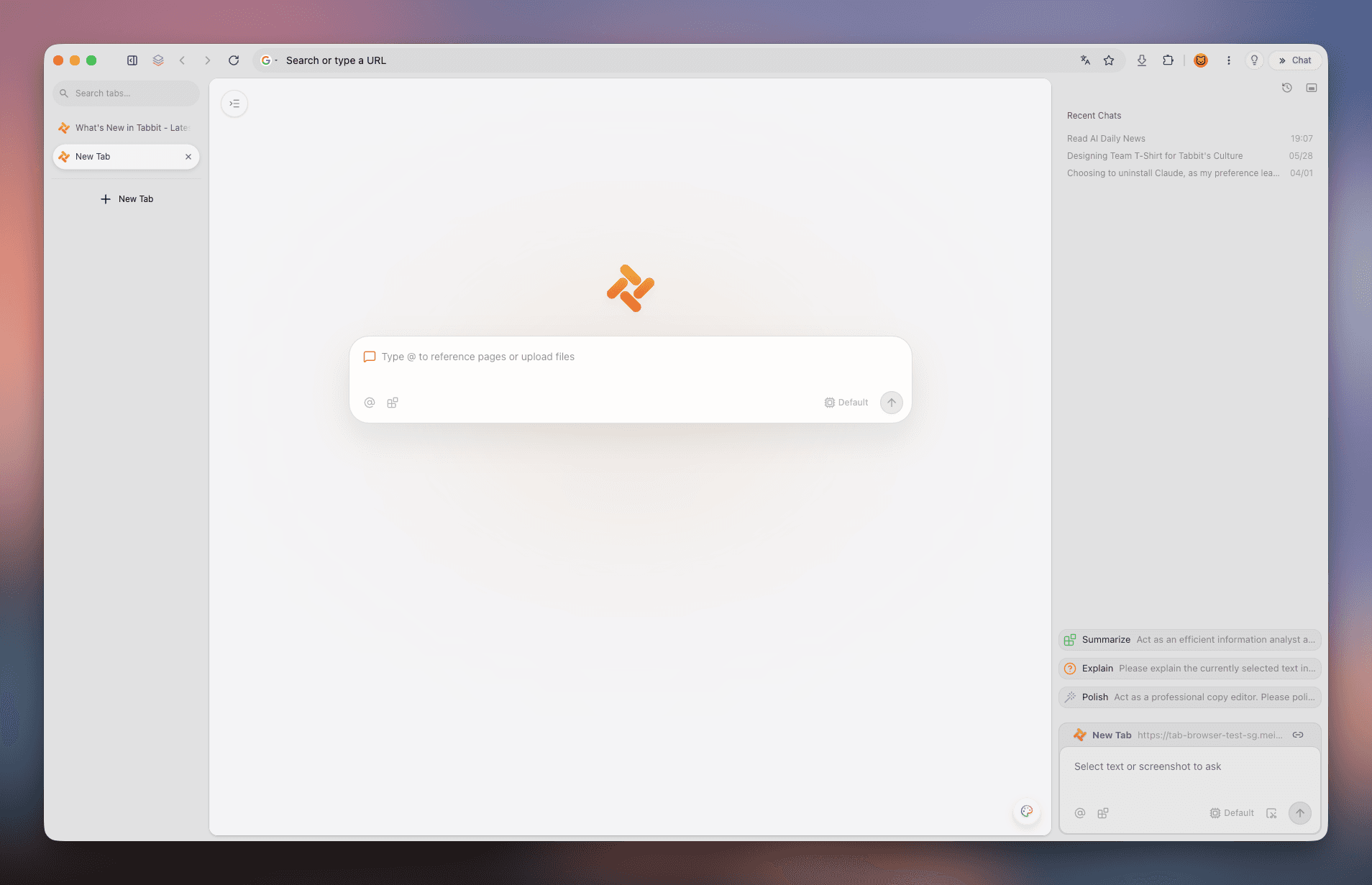
Tabbit keeps familiar browser elements—an address bar, tabs, pages, bookmarks, and extensions—but rearranges them around a persistent workspace. Vertical tabs sit on the left, the main page stays in the center, and AI chat or Agent execution can remain visible on the right. The layout matters because it lets you check the source while the AI is responding or acting.

Tabbit Browser new tab page with vertical tabs, an AI command box, and page tools in the right sidebar
Tabbit keeps tabs, the active page, and AI controls in one browser workspace.

From the new tab page, the central input can accept a URL, a normal web search, or a request for AI. This is the Omnibox: instead of deciding first whether you need search, chat, or an Agent, you can state the task and then choose the appropriate mode.

The right sidebar is equally important. It is not only a place for generic conversations. It can work with the page that is open, selected text, or a screenshot of a specific interface. That keeps the source close enough to inspect rather than hiding it behind a generated answer.

Agent Mode: from asking to getting work done

Agent Mode is Tabbit’s defining feature. A normal assistant tells you how to do something; an agentic AI browser can carry out browser steps toward the result.

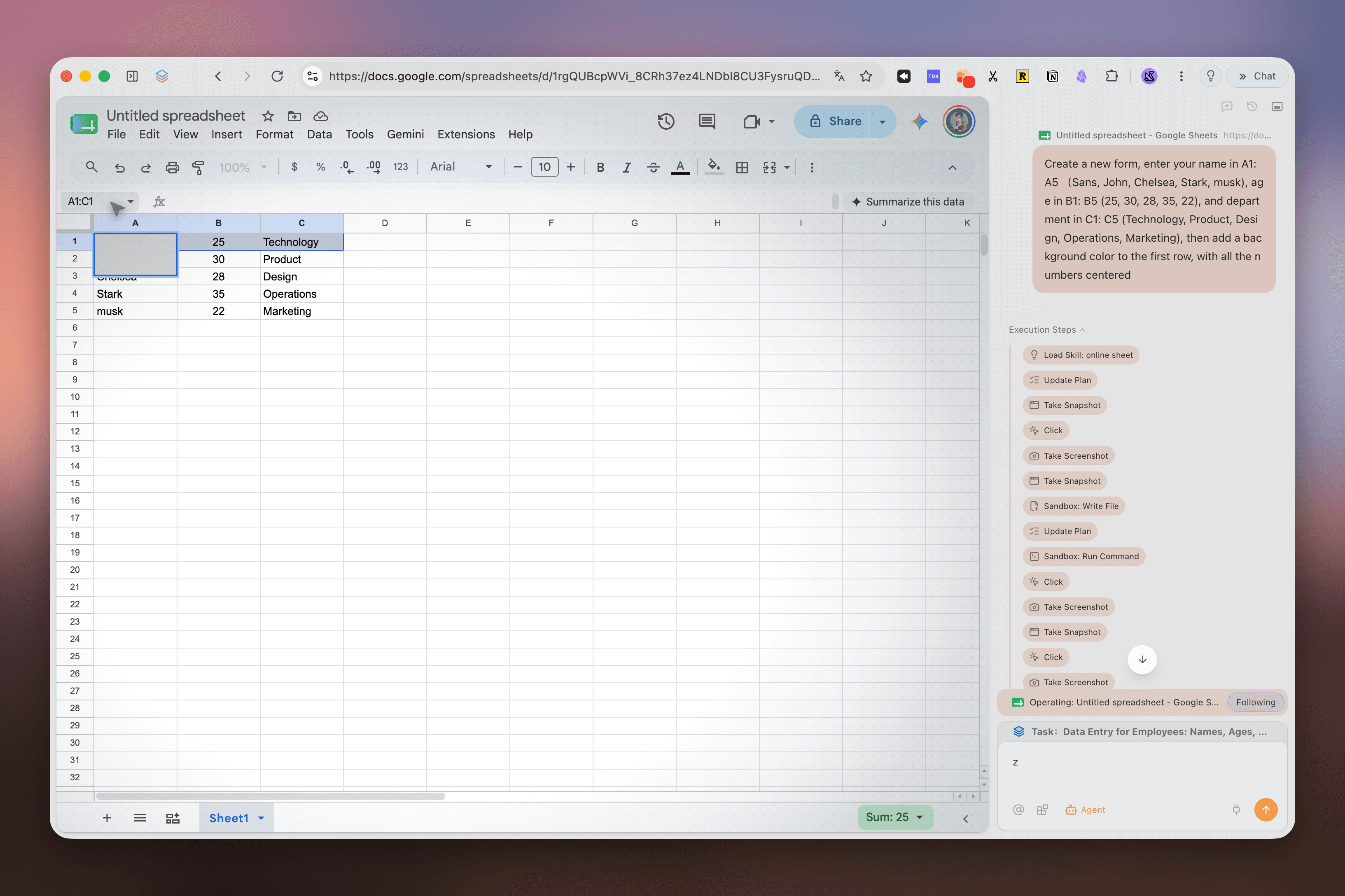
Imagine that you need to compare ten public product pages and create a spreadsheet with each plan name, price, and source URL. In Tabbit, you can describe the output, set rules such as “write Not stated when a field is missing,” and ask Agent Mode to begin. The Agent can open pages, collect the visible information, switch to a web spreadsheet, and enter the rows. Its plan and execution steps remain visible, so you can follow the work and intervene.

Tabbit Agent Mode entering structured information into Google Sheets with execution steps visible in the sidebar
Agent Mode can work in a live website while showing its instruction and execution trail.

This is browser-level automation, but the useful mental model is not “hands-free browsing.” It is “delegated work with review.” Live websites change, extracted information can be wrong, and logged-in pages may expose meaningful permissions. Start with public, reversible tasks; check a sample of the output; and keep purchases, account changes, confidential data, or other high-impact actions under direct control.

Deep Research uses the same browser context

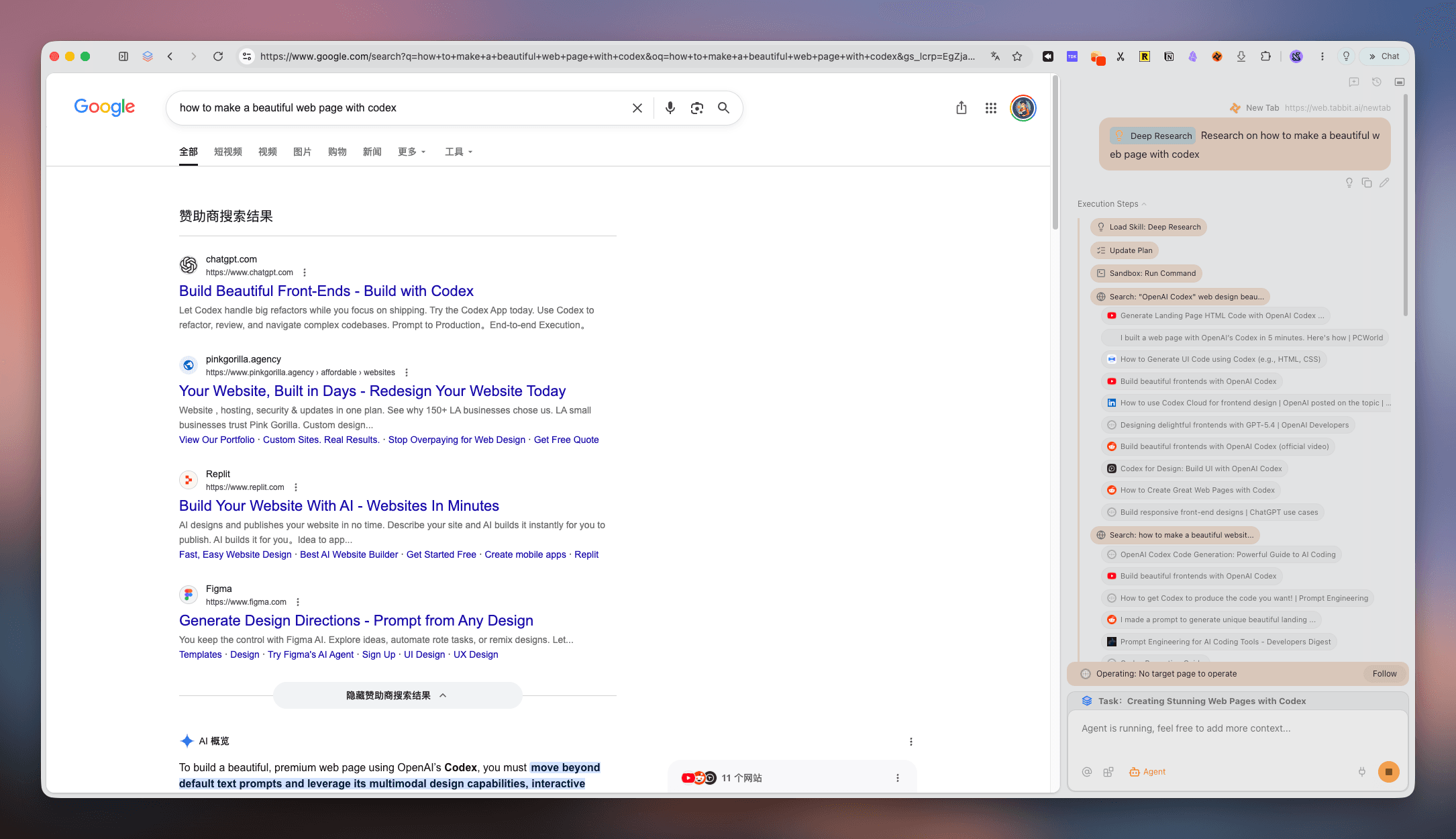
For a research question, Agent Mode can load a research workflow, search across sources, update its plan, and assemble the result. You can continue browsing in another tab group while the task runs in its own working area.

Tabbit Deep Research running beside Google search results with sources and execution steps listed in the Agent sidebar
Deep Research turns a broad question into visible searches, sources, and execution steps.

That separation is practical. The Agent can keep a long-running task together without taking over every tab you use. For serious research, however, the final answer still needs source inspection. Our guide to using an AI browser for research explains how to preserve citations and verify claims instead of treating a generated report as the source of truth.

Omnibox and Super @ connect the context you already have

Copying text from one tab to a chatbot and then explaining where it came from is tedious. Tabbit reduces that setup with @ references. Depending on the task, you can attach:

  • the current page or another open tab;

  • a complete tab group;

  • a screenshot or highlighted page element;

  • a bookmark or saved page;

  • a local PDF, spreadsheet, or other supported file.

A specific prompt is still better than a vague one. For example:

Using @launch-research and @customer-notes.pdf, make a comparison table.
Separate verified facts from suggestions and keep the source beside every claim.

The benefit is continuity. The browser already contains the materials, and you decide which ones enter the task. The boundary is equally clear: attaching more context is not automatically better. Add only what the task needs, especially when tabs or local files contain private information.

Chat with Page helps you read without leaving the source

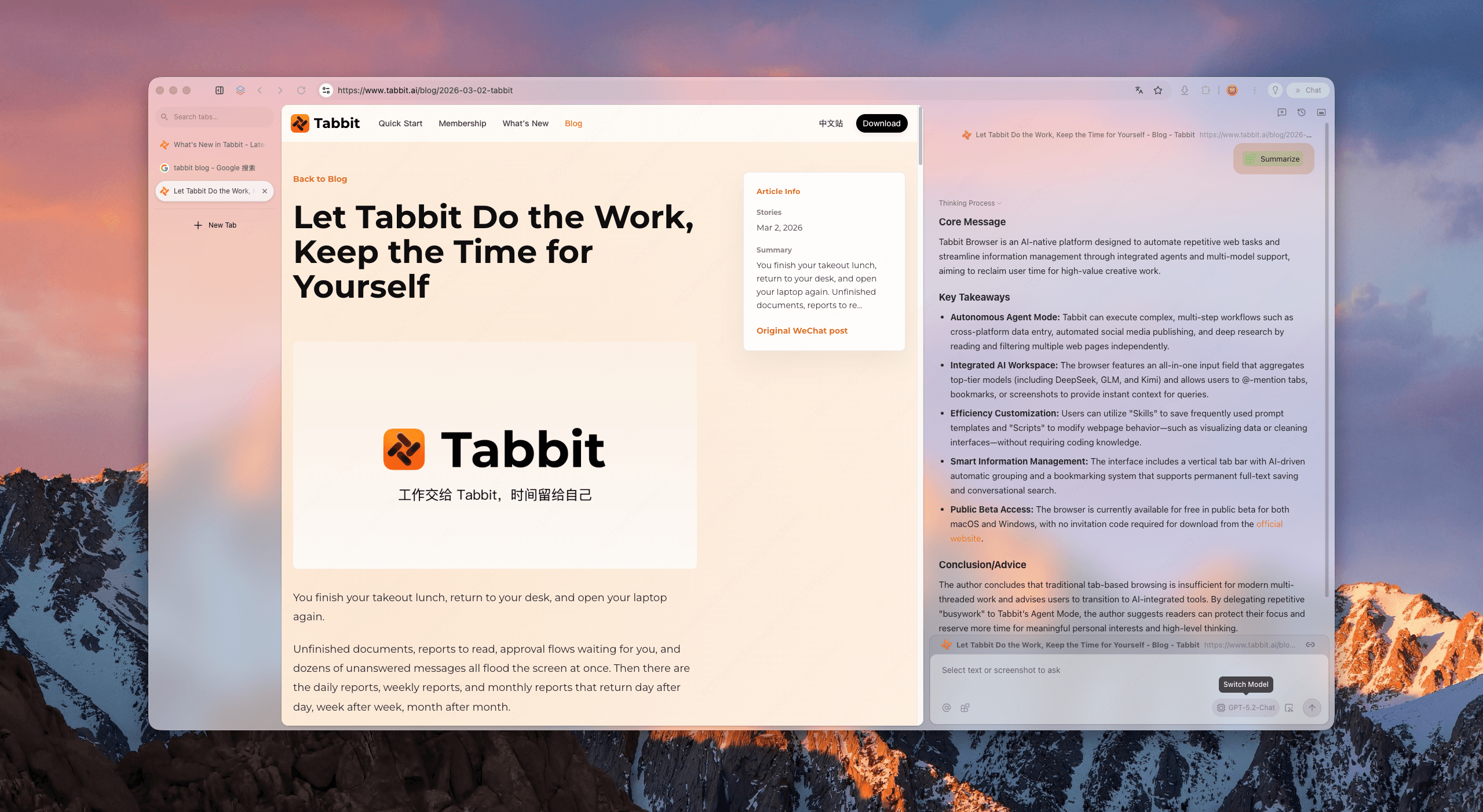
Chat with Page is the everyday mode for reading. On a long article, report, or documentation page, you can ask Tabbit to summarize the argument, explain a difficult section, translate a passage, identify open questions, or turn the content into a checklist.

Tabbit Browser displaying an article and its AI-generated summary together in the right sidebar
Chat with Page keeps the original article and the AI summary visible together.

You do not have to share the entire page every time. Selecting a paragraph or capturing a specific interface can give the AI a narrower target. This is where Tabbit feels less like a separate chatbot and more like an AI browser assistant: help appears next to the object you are working on.

Use the answer as a reading aid, not a replacement for the page. A summary can omit qualifications; an explanation can infer more than the text says. The side-by-side layout makes verification easier, but the user still has to do it.

Multi-model chat lets you compare answers in one place

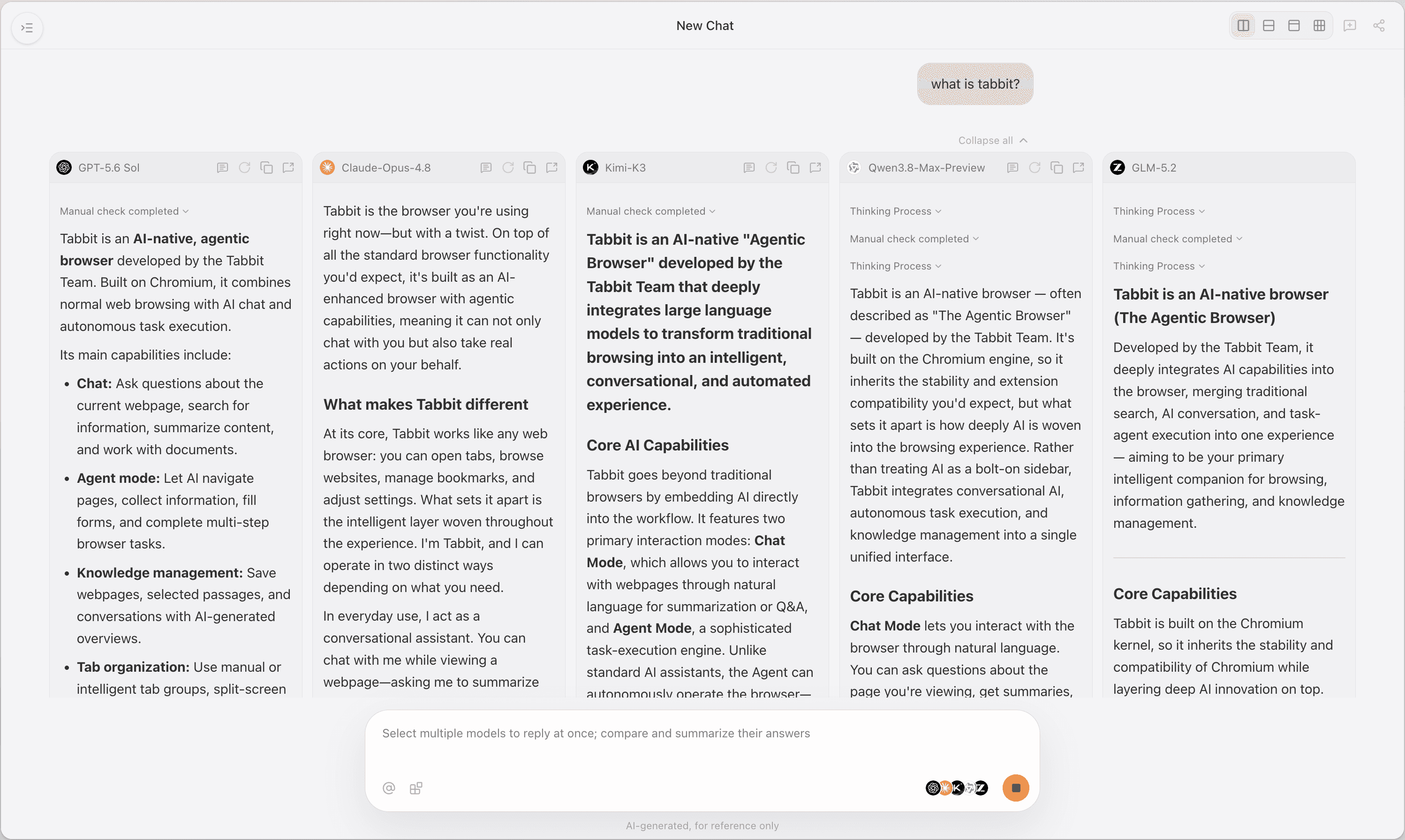
Tabbit includes access to multiple major AI model families. You can use one model for a task or ask several models to answer at the same time, then compare their reasoning, structure, or writing style without reconstructing the browser context in separate products.

Tabbit showing five AI model responses side by side for the same question
The multi-model view keeps one question and several model responses in a single comparison layout.

This is useful when the task has more than one reasonable approach: outlining an article, explaining technical material, or checking whether several models notice the same gap. It is less useful for establishing facts. Five similar answers are not five independent sources. Model names, access, and quotas also change quickly, so check the current plan inside Tabbit rather than treating any screenshot as a permanent roster.

Skills, Tips, and Script Mode make workflows reusable

Tabbit has several ways to move beyond one-off prompting.

Tips save the instruction you use repeatedly

If you often ask the same kind of question—“summarize this page for a product manager,” for example—you can save that prompt and invoke it with /. The value is consistency: the output rules do not disappear between sessions, and you spend less time recreating a good instruction.

Skills package a complete way of working

A Skill can combine instructions, tools, and an expected output. Examples include collecting material for a digest, extracting tables from papers, reviewing a long discussion, or saving content to a knowledge base. The exact catalog will evolve, but the product principle is stable: a useful workflow should be repeatable and shareable.

For an AI browser for productivity, that repeatability matters more than a spectacular demo. A good Skill has a narrow job, known inputs, a checkable result, and a rule for what to do when the page does not match expectations.

Script Mode creates small browser tools from natural language

Script Mode is for page-level jobs that are easier to express than to code. You can describe a desired change—remove distracting elements, extract all media links, restyle part of a page, or process repeated content—and let Tabbit generate and run the script.

Because a generated script changes or reads the active page, inspect the target and the result. Script Mode is well suited to temporary page cleanup and extraction; it should not be treated as an unquestioned production automation system.

Smart tabs and bookmarks turn browsing into a knowledge system

Tabbit’s vertical sidebar is designed for people who accumulate tabs faster than they close them. Smart Tab Organization can group pages by their content, while workspaces keep different projects apart. A Reddit user describing Tabbit called AI tab grouping “super cool”; a separate Dia discussion asked for exactly this kind of content-aware grouping. These are individual reactions, but they point to a familiar problem: once a research session becomes a strip of indistinguishable favicons, the information is technically open but practically lost.

AI grouping is a starting point, not permanent information architecture. Rename important groups, move misplaced pages, and close what no longer belongs. The same principle applies to bookmarks. Tabbit can save full pages or selected passages and make them available to later AI conversations, but a useful knowledge base still benefits from intentional names and project boundaries.

A practical Tabbit workflow from research to result

Here is how the features can work together on one realistic task: preparing a competitor brief.

  1. Open the relevant product pages and let Smart Tab Organization collect them into a project group.

  2. Use Chat with Page to understand unfamiliar pages and select only the passages that matter.

  3. Reference the group with @, add a local brief, and ask for a comparison structure with sources.

  4. Run Deep Research to find missing primary sources and label uncertain claims.

  5. Use Agent Mode to place the checked findings in a new spreadsheet or document.

  6. Save the final instructions as a Tip or Skill if the brief will be repeated next month.

This sequence shows why Tabbit is more than a chatbot attached to a browser. Each feature hands context to the next one. It also shows where the human remains necessary: define the result, choose the evidence, review the actions, and approve the final output.

Who Tabbit Browser is for

If your browser work looks like thisBest Tabbit featuresWhy it fitsWhat to watch
Reading long pages and documentsChat with Page, selection, screenshotsLess switching while the source stays visibleVerify summaries against the original
Research across many tabsSmart groups, Super @, Deep ResearchContext remains attached to the projectCheck citations and duplicated sources
Repetitive website operationsAgent Mode, Skills, Script ModeTurns a known process into visible stepsBegin with reversible, low-risk actions
Writing or analysis with different AI modelsMulti-model chat, local-file contextCompares approaches without repeated setupModel agreement is not factual proof
Building a personal reading archiveBookmarks, selected saves, AI searchSaved material can be reused in later workMaintain clear names and privacy boundaries
Basic browsing with little AI useStandard browser functionsTabbit still browses the web normallyIts main advantages may go unused

The strongest fit is someone whose browser already functions as a workspace: researchers, students, content teams, product and operations roles, and anyone who repeatedly moves information from websites into documents. If your main priority is a mature conventional browser with minimal AI involvement, the switching benefit may be smaller. See Tabbit vs Chrome for that specific decision.

Getting started: platforms, import, and plans

Tabbit currently lists macOS 12+ for Apple Silicon and Intel, plus Windows 10+. The official site says it can bring over history, bookmarks, extensions, and settings from Safari, Edge, or Chrome. That means you can test the browser without rebuilding every part of your setup. Use the AI browser download guide for the current installer and platform details.

The international membership page currently lists three plans:

  • Free — US$0/month: a weekly-reset usage allowance, limited Agent Mode, Skills, Super @, smart tab organization, and other core features.

  • Standard — US$0/month: unlocked by setting Tabbit as the default browser, with 10× the Free usage and broader Agent access.

  • Pro — US$30/month: a larger allowance, premium model access, more Agent use, and additional scheduled-task capacity.

Prices, quotas, models, and regional offers can change. Check the current Tabbit pricing overview and the official membership page before choosing a plan.

Use an AI browser with deliberate boundaries

An AI browser is most valuable when it can see useful context and take meaningful action. Those are also the reasons to use it deliberately. Tabbit’s terms say users can monitor Agent execution and that important actions, including logins and payments, require additional confirmation. A community post raised strong concerns about the scope of Agent permissions and the terms; that opinion is not a product fact, but it is a fair reminder to read the current policy rather than treating agentic browsing as risk-free.

Three habits cover most everyday use:

  • share the smallest amount of page or file context needed for the task;

  • keep sensitive, irreversible, or regulated work under direct human control;

  • verify the result against the source and review any action before it changes an account or submits data.

Tabbit is an AI browser because it connects the web you are viewing to AI that can understand, organize, and act on it. Its most convincing use is not a single generated answer. It is the complete path from scattered tabs and files to a checked result—without forcing you to leave the browser at every step.

FAQ

What is Tabbit Browser?

Tabbit is an AI-native desktop browser that brings web browsing, search, AI chat, task execution, and workspace organization into one product. Its AI can use the pages, tab groups, screenshots, bookmarks, and local files you choose as context.

What can Agent Mode do in Tabbit?

Agent Mode can turn a natural-language goal into browser steps, including opening pages, researching across sources, clicking controls, filling forms, extracting information, and preparing a result. Users can see its execution and should review important actions.

Can Tabbit understand the page I am viewing?

Yes. Chat with Page can summarize, explain, translate, or answer questions about the current page. You can also select text, capture an area, or use @ to add a page, tab group, bookmark, screenshot, or local file as explicit context.

Does Tabbit support multiple AI models?

Yes. Tabbit provides access to multiple major model families and can show replies from several models side by side. The exact model roster, quotas, and regional availability can change, so check the current plan page in the browser.

Is Tabbit Browser free?

Tabbit has a Free plan at US$0 per month. Its international membership page also lists a US$0 Standard plan unlocked by setting Tabbit as the default browser and a US$30 per month Pro plan. Limits and regional offers can change.

Which platforms does Tabbit support?

Tabbit currently lists macOS 12+ for Apple Silicon and Intel, plus Windows 10+. It can bring over history, bookmarks, extensions, and settings from Safari, Edge, or Chrome.

Take the next step

Let Tabbit work alongside you.

Research across tabs, automate repetitive browser work, and keep every piece of context within reach.