The best alternative to Google Chrome is Tabbit Browser if you want a familiar desktop browser that can also read across your work, organize it, and act on websites. If you are leaving Chrome only for built-in ad blocking, start with Brave. If you want to leave the Chromium engine itself, choose Firefox. If every device you own has an Apple logo, Safari remains the low-friction answer.
That conditional answer matters. Chrome is not difficult to replace because alternatives are scarce. It is difficult because your passwords, extensions, tabs, muscle memory, and mobile life may all be tied to it. One recent r/browsers poster captured the real hesitation: “I've gotten so used to Chrome that I'm not sure if switching is actually worth the hassle.”
This guide treats that hassle as part of the product decision. It gives the credible alternatives a fair hearing, then explains why Tabbit is the one I would put in front of people whose browser has quietly become their office. For a shorter conversion-focused comparison, use our browser-to-replace-Chrome decision page; this article is the deeper editorial version.

Key takeaways
There is no universal Chrome replacement. The right choice starts with the thing you actually want to change: privacy, engine independence, Apple continuity, interface control, or AI workflow depth.
Tabbit is the most interesting first install for desktop knowledge work. It can use pages, screenshots, highlights, local files, bookmarks, and tab groups as context, then move from answering to supervised action.
Switching does not have to be dramatic. Tabbit can import history, bookmarks, extensions, and settings from Chrome, so you can run both browsers while testing real work.
Chrome still wins for some people through cross-device sync, Google services, enterprise policy, and the broadest familiar extension path. Keeping it as a backup is a sensible migration tactic.
Choose Brave for default blocking, Firefox for a mainstream non-Chromium route, and Safari for Apple continuity. Pick Tabbit when the browser needs to become a working environment rather than a passive window.
Chrome alternatives at a glance
| Browser | Best for | Engine / compatibility | Biggest gain over Chrome | Main trade-off |
|---|---|---|---|---|
| Tabbit | Research, content, operations, and multi-tab AI work on desktop | Chromium-based; imports Chrome data and extensions | Context-aware AI, Skills, smart organization, and supervised web actions in one browser | No Linux or mobile app today; not a route away from Chromium |
| Firefox | People who want a mainstream non-Chromium browser | Gecko; its own add-on ecosystem | Engine independence, tracker blocking, broad desktop/mobile support | Some Chrome-only extensions and optimized web apps need alternatives |
| Brave | People who want ads and trackers blocked by default | Chromium; strong Chrome-style compatibility | Immediate privacy and page-cleanup benefits with little setup | Extra Brave services may not appeal to everyone; still Chromium |
| Safari | Mac, iPhone, and iPad users | WebKit; deep Apple integration | Battery optimization, privacy protections, Handoff, iCloud tabs and passwords | Apple-focused and a smaller extension universe than Chrome |
| Vivaldi | Power users who want to tune every surface | Chromium | Deep interface, keyboard, panel, and tab customization | Its density and settings can become a project of their own |
| Microsoft Edge | Managed Windows and Microsoft 365 work | Chromium | Windows integration, enterprise controls, Copilot, mature cross-device support | Replaces Google's ecosystem with Microsoft's rather than simplifying it |
| Chrome | Google-centric, cross-device, compatibility-first users | Chromium | Mature sync, extensions, password manager, broad site support | May not solve the privacy, focus, or workflow problem that started your search |
This is a product-shape comparison, not a speed benchmark. The facts were checked on August 4, 2026 against the official pages for Chrome, Tabbit, Firefox, Brave, and Safari. Features, plans, and platform support can change.
Start with why you are leaving Chrome
The browser market has become more specialized. A 2026 TechCrunch overview separates new challengers into AI browsers, open-source or privacy-led products, and even “mindful” browsers. That is more useful than pretending seven products are competing for one trophy.
Use this formula:
best Chrome alternative =
must-keep compatibility
+ desired workflow gain
- migration cost
- missing-platform riskThe first line—must-keep compatibility—is where listicles often become unrealistic. Chrome's official page now highlights cross-device access to bookmarks and passwords, the Chrome Web Store, automatic updates, tab groups, vertical tabs, split view, Memory Saver, Google Password Manager, and AI Mode. Those are not theoretical benefits. They are the plumbing of many people's daily lives.
So write down the reason you are leaving in one sentence. “Chrome uses too much memory” is different from “I do not want Google tied to my browsing.” “My tabs are chaos” is different from “I want AI to compare these six pages and update a sheet.” A browser that solves the wrong sentence is not an upgrade.
Our current Chrome alternatives guide uses the same priority-first approach. The important editorial point is simpler: switch for a measurable gain, not for novelty.
The credible short list
Firefox: the answer when engine independence matters
Firefox is the clearest mainstream answer to “I want something that is not Chromium.” Mozilla says it blocks trackers by default, works across desktop and mobile, offers more than 30,000 extensions, and can import bookmarks, passwords, and history. Its AI features are designed to remain optional.
That combination makes Firefox strategically important as well as practical. You are not just changing branding on a Chromium base. You are choosing another browser engine and another extension ecosystem. The cost is equally clear: a few Chrome-specific extensions will need replacements, and some workplace web apps are still tested most heavily against Chromium.
Choose Firefox when engine diversity or default privacy controls are the decision. Do not choose it expecting Tabbit-style multi-source Agent workflows; that is not its core proposition.
Brave: the fastest privacy-first test
Brave is the easiest experiment for someone who wants a familiar Chromium browser with aggressive blocking enabled from the start. Brave's official page says Shields blocks third-party ads and trackers by default, and the browser is available on Windows, macOS, Linux, Android, and iOS. It also supports importing settings from Chrome.
This is a crisp value proposition. Install it, visit the sites that annoy you, and see the difference. You do not need to design an elaborate workflow first. The trade-off is that Brave comes with its own search, rewards, wallet, VPN, and AI ecosystem. Those features are optional, but users who want a very quiet product may still spend time configuring the browser.
Safari: the practical Apple answer
Safari is difficult to beat when the real goal is “make browsing fit my Mac, iPhone, and iPad.” Apple positions it around battery optimization, Intelligent Tracking Prevention, Tab Groups, profiles, iCloud Keychain, and Handoff. Those integrations are more important than a generic benchmark when you regularly move between Apple devices.
Safari is less persuasive if your work depends on Chrome-only extensions, Windows, or heavy browser automation. It is an ecosystem choice, and a very coherent one.
Vivaldi and Edge: control or corporate fit
Vivaldi is for people who see a browser UI and immediately want to rearrange it. Panels, shortcuts, tab behavior, themes, toolbars, and commands can be shaped to a remarkable degree. That power is the benefit and the tax.
Edge is the corporate pragmatist's answer. If your organization manages browsers through Microsoft policies and your work lives in Microsoft 365, switching to an independent AI browser may create more friction than it removes. Our detailed Tabbit vs Chrome comparison covers the product-level differences; the same principle applies here—ecosystem gravity is real.
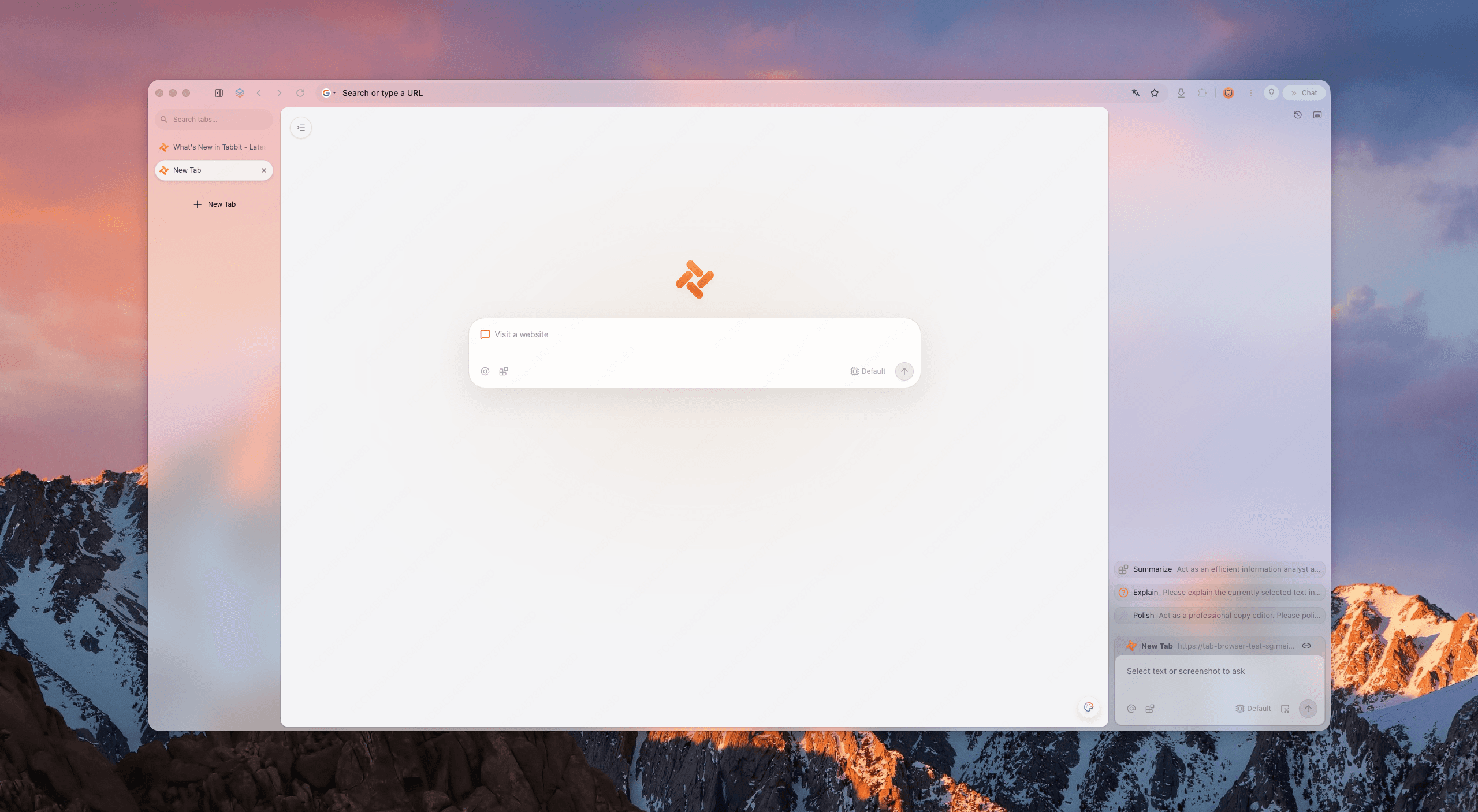
The practical Chrome alternative for AI-heavy work: Tabbit
Tabbit becomes interesting when your complaint is not simply “Chrome is bad.” It is “the browser still makes me manually shuttle context between pages, AI chats, notes, files, and forms.” That is a newer problem, and conventional browsers mostly address it with another panel.
Tabbit treats the surrounding material as part of the task. Its official product page says you can bring pages, screenshots, highlights, local files, bookmarks, and other browser context into a request. Research, Operator, Writer, and Analyst roles can use Skills suited to the job. The agent can read, plan, and run rather than stopping at a paragraph of advice.
This is the difference between an AI browser and an ordinary browser with a chatbot attached. It is also why Tabbit belongs in any serious list of browsers with AI features.
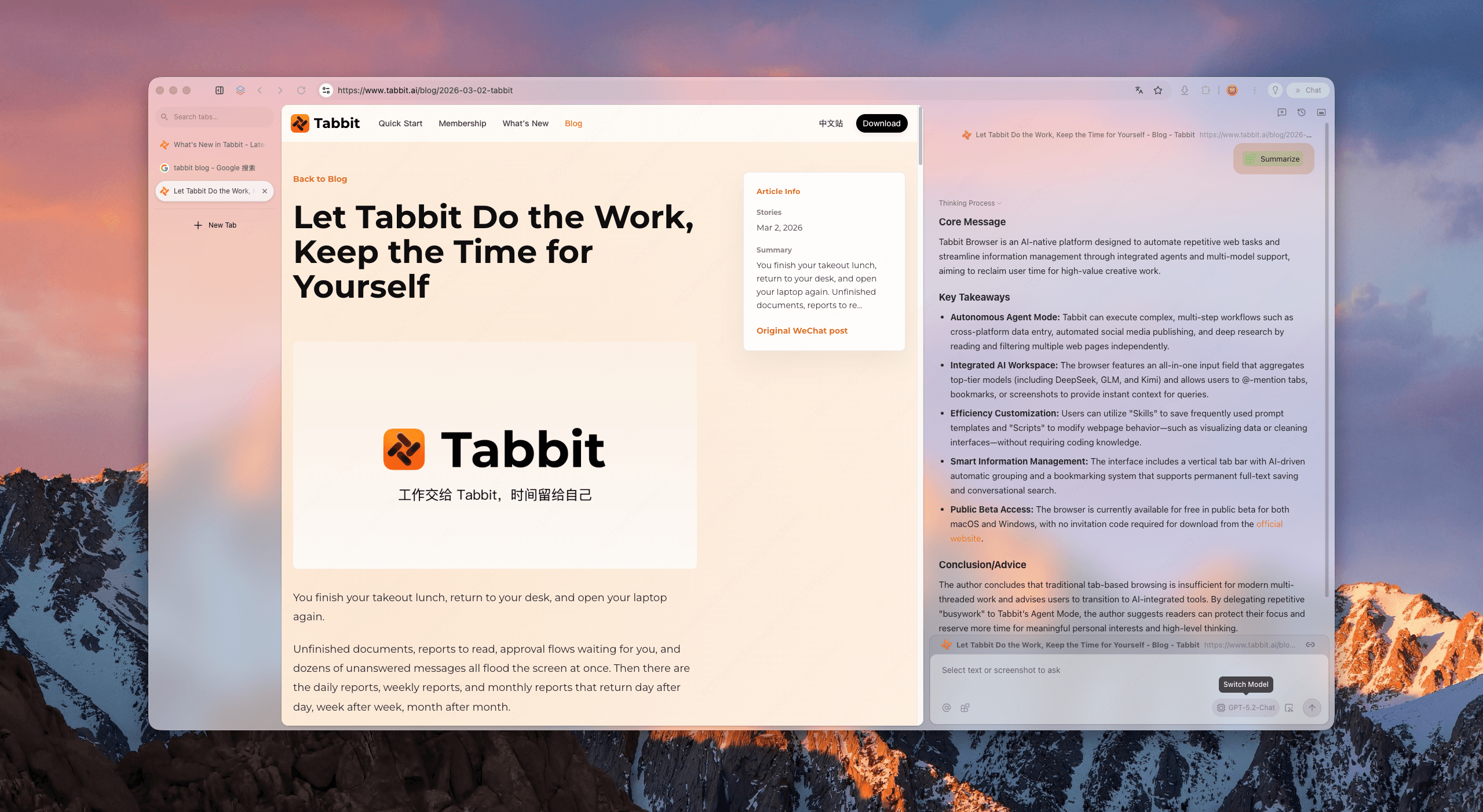
Page understanding without the copy-paste tax
The first useful feature is not dramatic. Open a long page and ask for its argument, evidence, dates, and unresolved questions. The source stays beside the answer, so checking a claim takes seconds rather than another search.

The useful part comes after the summary. Add another tab, a highlighted paragraph, a screenshot, or a local requirements file. Ask Tabbit to compare only the supplied sources, mark missing information, and keep links next to claims. You are briefing the model with objects already in the browser rather than rebuilding the project in a blank chat box.
People who regularly read reports, compare software, prepare interviews, or turn research into briefs will feel this quickly. Our browser productivity guide explains how to evaluate that gain without relying on vague “work smarter” language.
Tabs become context, not just open pages
Chrome now supports tab groups and vertical tabs, so layout alone is no longer a decisive reason to switch. Tabbit's advantage is the relationship between organization and AI. Vertical tabs keep titles readable; task-specific groups can become a context set for a question or Agent run. Smart Tab Organization helps sort the pile before it becomes a strip of anonymous favicons.
If vertical layout is the only thing you want, read our vertical tabs in Chrome guide first. You may not need another browser. If the group itself should become something AI can read and work with, Tabbit changes the equation.
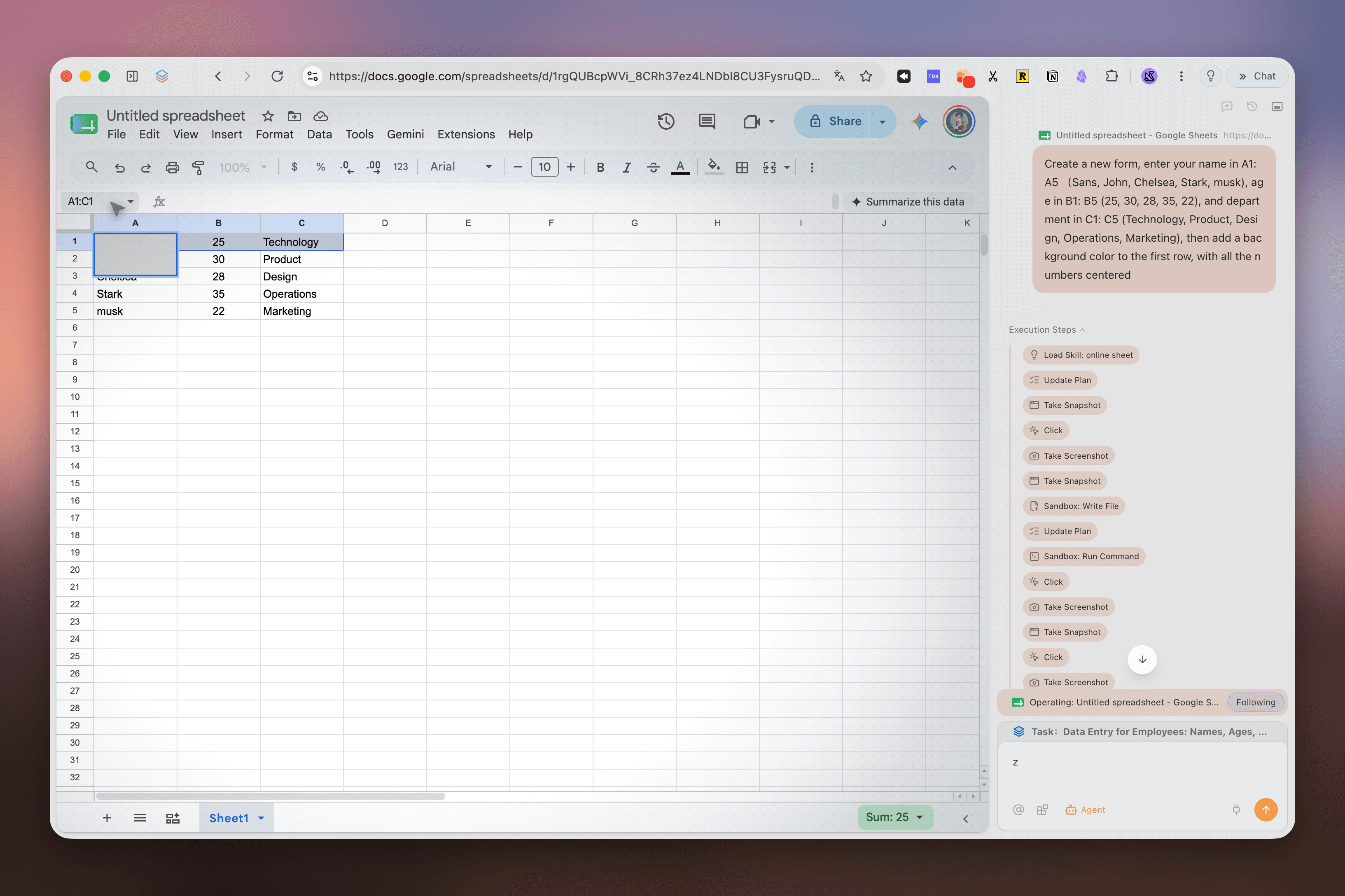
Agent Mode moves from advice to browser work
Suppose you ask a chatbot to collect event dates from six pages and put them in a spreadsheet. It can explain the steps. You still open the links, copy the fields, create the columns, and clean up the result.
Agent Mode is built for that browser-shaped gap. It can inspect a page, create a plan, click, type, take snapshots, and show the execution steps. The screenshot below shows a simple Google Sheets data-entry task, with the website on the left and the action trail on the right.

This is not permission to automate everything. Start with public information and reversible tasks. Do not let any browser agent submit a purchase, publish a post, send a message, or change consequential data without review. Read what an agentic browser is and the practical boundaries in our browser automation guide before handing it a sensitive workflow.
Skills make the successful workflow reusable
A good prompt often disappears into chat history. A Skill keeps the method: which pages to inspect, which fields to collect, which claims require sources, how to format the result, and what not to infer. The next run needs new inputs, not a reconstructed instruction manual.
For a content editor, that might mean extracting claims, dates, sources, and counterarguments from each article. For operations, it might mean reading a queue and preparing a review sheet. For product work, it could turn release notes and issue pages into a draft with a fixed structure.
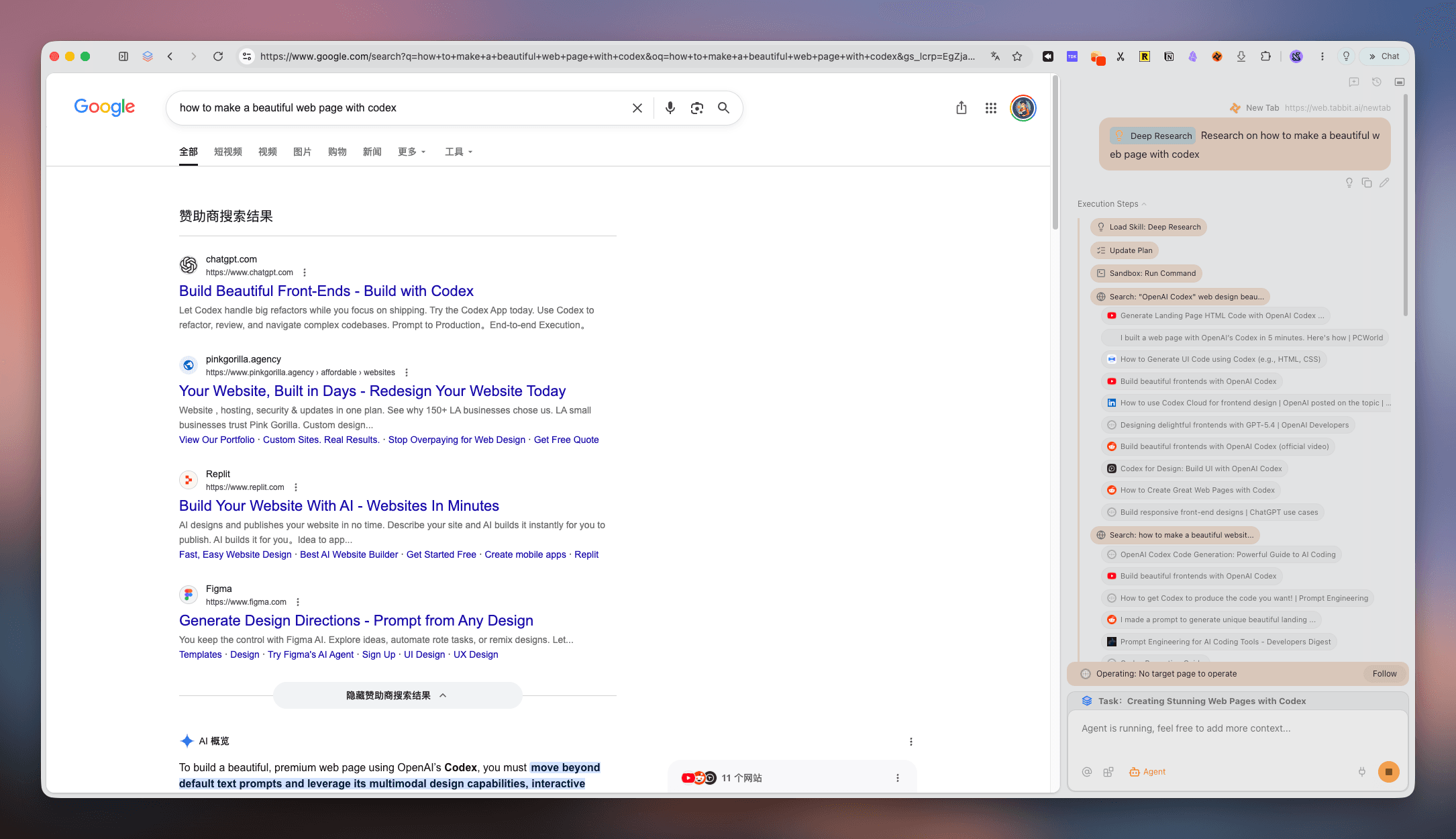
Tabbit's Deep Research view makes this approach visible: searches, sources, execution steps, and the active task sit beside the browser rather than disappearing behind a loading animation.

If all you need is an occasional summary, an AI assistant for Chrome may be enough. Tabbit earns the installation when context, repeatability, and action belong in the same workflow.
What you give up when you choose Tabbit
A useful recommendation includes the reasons not to take it.
First, Tabbit is currently a desktop product. Its official FAQ lists macOS 12+ and Windows 10+, with Linux and mobile on the roadmap. If phone-to-desktop continuity is non-negotiable, Chrome, Firefox, Brave, Safari, or Edge will fit better today.
Second, Tabbit is not a way to leave Chromium. Choose Firefox if that is the goal.
Third, AI context has a data path. Tabbit says history, bookmarks, highlights, and chats are encrypted on the device; when you use a model or cloud service, the prompt and required context go to the selected provider or partner. That is not “everything stays local.” Check your organization's rules and the current privacy terms before using confidential material.
Finally, Chrome's ecosystem can pull people back. One Reddit user who returned to Chrome wrote that they needed “stability, speed, easy integration with other Google services, and synch with other devices.” That is a preference, not a benchmark. It is still a precise warning: a replacement must pass your boring daily requirements before its novel features matter.
A one-hour migration test
Tabbit says it can import Chrome history, bookmarks, extensions, and settings in one click. Treat that as permission to test, not a reason to uninstall Chrome.
Minutes 0–10: import a copy, then trim it
Install Tabbit from the official site. Import your Chrome data, but disable extensions you have not used in the last month. Open your essential sites and confirm sign-in, password autofill, uploads, downloads, printing, video meetings, and media playback.
Minutes 10–25: summarize something you already owe attention
Open a report, long article, policy, or discussion you genuinely need to read. Ask:
Summarize this page in five points.
Separate confirmed facts from the author's judgment.
List dates, named sources, and two claims I should verify.Check three items against the page. The test is not whether the answer sounds polished. It is whether verification is easier.
Minutes 25–45: compare messy context
Open two or three product pages. Add a screenshot and a local requirements file. Ask for a decision table with source links and an explicit “unknown” value wherever the material is incomplete.
This tests Tabbit's real advantage over a standalone AI tab: can it use the browser context without making you copy everything into a new conversation?
Minutes 45–60: run one reversible Agent task
Choose public information. Ask Agent Mode to collect a small set of fields into a table. Watch the plan and action log. Stop the run if it drifts. Then inspect every row.
At the end, score four questions from 0 to 2:
less copying + easier verification + usable output + reliable executionA score of 6–8 is a reason to keep testing Tabbit. A score of 3–5 suggests a two-browser setup. A score of 0–2 means your current Chrome workflow is probably not the problem Tabbit solves.
Choose by scenario
| Your priority | Start with | Why | Keep Chrome as backup? |
|---|---|---|---|
| Research across tabs, screenshots, and local files | Tabbit | Context can move directly into summaries, comparisons, documents, and Agent tasks | Yes, during a one-week compatibility test |
| AI should navigate pages or update a web app | Tabbit | Agent Mode is designed around visible, supervised browser actions | Yes, especially for sensitive sites |
| Block ads and trackers with minimal setup | Brave | Shields is enabled by default and the Chromium transition is familiar | Optional |
| Leave Chromium itself | Firefox | Mainstream Gecko browser with desktop/mobile coverage and a large add-on ecosystem | Yes, until essential sites pass |
| Best fit across Mac, iPhone, and iPad | Safari | Apple continuity, battery optimization, iCloud credentials, and Tab Groups | Keep Chrome only for compatibility gaps |
| Maximum UI and shortcut customization | Vivaldi | Nearly every browser surface can be tuned | Optional |
| Managed Windows or Microsoft 365 work | Edge | Enterprise policy and Microsoft integration outweigh novelty | Usually no; Edge can be the managed backup |
| Google sync and Chrome extensions are the job | Chrome | The cost of leaving exceeds the current gain | Chrome remains primary |
| Occasional page summary only | Chrome + an extension | A full browser migration may be unnecessary | Chrome is the base |
| Desktop knowledge work with no desire for a hard switch | Tabbit + Chrome | Separate AI-heavy projects from compatibility-critical browsing | Yes—that is the point |
Final verdict
If you ask for one alternative to Google Chrome for modern desktop work, install Tabbit first. It preserves a familiar browser shape and a low-risk import path, then adds something more consequential than a different toolbar: pages and files can become shared context, repeated methods can become Skills, and Agent Mode can carry a task into the website itself.
That recommendation has edges. Pick Brave when blocking is the whole brief. Pick Firefox when leaving Chromium is the principle. Pick Safari when Apple continuity matters more than browser-level AI. Stay on Chrome when company policy, mobile sync, or a specialist extension leaves no room for experimentation.
Do not decide from a feature list. Give Tabbit one hour and one real project. Summarize a page you need to read, compare several sources against a local file, then supervise one reversible browser task. If the result leaves you with less copying and more verifiable work, you have found a meaningful Chrome alternative—not just a different icon.
FAQ
What is the best alternative to Google Chrome?
Tabbit is the strongest first try for desktop users who want Chrome-like familiarity plus page-aware AI, multi-source context, Skills, and supervised browser agents. Brave is a better first choice for built-in ad and tracker blocking, Firefox for leaving Chromium, and Safari for people committed to Apple devices.
Is Tabbit based on Chromium?
Yes. Tabbit uses a Chromium foundation, so switching is closer to changing your workflow than learning an unfamiliar web platform. If your goal is specifically to reduce dependence on Chromium as an engine, Firefox is the clearer alternative.
Can I move my Chrome bookmarks and extensions to Tabbit?
Tabbit says it can import history, bookmarks, extensions, and settings from Chrome in one step. Some specialized extensions or sign-in flows may still behave differently, so test the tools you rely on before making Tabbit your default browser.
Is Tabbit better than Chrome for privacy?
Do not reduce privacy to one winner label. Tabbit says browser data such as history and bookmarks is encrypted on the device, while prompts and required context go to the selected model or cloud partner; review those terms for sensitive work. Brave or Firefox may be a more direct starting point if privacy and tracker blocking are your only reasons for leaving Chrome.
What is the best non-Chromium alternative to Chrome?
Firefox is the most practical mainstream non-Chromium alternative because it is available across desktop and mobile platforms, supports a large add-on ecosystem, and imports common Chrome data. Safari is also non-Chromium, but it is primarily the right answer inside Apple's ecosystem.
Should I uninstall Chrome after switching?
No, not immediately. Keep Chrome for one or two weeks while you test work logins, banking, video meetings, extensions, password autofill, printing, uploads, and device sync in the new browser. Remove it only when the replacement passes your own essential-site checklist.