
Start with DeepSeek V4.1 Flash if you need downloadable weights or can schedule API work off peak. Test LongCat 2.5 if your workload includes visual inputs or its stronger reported coding tasks. Neither vendor's scorecard establishes a universal winner, and DeepSeek's live API now serves the 1017 update, which may not be the version in LongCat's comparison table.
That distinction matters for agents. A Reddit user reported repeated loops while asking the earlier LongCat 2.5 Preview to analyze five C# classes. This is one complex task on a preview, not a result for the released model. It is a useful reason to measure completion, retries and cost on your own work. Tabbit Browser can help organize the source pages and compare answers; model availability must be checked in the live selector.
Prices and product details below were checked on November 3, 2026. Provider prices, model aliases and limits can change.
Key takeaways
LongCat's limited-time API rates equal DeepSeek's peak rates. DeepSeek's off-peak token rates are half as much.
LongCat's own table shows DeepSeek ahead on DeepSWE v1.1 and Terminal Bench v2.1, while LongCat leads on Program Bench and Terminal Bench v4.0. Those figures have different sources and may use different setups.
Both APIs advertise roughly 1M context. LongCat currently documents a 256K output parameter limit; DeepSeek lists a 384K maximum. Total input plus output still matters.
DeepSeek links to downloadable weights. LongCat's 2.5 launch page labels its GitHub and Hugging Face releases as coming soon.
For a purchase decision, run the same representative tasks with pinned model versions, tools and stopping rules. Track successful outcomes and actual bills, not token prices alone.
LongCat 2.5 vs DeepSeek V4.1 Flash at a glance
| Decision factor | LongCat 2.5 | DeepSeek V4.1 Flash |
|---|---|---|
| Provider | Meituan LongCat | DeepSeek |
| Architecture | 1.6T total, about 48B active per token | 552B MoE backbone, 8B active for input and 16B for output |
| Official API context | 1,048,576 tokens, input plus output | 1M tokens |
| Maximum output | max_tokens limit 262,144 | 384K |
| Visual inputs | Image and video documented | Vision documented; check the API for the input type you need |
| Weights | GitHub and Hugging Face marked coming soon on launch page | Downloadable weights linked by DeepSeek |
| Official API price | Limited-time $0.30 / $0.006 / $1.20 | Peak $0.30 / $0.006 / $1.20; off peak $0.15 / $0.003 / $0.60 |
Prices are USD per million uncached input, cached input and output tokens, respectively. The LongCat launch, model parameters, LongCat price page, DeepSeek release and DeepSeek price page supply the figures. Some third-party pages say LongCat's output limit is 128K; its current parameter reference says 262,144. Confirm the endpoint's current limit before building around it.
Parameter counts are architectural descriptions, not a quality or speed ranking. Different routing and input/output designs make a simple 1.6T-versus-552B comparison incomplete. For background on each family, see our DeepSeek V4.1 Flash overview and LongCat 2.0 guide.
API cost: equal at peak, half price off peak
DeepSeek's peak window is 01:00–04:00 and 06:00–10:00 UTC on weekdays, excluding Chinese public holidays. The remaining hours are off peak. LongCat describes its listed rate as a limited-time discount without specifying an end date. These are direct vendor rates, not necessarily the price charged by another provider.
For one task using 300,000 uncached input tokens, 200,000 cached input tokens and 100,000 output tokens:
LongCat 2.5 = 0.3 × $0.30 + 0.2 × $0.006 + 0.1 × $1.20 = $0.2112
DeepSeek peak = $0.2112
DeepSeek off peak = 0.3 × $0.15 + 0.2 × $0.003 + 0.1 × $0.60 = $0.1056
That is a price calculation for the same token counts, not a promise that the models use the same number of tokens or succeed equally often. At 1,000 such tasks, the totals are $211.20 and $105.60 respectively, before other charges. DeepSeek also lists separate Search and Fetch fees. Retries, reasoning tokens, cache behavior and provider markups can change the outcome. Our older DeepSeek V4 Flash pricing guide covers a different generation, so use the current official rate card for this decision.
Coding benchmarks: the winner changes with the test
The following numbers come from LongCat's launch table. They are vendor-reported comparisons, not a new Tabbit test.
| Benchmark | LongCat 2.5 | DeepSeek V4.1 Flash | Reported lead |
|---|---|---|---|
| Terminal Bench v2.1 | 88.4 | 90.6 | DeepSeek +2.2 points |
| Terminal Bench v4.0 | 38.5 | 31.2 | LongCat +7.3 points |
| Program Bench | 25.5 | 20.3 | LongCat +5.2 points |
| DeepSWE v1.1 | 64.6 | 74.2 | DeepSeek +9.6 points |
| BrowseComp | 91.9 | 91.5 | LongCat +0.4 points |
LongCat says starred competitor scores come from public reports, blogs or official leaderboards; unstarred competitor results are its own tests. LongCat reports thinking enabled for its results and documents harnesses for individual tests. That does not establish identical harnesses, budgets or model snapshots for both columns. In particular, the table does not label its DeepSeek entry 1017, while DeepSeek's current API page names deepseek-flash as V4.1-Flash-1017. Do not assume those are the same build.
Treat the larger differences as reasons to investigate a task type, not as guaranteed improvements on your repository. The 0.4-point BrowseComp difference is too small to turn into a practical winner without uncertainty and comparable test conditions. Agent quality also depends on the harness, tools and recovery from errors. Our guide to agentic reasoning and deep research explains why the model is only one part of that system.
Images, context and deployment
LongCat describes 2.5 as a native multimodal model and documents visual inputs. This makes screenshot-based UI work or video analysis reasonable candidates for a trial. DeepSeek also advertises native vision; verify the input formats and video support for the endpoint you intend to use instead of assuming every provider exposes the same features.
A 1M-token window is a capacity limit, not a guarantee that a model will accurately use a million tokens. Large inputs can increase latency and cost. Test retrieval of a fact near the beginning, middle and end of your own material, and keep room for output inside the total window.
If self-hosting is required, DeepSeek publishes V4.1 Flash weights. LongCat's launch page currently marks its 2.5 repositories as forthcoming. Check the actual license, hardware requirements and inference stack before committing to either deployment. A downloadable model can still require substantial infrastructure.
What preview users reported
Community reports provide useful test ideas, but they are not measurements of the November release. The C# report above describes a repeated loop in a complex task. In a separate Terminal Bench preview test, u/wwdennis5 reported three runs and fewer exceptions and timeouts for LongCat 2.5 Preview in that comparison. The author also noted a local task failure and tests conducted on different dates.
Another user testing a JavaScript-to-Swift port reported loops but said an interruption could get the preview moving again. The practical test is straightforward: set a retry limit, log repeated tool calls and check whether the final code passes your tests. Do not infer that the released model has the same failure rate as its preview.
Compare the evidence in Tabbit Browser
When documentation and scores change, keep the vendor release notes, API price pages and your evaluation notes together. In Tabbit Browser, open those pages, use Chat with Page to extract each source's version and date, then verify the extracted facts against the originals. The Tabbit workflow guide describes the browser's page-context tools.
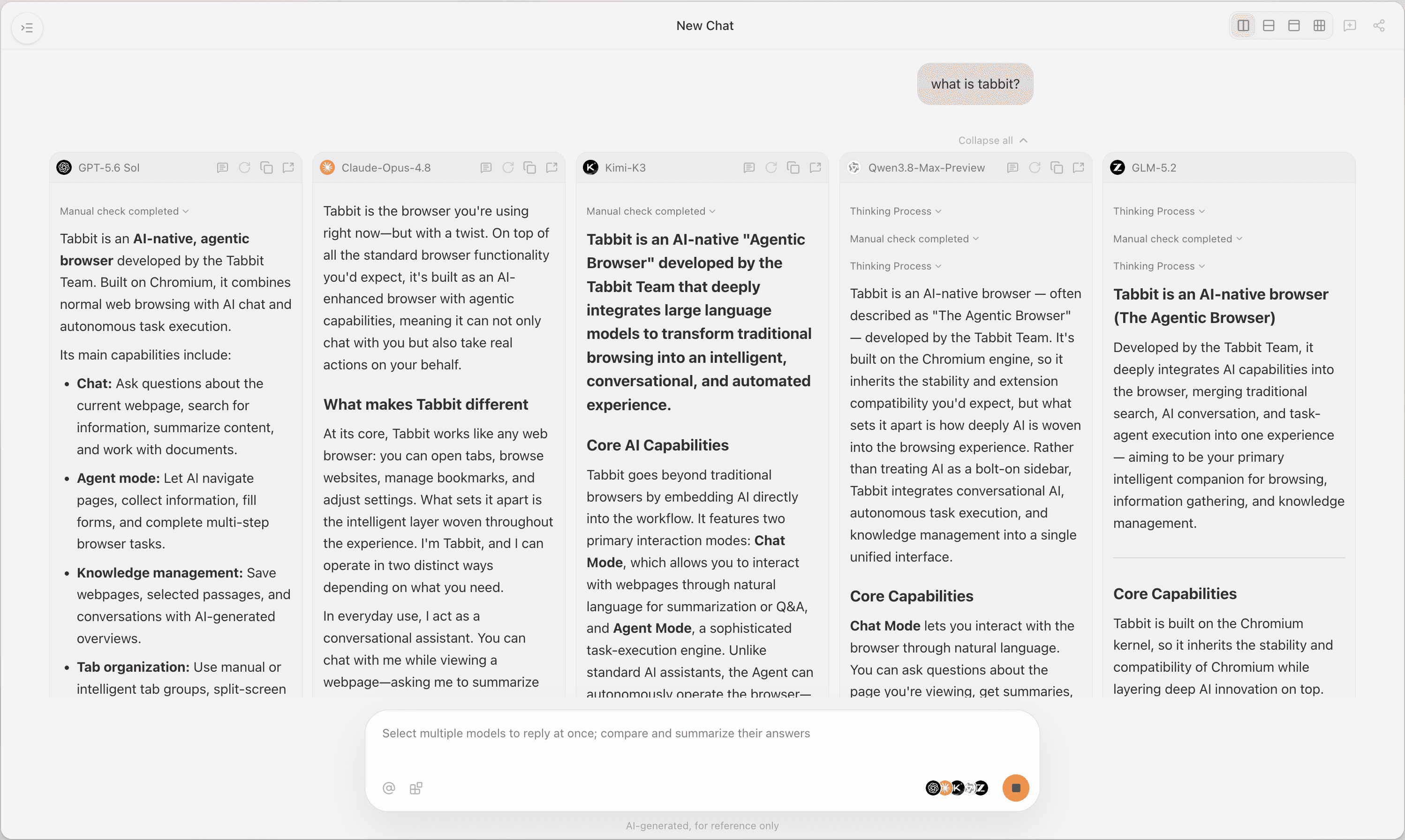
The image below shows Tabbit comparing answers from other models. It does not establish that LongCat 2.5 or DeepSeek V4.1 Flash is available in every Tabbit account. Check the model selector for your region and account. If either model is absent, run the evaluation through its own API and bring the results back into your notes.
For a broader look at browser-based agents, read what an agentic browser does and the AI browser comparison. Comparing answers helps identify disagreements; it does not replace a controlled benchmark or a review of generated code.
Which should you choose?
| Your priority | Starting point | What to verify |
|---|---|---|
| Lowest direct API price for schedulable work | DeepSeek off peak | Peak window, total tokens and separate tool charges |
| Downloadable weights now | DeepSeek | License, hardware and serving costs |
| Visual or video-heavy agent tasks | Trial LongCat | Input formats, token use, accuracy and provider limits |
| Repository coding | Test both | Same tasks, harness, model snapshots, retry budget and tests |
| Long documents | Test both | Recall at several positions, latency and output budget |
DeepSeek is the stronger first baseline when off-peak pricing or downloadable weights decide the purchase. LongCat is worth a direct trial where its multimodal workflow or specific reported benchmark fits the task. For both, use a held-out set of real work and calculate cost per accepted result, including retries and human review. Our model comparison example shows how workload-specific choices can differ from a single headline score.

FAQ
Which model costs less through its official API?
As checked on November 3, 2026, LongCat's promotional token rates match DeepSeek's peak rates. DeepSeek charges half those rates off peak, but the total bill also depends on tokens, cache hits and any separate tool fees.
Is LongCat 2.5 better than DeepSeek V4.1 Flash for coding?
LongCat's published table shows wins for each model on different coding tests. The sources and configurations differ, so test the exact versions and tools on your own tasks before choosing.
How much context and output do the APIs allow?
LongCat documents a 1,048,576-token total context and a 262,144 max_tokens limit. DeepSeek lists a 1M context and a 384K maximum output; the input and output must still fit within the overall context.
Can I download both models' weights?
DeepSeek links to downloadable V4.1 Flash weights. LongCat's 2.5 launch page says its GitHub and Hugging Face releases are coming soon, so check the current release and license before planning a deployment.
Do both models accept images and video?
Both vendors describe visual understanding. LongCat documents image and video inputs for 2.5, while supported formats and limits differ by API and provider; verify DeepSeek's current documentation for your particular video workflow.
Can I use both models in Tabbit Browser?
Availability depends on the current Tabbit model selector, account and region. Check the selector before planning a comparison; the screenshot in this article illustrates other models.