Your best second browser is not the browser that finished second in a ranking. It is the browser with the clearest job beside the one you already trust.
That is why Tabbit Browser makes sense as a second browser before it becomes a default browser. Keep Chrome, Edge, or Safari for routine logins, mobile sync, and the sites that already work. Open Tabbit when a task needs several sources, page context, careful comparison, or browser action.
A user in r/browsers described a separate browser as “a more customised session.” That is the useful mental model. This article turns it into a practical two-browser system and uses Tabbit as the full case study. If you want the shorter product overview first, see the Your Second Browser guide.
Key takeaways
A second browser works when it has a defined job. “Backup browser” is too vague to change a workflow.
A second profile is enough for account separation. A second browser is justified when you also need different tools, habits, or safeguards.
Tabbit is a strong second-browser fit for AI research, page understanding, context across sources, and supervised Agent tasks.
You do not need an all-or-nothing migration. A seven-day project test reveals more than a feature checklist.
Tabbit is not the right second browser for leaving Chromium, Linux or mobile continuity, or unsupervised high-risk actions.
Second-browser options at a glance
| Setup | Problem it solves | Keep your main browser? | AI context across sources | Browser actions | Main trade-off |
|---|---|---|---|---|---|
| Second profile in Chrome | Separate accounts, history, passwords, and bookmarks | Yes | Same as Chrome | Same as Chrome | Different identity, not different capability |
| Another general browser | Compatibility checks, privacy preferences, or one special feature | Yes | Depends on product | Usually manual | Another app to maintain |
| Agent-only browser | Give a coding or desktop Agent a logged-in browser | Yes | Agent-oriented | Strong focus | Often built for the Agent more than the human |
| Tabbit as a second browser | Research, understand, compare, and act in one workspace | Yes | Pages, screenshots, highlights, bookmarks, and local files | Supervised Agent Mode | Desktop-only today; Agent work needs review |
The table is about product shape, not benchmark scores. BrowserOS neo calls itself a second browser for agents. ChakraBrowser frames itself as a second browser for builders. Tabbit occupies a broader middle: a human can browse and think in it, then hand a bounded task to an Agent.
Why a second browser is useful again
People have used multiple browsers for years. The old reasons still hold: work and personal separation, a browser-specific feature, testing a broken site, or keeping a particular extension away from everyday browsing. A 2022 How-To Geek guide covered that familiar case well.
AI adds a new reason. The expensive part of web work is often no longer opening a page. It is moving context between pages, chat windows, notes, screenshots, local files, and the website where the final action happens.
A conventional browser is excellent at displaying those objects. An AI browser can treat them as related context. An agentic browser can go further and perform browser actions. That difference gives a second browser a real job instead of making it an emergency spare.
The best arrangement is asymmetric:
main browser = continuity + compatibility + routine
second browser = a distinct capability + focused projectsThe two apps should not compete for every click. They should reduce each other's weaknesses.
When a second profile is already enough
Do not install another browser just to create complexity. Google says Chrome profiles can keep bookmarks, history, passwords, settings, and work or personal accounts separate. If your entire requirement is “stop opening the client document from my personal Google account,” a profile may solve it.
That matches community behavior. One r/browsers participant kept a school Google account in Chrome so it would not interfere with the main account. The motive was identity separation, not a new browser workflow.
Use a second profile when:
the browser itself already does everything you need;
you only need separate sign-ins, extensions, bookmarks, or history;
one update cycle and one policy surface are preferable;
you switch contexts briefly and frequently.
Use a second browser when the work needs a different interaction model. A vertical tab layout alone may not be enough—our vertical tabs guide helps you test that smaller change first. Likewise, occasional summaries may be covered by an AI assistant for Chrome. Install a whole second browser when the context, tools, and actions belong together.
Give each browser a job
The assignment should be visible enough that you do not pause to decide where a link belongs. A business-focused YouTube creator makes the simple case that using more than one browser is useful when handling personal and client work. The principle generalizes: route by task, not by mood.
| Task | Main browser | Tabbit | Why | Review requirement |
|---|---|---|---|---|
| Personal email, banking, streaming | Default | Avoid by default | Preserve familiar logins and low-friction routine | Normal account security |
| Open one known site and read briefly | Default | Optional | AI context adds little | None beyond normal browsing |
| Compare five product pages with a brief | Keep source-of-truth accounts available | Primary workspace | Pages and local criteria can stay in one context | Check quotes, dates, and missing fields |
| Summarize a long report | Optional | Primary workspace | Original page remains visible beside the answer | Verify claims against the source |
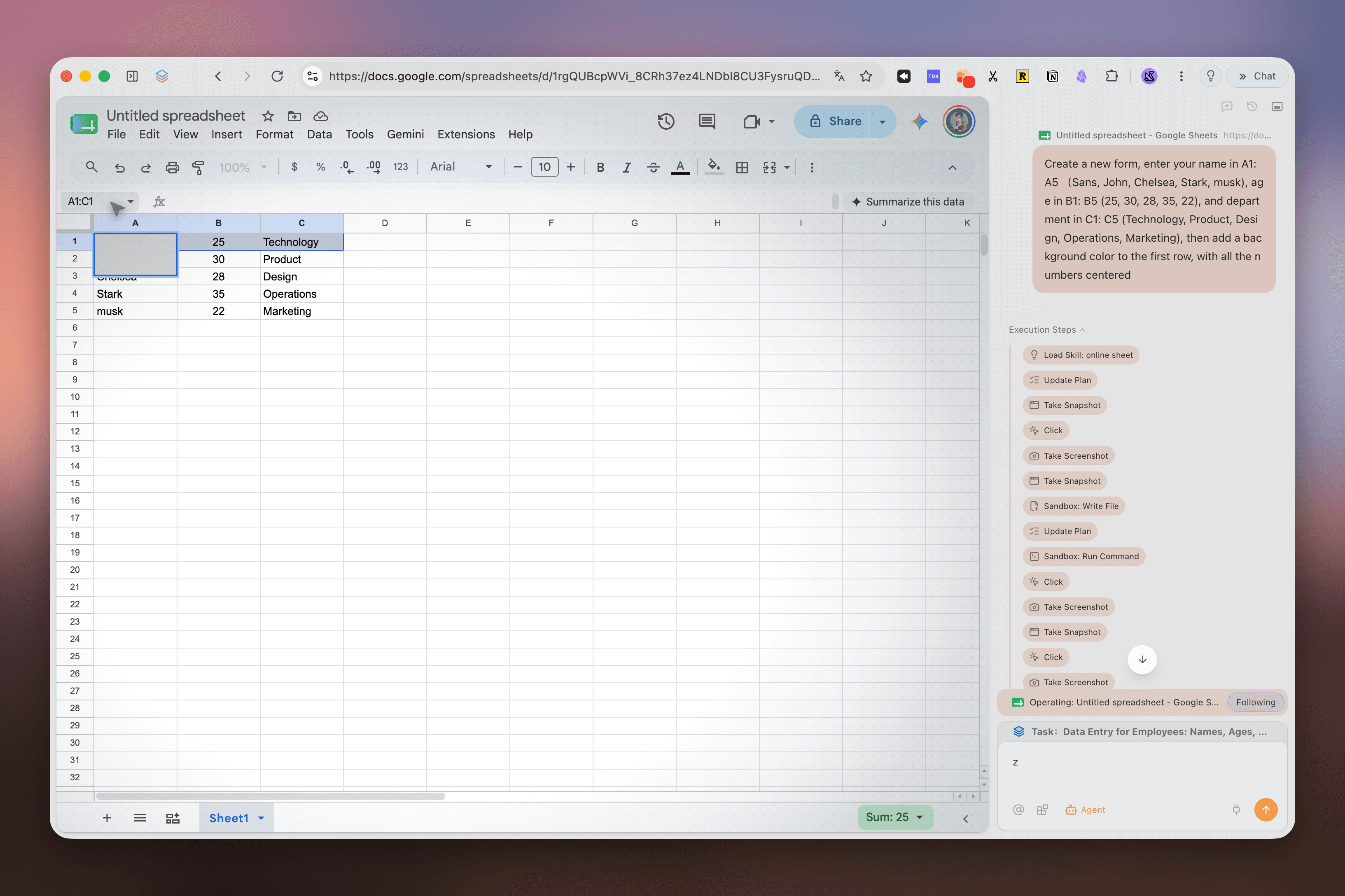
| Collect public fields into a sheet | Keep a fallback window | Agent task | Repetitive navigation can be delegated | Review every row before reuse |
| Purchase, publish, delete, or message | Primary and human-controlled | Draft or assist only | Consequences are hard to reverse | Explicit final approval |
This is also the more honest way to evaluate browser productivity. Count fewer context transfers, easier verification, and usable outputs. Do not count the number of AI buttons.
Putting the two-browser workflow into practice with Tabbit
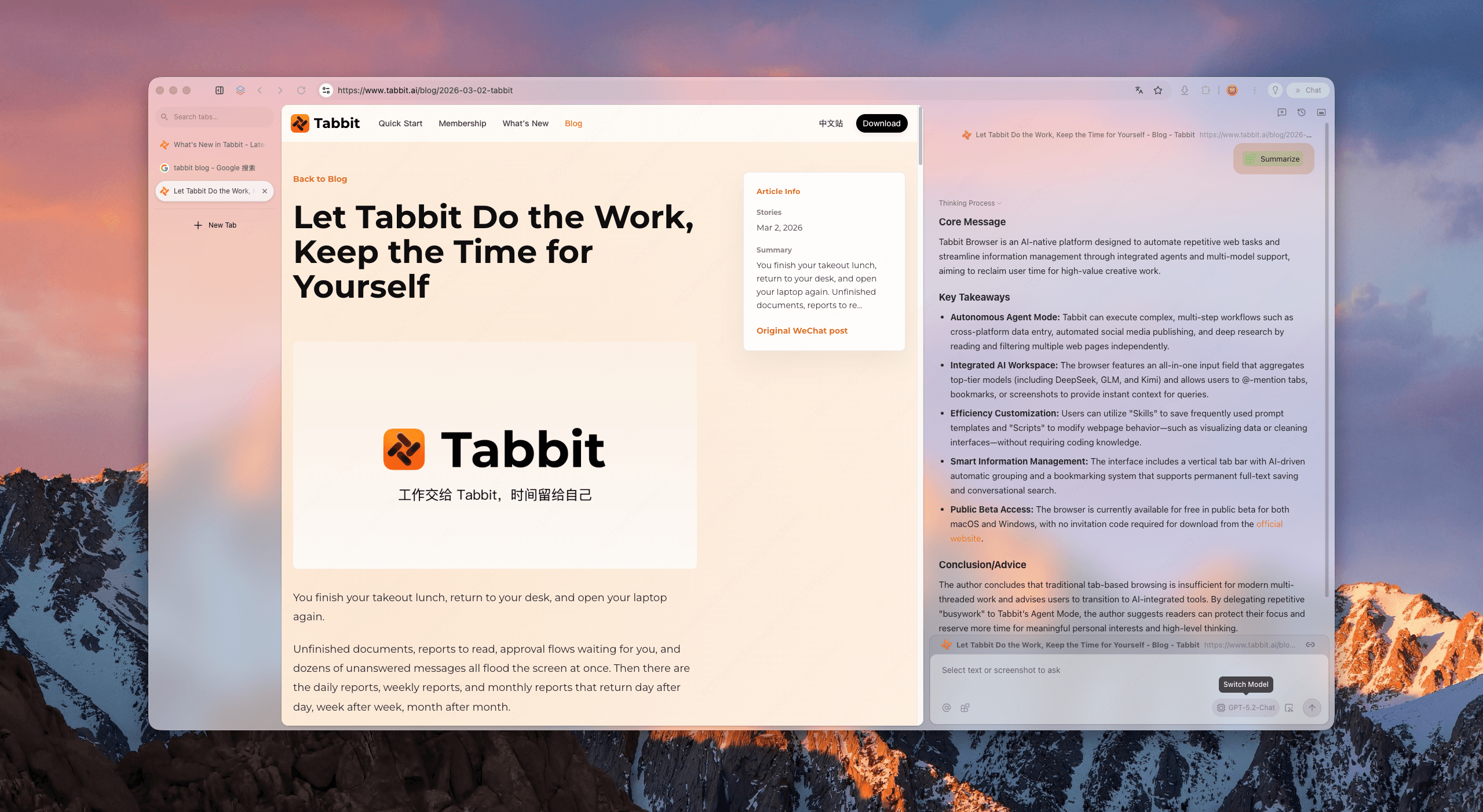
Tabbit is a practical second browser because its official product design starts with context. Its site says pages, screenshots, highlights, bookmarks, and local files can enter a request. That means a research task can live in one window instead of being reconstructed in a separate chatbot.
Keep the source beside the answer
Open the article, report, or policy in Tabbit. Ask for a summary that separates confirmed facts, author judgment, dates, and unresolved claims. Then keep the original page visible while checking the answer.

For a multi-source project, add the relevant tabs, screenshot, or local brief as context. Ask for a decision table with a source beside every factual claim and unknown wherever the sources do not answer. This is where Tabbit moves beyond “browser plus chat box.” The workflow is also why it appears among browsers with AI features, but the second-browser role is less disruptive than replacing your default immediately.
Let Agent Mode handle bounded browser work
When the output requires clicks, form fields, or copying structured data, switch from answer generation to Agent Mode. The visible action log matters: you can see the plan, stop a bad path, and inspect the result.

Start with public information and reversible output. A sheet you can delete is a better first test than a purchase, a public post, or an account change. Our browser automation guide explains the wider safety boundary.
Accept the trade-off
The second-browser pattern reduces migration risk; it does not remove product limits. Tabbit currently supports macOS 12+ and Windows 10+. Linux and mobile are on the roadmap. It is Chromium-based, so it does not satisfy a goal of leaving Chromium. And any content sent to a selected model or cloud service follows that provider's data path, as the Tabbit product FAQ explains.
The fair comparison is not “Can Tabbit replace every Chrome habit today?” It is “Does Tabbit make one important class of work materially easier while Chrome handles the rest?” For a deeper product-by-product view, read Tabbit vs Chrome.
Run a seven-day second-browser test
Pick one real project. Do not migrate your whole digital life.
Day 1: define the border
Write one sentence:
I will open Tabbit when a task needs three or more sources, a local brief, or a supervised browser action.Everything else stays in the main browser.
Days 2–3: test understanding
Use a long page you genuinely need to understand. Ask for claims, evidence, dates, disagreements, and missing information. Check the answer against the visible source.
Days 4–5: test synthesis
Open several sources and add your requirements. Ask for a comparison that cites each source and refuses to fill gaps. Record how many copy-paste steps disappear.
Day 6: test one reversible action
Let Agent Mode collect a small public dataset or prepare a draft in a disposable sheet. Watch the execution and inspect the output.
Day 7: score the fit
second-browser value =
context transfers removed
+ verification made easier
+ useful work completed
- supervision cost
- compatibility frictionIf Tabbit wins on a recurring task, keep the division. If it only duplicates a browser you already like, remove it. Readers who are actually ready to replace Chrome can use the broader Chrome alternatives guide instead.
Which setup should you choose?
| Your actual need | Start with | Reason |
|---|---|---|
| Separate work and personal Google accounts | A second profile | The problem is identity, not capability |
| Test a broken site or one special extension | Another general browser | A narrow compatibility role is enough |
| Give a coding Agent its own logged-in environment | An Agent-only browser | The Agent, not the human, is the primary user |
| Research across pages and files, then take supervised action | Tabbit as your second browser | Context, reasoning, and browser action share one workspace |
| Leave Chromium | Firefox or another non-Chromium option | Tabbit does not meet that requirement |
| Keep phone and desktop browsing continuous | Your current cross-device browser | Tabbit is desktop-only today |
Final verdict
Tabbit is the best second-browser fit for people who are happy with their main browser's reliability but want a separate place for AI-heavy web work. It gives the second browser a real job: understand pages, combine context, compare sources, and execute bounded tasks while the familiar browser protects routine continuity.
That verdict has limits. Use a profile if you only need account separation. Choose another product if Linux, mobile continuity, or a non-Chromium engine is mandatory. Keep sensitive and irreversible actions human-controlled.
The practical next step is small: install Tabbit beside your current browser, choose one seven-day project, and route only that work into it. A second browser earns its place by doing a distinct job well—not by asking you to abandon the first one.
FAQ
Why should I use a second browser?
A second browser gives one class of work its own environment, accounts, tabs, history, and tools. It is useful when that separation reduces mistakes or gives you capabilities your main browser does not need.
Is a second browser better than a second profile?
Not always. A second profile is usually enough for separating work and personal accounts inside the same browser, while a second browser makes more sense when you also want a different workflow or capability set.
Can Tabbit be a second browser without replacing Chrome?
Yes. You can keep Chrome, Edge, or Safari for routine browsing and open Tabbit only for AI-assisted research, page understanding, multi-source comparison, or supervised web tasks.
What should I use Tabbit for as a second browser?
Start with tasks that involve several pages, a long document, a local file, or repetitive browser actions. Keep sensitive and irreversible actions under direct review until you trust the workflow.
Does using two browsers improve privacy?
Two browsers can reduce accidental mixing between activities, but they do not automatically make you anonymous or stop websites from tracking you. Privacy still depends on browser settings, account choices, extensions, network conditions, and the services you use.
What are the limits of using Tabbit as a second browser?
Tabbit currently supports macOS 12 or later and Windows 10 or later; Linux and mobile are on the roadmap. It is Chromium-based, and its Agent still requires supervision for sensitive, costly, or irreversible work.