You update Chrome, open the browser, and one of the extensions you rely on is gone or no longer works. That is a real pain when the extension holds your ad-blocking rules, saves research, counts words, or handles a repetitive work task.
The timing can be misleading. Sometimes an update exposes a corrupt local file or an API change. Sometimes Chrome has disabled a Manifest V2 extension on purpose. A Reddit user described the second case plainly: "It took me an hour to migrate to Brave" after Chrome stopped working with favorite V2 extensions. Read the comment in context.
This article separates those cases, then gives you a safer migration path. If the extension was an AI assistant or browser automation tool, Tabbit Browser is worth testing as a second browser because those capabilities are built in. It is not a universal fix for Chrome extensions.
Key takeaways
"It broke after the update" is a useful timestamp, not a diagnosis.
A broken install can often be repaired. A disabled MV2 extension needs an update, an alternative, or a different browser.
Chrome 138 was the last version where an enterprise policy could preserve MV2. Chrome 139 removed that policy path, according to Chrome's official timeline.
Do not start with a downgrade. Preserve unsynced profiles and test the exact workflow first.
Tabbit is most useful when the missing extension was an AI tool. It provides page chat, Agent, Skills, and multiple models without another Chrome extension.
Extension failure at a glance
| What you see | Likely cause | Safe first test | Next action |
|---|---|---|---|
| The extension disappeared or says it is no longer supported | Manifest V2 deprecation or store removal | Open its store listing and developer notes | Find the official MV3 build or a replacement |
| It appears installed but its popup or content script fails | API, permission, or MV3 migration bug | Disable other extensions and test one site | Update, report, or replace the extension |
| It works in a fresh profile | Local profile, cache, or extension files | Test the extension before importing settings | Reinstall only the affected extension or repair the profile |
| It fails in every profile but another browser works | Chrome-specific policy or API behavior | Compare the exact extension task elsewhere | Use a verified browser alternative or wait for the developer |
| Several extensions fail after the same update | Browser version or policy change | Check chrome://extensions and the Chrome version | Read the official release notes before changing data |
This is a routing table, not a verdict. A local problem and a platform change can happen together. Start with the smallest test that can separate them. The broader browser update diagnosis guide covers the same evidence-first habit for broken websites.
Why a browser update can stop an extension
Chrome extensions are small applications tied to browser APIs. An update can change how those APIs behave, how permissions are enforced, or which manifest versions are still allowed to run.
Google's Manifest V3 overview describes the main platform changes:
background pages move to service workers that run when needed;
remotely hosted code is no longer allowed to execute inside the extension;
network request modification moves away from blocking
webRequesttowarddeclarativeNetRequestfor many use cases.
Those changes affect different extensions in different ways. An extension that only adds a button may need a small manifest and API update. An ad blocker, script manager, or tool that depends on long-lived background state may need a larger redesign.
The migration guide is for developers, not end users. It lists changes to manifest.json, service workers, API calls, web requests, security, and publishing. Google also provides an Extension Manifest Converter, but the same guide says the converter only gets a developer started.
That is why reinstalling an old copy usually does not solve a completed deprecation. Chrome is refusing the platform behavior, not failing to find the file.
Check the cause before reinstalling everything
1. Record the failure
Write down the extension name, its version, your Chrome version, operating system, and the exact task that stopped working. Save the error text from chrome://extensions and take a screenshot if the page shows one.
Do this before clearing data or removing profiles. A YouTube commenter asked whether downgrading Chrome would delete several unsynced profiles used for different work accounts. That concern is visible on the video page. It is the right question to ask before experimenting with browser versions.
If you need a migration, use the browser backup checklist first. Do not assume that bookmarks, passwords, extension settings, and local storage have the same backup path.
2. Look for a supported build
Open the extension's Chrome Web Store page. Look for a recent release, a note mentioning Manifest V3, or an official replacement. Do not install an unrelated copy just because the name is similar.
Chrome's official help page recommends checking the Chrome version, device restrictions, managed-device policies, and the extension developer's support channel. That is a better route than downloading a random CRX file from a forum.
3. Isolate a local conflict
If the extension still has a supported listing, test the local installation:
Open a fresh browser profile or a private window.
Test one known page where the extension should work.
Temporarily disable other extensions that can change the same page.
Update the extension from
chrome://extensions.Remove and reinstall only that extension if its files appear corrupted.
If it works in a clean profile, the original profile is the suspect. If it fails in every profile and the store says the extension is unsupported, stop clearing caches. You have probably reached a platform boundary.
The same method helps with an unexpected interface change. See what to do when browser UI changes after an update, but do not apply a UI workaround to an extension deprecation.
What Manifest V2 to V3 migration changes
For developers, MV2 to MV3 is not a one-line version edit. Google identifies several work areas:
| Migration area | What changes | Why users notice |
|---|---|---|
| Background code | Event or background pages move to service workers | Timers and global state may not survive when the worker stops |
| Page access | DOM and window calls need another context or an offscreen document | Features that edit pages can fail in new places |
| Network rules | Blocking request listeners change to a declarative rules model for many cases | Content blockers may offer a different set of controls |
| Remote code | Code must be included in the reviewed package | Some update and scripting patterns no longer pass store rules |
| Permissions and publishing | Developers need to review permissions and roll out the update | An update can show a new permission warning or need a fresh approval |
The service-worker migration guide is explicit about several differences: service workers cannot access the DOM or window, they can terminate when not in use, and state should be persisted rather than kept in globals. Those are code changes the user cannot complete from the extensions page.
Choose the replacement by the job
There is no single answer for every extension.
If the developer shipped an MV3 update
Use the official update. Read the release notes and retest the task that matters to you, not just whether the icon appears. An extension can load while one content script, shortcut, or network rule still behaves differently.
If the extension has a clear MV3 alternative
Compare the exact feature, permissions, data handling, and maintenance status. An alternative that blocks pages is not automatically equivalent to one that edits a selected element or manages a research workflow.
If the extension is specialized and has no replacement
Keep the old browser or choose a different browser only after checking its current extension policy. Do not use a browser downgrade as a permanent plan. The moderator of a Reddit alternatives thread warns that old-browser workarounds are unsafe and that many flags are temporary or already disabled. See the thread.
If you move, start with a copy of your data. Keep Chrome installed until the important pages, profiles, and extension settings have been checked. A second-browser workflow is useful when you want to compare without deleting the first setup.
If the missing extension was an AI tool
You may not need another extension-shaped replacement. A browser with AI built in can remove the specific dependency on the Chrome extension stack, while Chrome remains available for specialist tools.
A practical option for AI extensions: Tabbit Browser
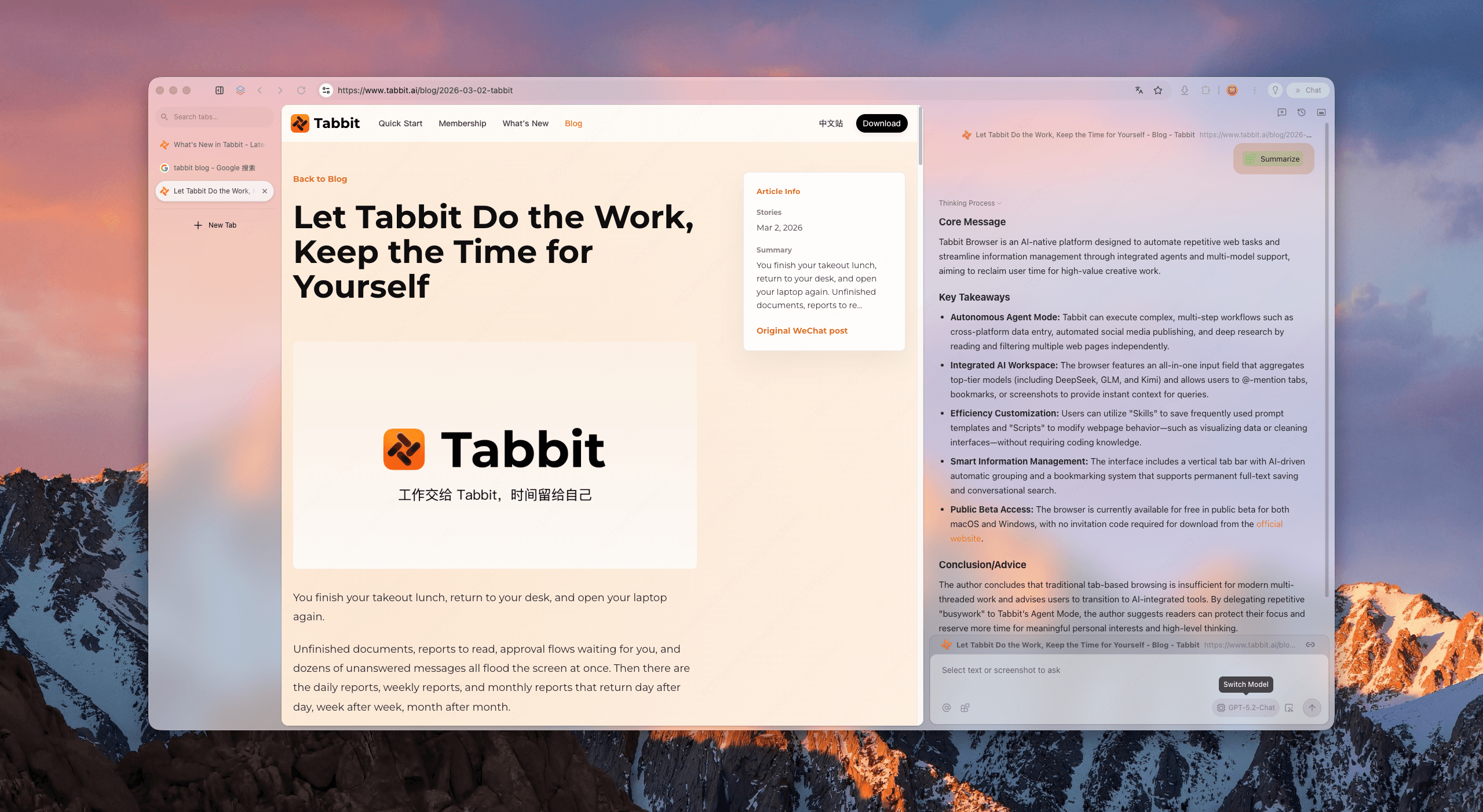
Tabbit is relevant when the extension you lost was a summarizer, writing assistant, research helper, or browser automation tool. The official download page lists AI Chat, Agent, Skills, and built-in models for macOS and Windows. It also supports importing browser data, so you can bring over what you need without making Chrome disappear.
The safe way to test it is simple:
Install Tabbit beside Chrome.
Open the same public page where the extension used to help.
Use page chat or select content and ask for the small task you actually need.
Try Agent only for bounded work that you can review.
Import bookmarks or other browser data after the clean comparison, not before.
For example, a broken summarizer extension might have done this:
Select the article, open the extension, wait for a summary, then copy the answer into notes.In Tabbit, the page and AI chat live in the same browser. You can ask about the page, use Skills for a repeated instruction, or hand a multi-step public-page task to Agent. The product page also describes multi-model support, which is useful if the old extension locked you to one provider.

There are trade-offs. Tabbit does not promise to run every Chrome extension, and a built-in AI feature is not a replacement for a password manager, developer tool, content blocker, or niche workflow without testing. It is also a second desktop app, not a way to keep an MV2 extension alive.
For a broader comparison, read the Tabbit AI browser guide, the AI browser overview, and the Tabbit and Chrome comparison. If the workflow fits, the AI browser download page is the next step.
Decision table: keep, replace, switch, or wait
| Your situation | Best path | What to verify | Trade-off |
|---|---|---|---|
| Official MV3 update exists | Update and retest | Feature parity and new permissions | The extension may behave differently |
| Supported alternative exists | Compare and install the official listing | Permissions, data handling, exact task | Setup and habits change |
| Specialist extension has no replacement | Keep Chrome or test another verified browser | Current policy, profile import, task compatibility | You may maintain two browsers |
| AI extension stopped working | Test Tabbit's built-in AI workflow | Page chat, Agent, Skills, model choice | Tabbit is not an all-purpose extension host |
| Only one profile is broken | Repair that profile or reinstall one extension | Fresh-profile comparison | You need to preserve local state |
| You are considering a downgrade | Stop and back up first | Security updates and profile recovery | A rollback can create a larger problem |
Final verdict
When a browser extension stops working after an update, first decide whether Chrome broke a local install or ended support for the extension's platform. That one distinction saves you from repeating cache clears against a policy change.
If an MV3 update exists, use it. If not, compare a verified alternative or another browser without downgrading blindly. Preserve unsynced profiles before you move.
If the missing tool was an AI extension, install Tabbit Browser beside Chrome and run one real task in a clean workspace. Keep the old browser until the result is good enough for your work. That is a migration you can undo.
FAQ
Why did my Chrome extension stop working after an update?
The update may have exposed a local file or permission problem, changed an API, or disabled a Manifest V2 extension. Check whether the extension has an MV3 update before clearing data or reinstalling everything.
How do I know if an extension uses Manifest V2?
Check the extension's Chrome Web Store listing and developer notes for an updated version. If you own the code, open manifest.json and read the manifest field. A store warning that the extension is no longer supported is a strong sign that the problem is platform support, not just a broken install.
Can I re-enable a Manifest V2 extension in Chrome 139 or later?
Chrome's official timeline says Chrome 138 was the last version where the enterprise policy could preserve Manifest V2, and Chrome 139 removed that policy path. A normal reinstall or a flag should not be treated as a durable fix.
Is downgrading Chrome a safe fix?
Usually no. A downgrade can remove security fixes and may put profile data at risk. Keep a backup of bookmarks, passwords, and unsynced profiles, then look for an MV3 update or a verified replacement instead.
What should I do if there is no MV3 version?
Choose between a verified alternative, another browser whose current policy supports the workflow, or dropping the extension if the job can be done another way. Test the exact task before deleting your old browser or profile.
Can Tabbit replace a Chrome AI extension?
It can replace some AI extension workflows because Tabbit includes AI Chat, Agent, Skills, and multiple models inside the browser. It does not guarantee compatibility with specialist Chrome extensions, so keep Chrome available until the workflow is checked.