
Gemini 4 Carbon is a plausible candidate for a controlled pilot on difficult, long-horizon work, but the public record does not establish that it is the best model for your workload. Google describes Carbon for the hardest tasks and says Argon remains suitable for most software engineering and knowledge work. Its model card combines distinct benchmarks with different tasks and harnesses; treat each as a signal, not as a universal success rate.
What users reported
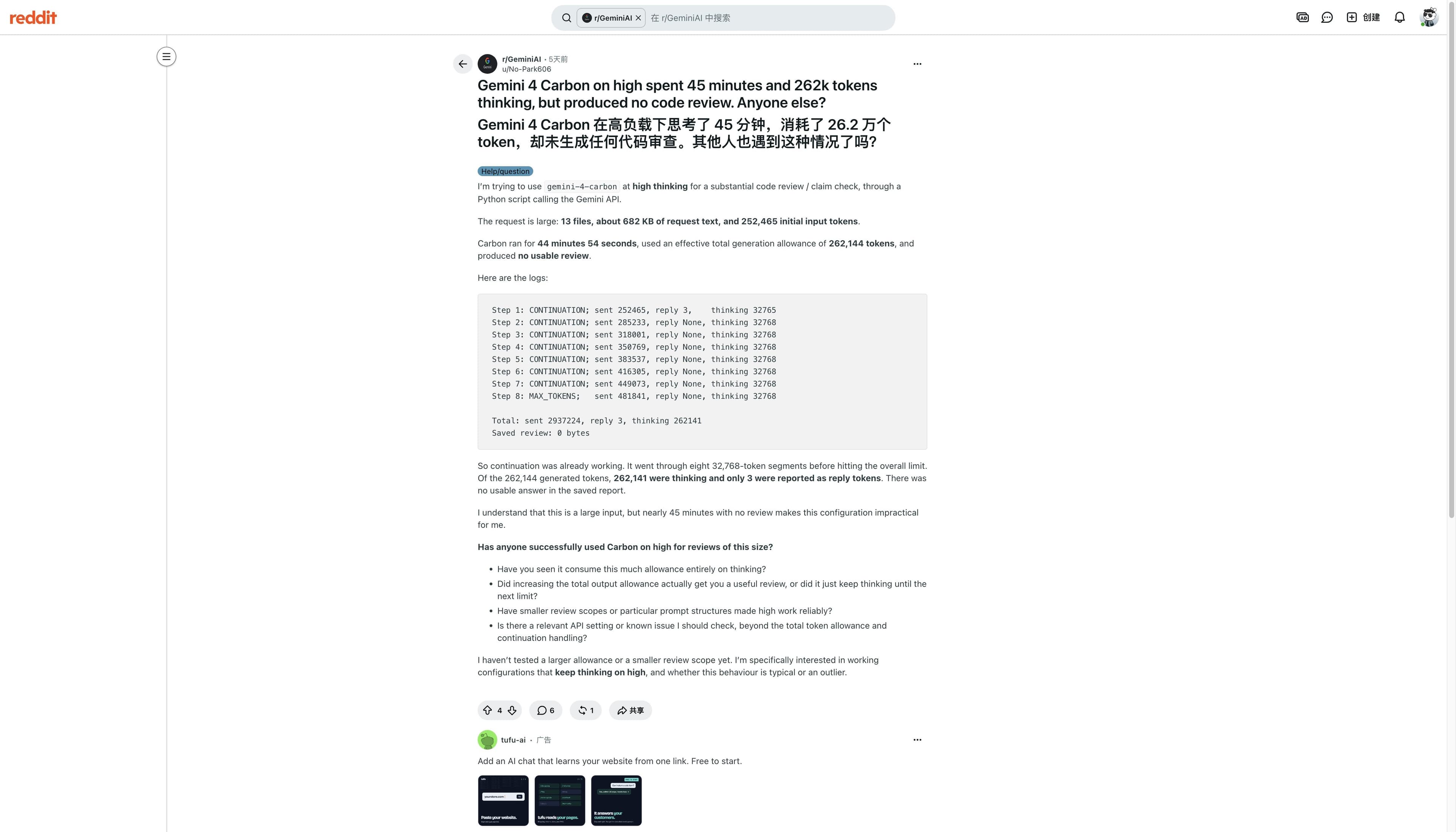
One Reddit user reports a 13-file high-thinking review that ran about 45 minutes, consumed 262,141 thinking tokens and produced no usable review. That is one setup and one failed task, not a general reliability rate. The screenshot preserves the author’s task description and displayed run details. Read the post.
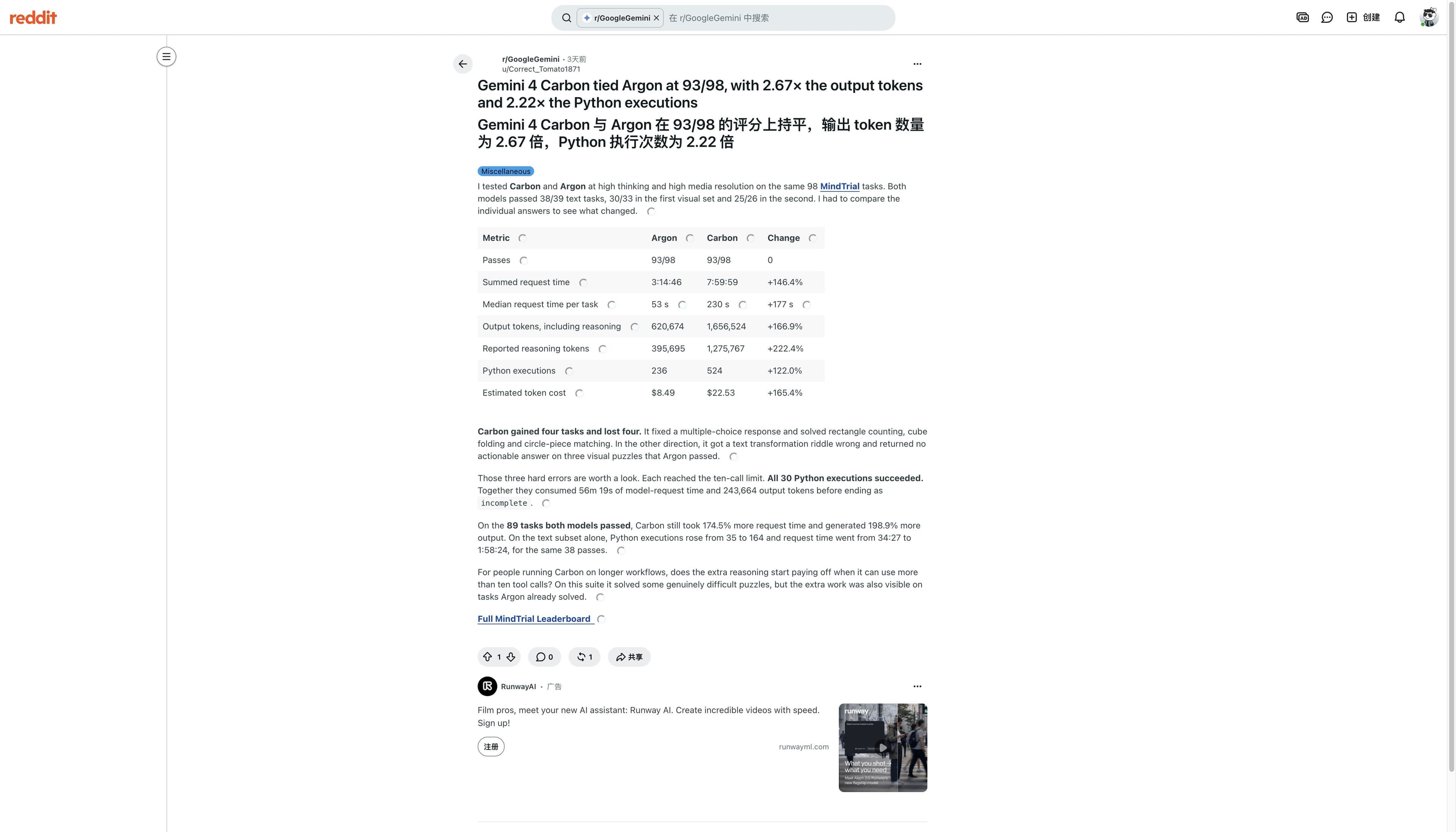
Another Reddit user compared Carbon and Argon on 98 MindTrial tasks and reports both at 93/98, while Carbon used 2.67× the output tokens and took 2.46× the time; the author estimated $22.53 vs $8.49. This self-reported comparison is useful for designing a cost-per-passed-task test, not a replicated score. Read the original.
Key takeaways
Google positions Carbon for its hardest long-horizon work; that is a reason to pilot, not an independent recommendation.
The model card reports distinct benchmark results; version, harness and task matter more than a single headline score.
Google notes higher token use at high thinking plus latency, timeouts and hallucinations; it publishes no universal success rate.
User reports show task-level variability, but no Tabbit Carbon run or repeated controlled trial is verified here.
A practical decision table
| Task | What the sources support | What remains unproven | Next check |
|---|---|---|---|
| Vendor benchmarks | Model card names task, harness and score | General reliability on your workload | Reproduce a benign task |
| User reports | Individual Reddit/X experiences | Population-level result | Keep prompts and settings attached |
| High-thinking work | Vendor notes higher token use and possible latency/timeouts | Fixed quality-per-dollar advantage | Measure tokens and accepted output |
Turn the claim into a task test
For a pilot, write down the accepted answer before running the model. Use read-only inputs and a harmless output, then repeat the task with the same context and rubric. Record correctness, omissions, time, input/output tokens, and cost. If an answer is wrong, note whether the error came from the model, the prompt, or missing source material; do not silently change the task between runs.
Google’s Carbon model card reports multiple results, including Terminal-Bench 4.0 (AA) 65.2%, Agents’ Last Exam v1.1 at 77.4, and GraphWalks F1 96.2% for a stated 256k–1M BFS setup. Those figures address different evaluations. The Artificial Analysis page currently labels its index v5.0.1, while the Google card’s snapshot says v5.0. Do not read 59 versus “up to 60” as a clean before/after gain.
| Evidence | What it can tell you | What it cannot tell you |
|---|---|---|
| Vendor benchmark | Performance on named task and harness | Your production success rate |
| Community task report | A person’s experience under their own setup | Independent replication or average cost |
| Your pilot | Fit for the chosen task and rubric | All future prompts or account configurations |
The release is public, but access depends on product and account. Google’s announcement lists developer/business access through Gemini API and AI Studio and consumer use in the Ultra Gemini app. Check the product picker and billing surface you actually plan to use.
For repeatable evidence work, see multi-model research notes, browser research with sources, deep-research methods, and the cost-per-success framework.
Where Tabbit fits
Tabbit is a browser/workflow layer, not evidence that Carbon itself can control a signed-in browser. The existing Carbon browser-use guide explains the separation between model access and local browser execution. This article does not report a Tabbit Carbon benchmark or a Carbon run; the test above is a protocol, not a result.
To test Carbon around a browser workflow, separate model access from local execution with the Tabbit CLI guide, existing-browser connection steps, first-task checklist, local automation guide, and agentic-browser explainer.
Read benchmark scores with their setup attached
A model card is most useful when its score stays beside the task name, version, harness and input conditions. A high result on a long-context graph task does not show that Carbon will browse a business account accurately; a coding benchmark does not measure citation quality. Vendor testing can help identify where to pilot, while community posts surface practical questions such as token use and timeouts. Neither substitutes for repeated testing on your own accepted output. The fair review question is not “Is Carbon good?” but “Does Carbon complete this named task to our standard at a cost and delay we can accept?”
Treat the published evidence as a starting point, not a promise for your workload. Verify the current model, account terms and measured result before committing sensitive data or recurring spend.

FAQ
Is Gemini 4 Carbon worth testing?
Consider a bounded pilot for a difficult task if the current account exposes the model. Public evidence does not establish that it is the right choice for every workload.
Do benchmark scores predict my result?
No. Scores depend on a task, harness, model version, and settings. Use them to form a test question, then measure your own task.
Does the model card disclose limitations?
Yes. It describes higher token use at high thinking and notes latency, timeouts, and hallucinations. It does not provide a universal failure rate.
Can Carbon browse my signed-in pages?
A model does not itself control a browser. Browser access depends on a separate local host, connector, account, and authorized site session.
How should a pilot be reviewed?
Use a benign task, fixed input, rubric, and repeated runs. Check factual claims, omissions, time, tokens, and cost before expanding access.