
Gemini 4 Argon is a capable model for sustained coding and knowledge work, but the public evidence does not support a blanket “best model” verdict. Google reports concrete internal gains on specific engineering tasks; independent results vary by reasoning setting and benchmark. For individual buyers, the unresolved practical issue is whether the work quality justifies the API bill or the limited subscription allowance. Google’s October ADK case study says Argon cut long-session preparation time by 40% in the Python Agent Development Kit and reduced cold-import time by 21%. That is the clearest decision anchor in this review: a measured result on one real codebase, published by Google, not a universal estimate for every project.
Key takeaways
Argon targets complex coding, research and multi-step work; Google documents a 1M combined input-output context window for Gemini API use.
Google’s ADK example reports 40% faster in-memory session preparation in long sessions and 21% faster cold imports. It is a vendor case study with no independent replication stated on the page.
Artificial Analysis’ current Index v5.0.1 table shows Argon High at 50 and Carbon High at 60. The score summarizes nine evaluations; it is not a direct measure of every workflow.
Reddit reports are divided: some users describe capable coding or reasoning, while others cite quota burn, token use and weak follow-through. These are anecdotes, not controlled tests.
Choose Argon when you can review the result and the task benefits from a deeper pass. Do not choose it on benchmark rank alone.
Gemini 4 Argon review at a glance
| Evidence | What it says | What it does not establish |
|---|---|---|
| Google ADK engineering case | 40% less in-memory session preparation time in long sessions; 21% faster cold imports | Expected gain on an unrelated codebase or a user’s private workload |
| Artificial Analysis Index v5.0.1 | Argon High scores 50; nine benchmark evaluations are combined | A universal ranking or an equal-effort comparison across products |
| Gemini 4 Argon model card | 1M combined input-output token window; text and image input listed | That every interface exposes the same context size or quota |
| Reddit user reports | Conflicting views on task quality, quota use and final-step reliability | Product limits, model-wide success rate or controlled competitor results |
What Argon appears to do well
Google positions Argon for complex coding, finance, legal work, cybersecurity and science. Its October announcement describes an ADK Python optimization run in which Argon worked overnight from a short goal plus the repository’s agent rules. Google says the resulting changes cut long-session in-memory session preparation by 40%, while cold imports improved by 21%. The linked commit makes this a more inspectable example than an unsourced capability claim.
The case still has boundaries. It is a Google team’s selected project, the published post does not describe a randomized comparison, and the gains belong to that code path. Treat the result as proof that Argon helped on this workload, not a promise that it will make any codebase 40% faster. The Gemini 4 Argon model card describes intended use, limits and evaluation results; it also warns about hallucinations, timeouts and higher token use at higher thinking levels.
Benchmarks: useful signal, narrow answer
Artificial Analysis’ release comparison currently lists Argon High at 50 and Carbon High at 60 on Index v5.0.1, which combines nine evaluations. Its measurement page updates regularly, so record the version and retrieval date before comparing results. The values are not a stable ranking for all time. The two models’ output price can match while their task costs differ because tasks consume different quantities of input, cached, reasoning and answer tokens.
A separate Reddit user published a small reverse-engineering comparison with different harnesses: Codex, Claude Code, Antigravity and OpenCode. The author’s table reports 56.33 for Argon Medium on three tasks, while other models used different harnesses. That post is useful as a warning about evaluation design, not as a clean head-to-head result. Different tools, prompts, plans and task scoring make the totals unsuitable for a universal ranking.
The practical trade-offs
| Work pattern | Argon may fit when… | Reconsider when… |
|---|---|---|
| Repository analysis or debugging | You can provide relevant files and inspect proposed changes | The task needs a guaranteed result or a fixed time budget |
| Long research or document work | Several reasoning steps materially improve the deliverable | The task is a quick lookup that a lighter model can handle |
| API use | You can track input, output, caching and thinking-token charges | A fixed subscription quota is your only budget control |
| Gemini app / Antigravity | Argon appears in your account’s current model selector | Your plan or usage meter makes sustained work impractical |
Community feedback helps explain that last row. In one r/GeminiAI discussion, user MammothResult8482 said the model could handle complex prompts in Gemini but consumed many tokens; they described it as more token-efficient for coding in Antigravity. Another commenter, Lost-Willow386, said a single prompt could use too much quota. Those accounts differ by interface and workload, so they should not be averaged into a capability score. They do show why an API price table cannot predict subscription usefulness.
Verdict: capable, but evaluate it on your own task
Argon is worth a trial for complex coding, analysis or research when you have a review step and a clear stop condition. It is a weaker default for simple questions, unattended high-stakes work or workflows constrained by consumer quota. Begin with a small representative task, save the prompt and output, check the result against source files, then inspect the usage meter. Do not extrapolate a single good or bad run to a general success rate.
For browser-based coding research, the Gemini 4 Carbon browser guide and Gemini CLI browser MCP guide cover separate workflows.
MammothResult8482 described the Gemini app experience as “consumes a lot of tokens”; Lost-Willow386 said a prompt can use “way too much quota for a single prompt.” These are different users’ reports, not a quota measurement.
Related reading
Reddit evidence snapshots
Browser captures of the original discussions. Posts reflect individual experiences, not product guarantees.
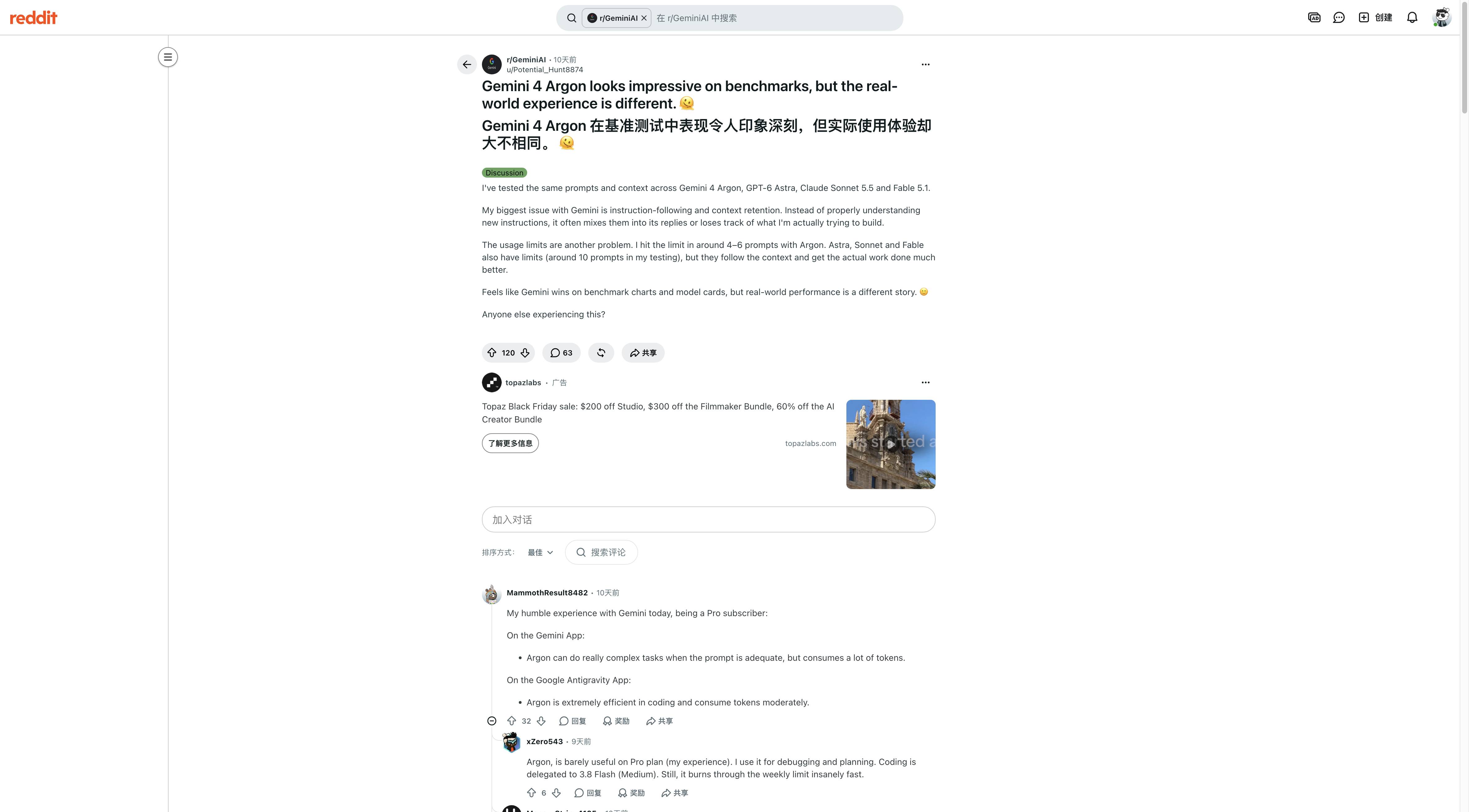
MammothResult8482 compares Gemini app and Antigravity usage; posted about 10 days before collection. Original Reddit discussion
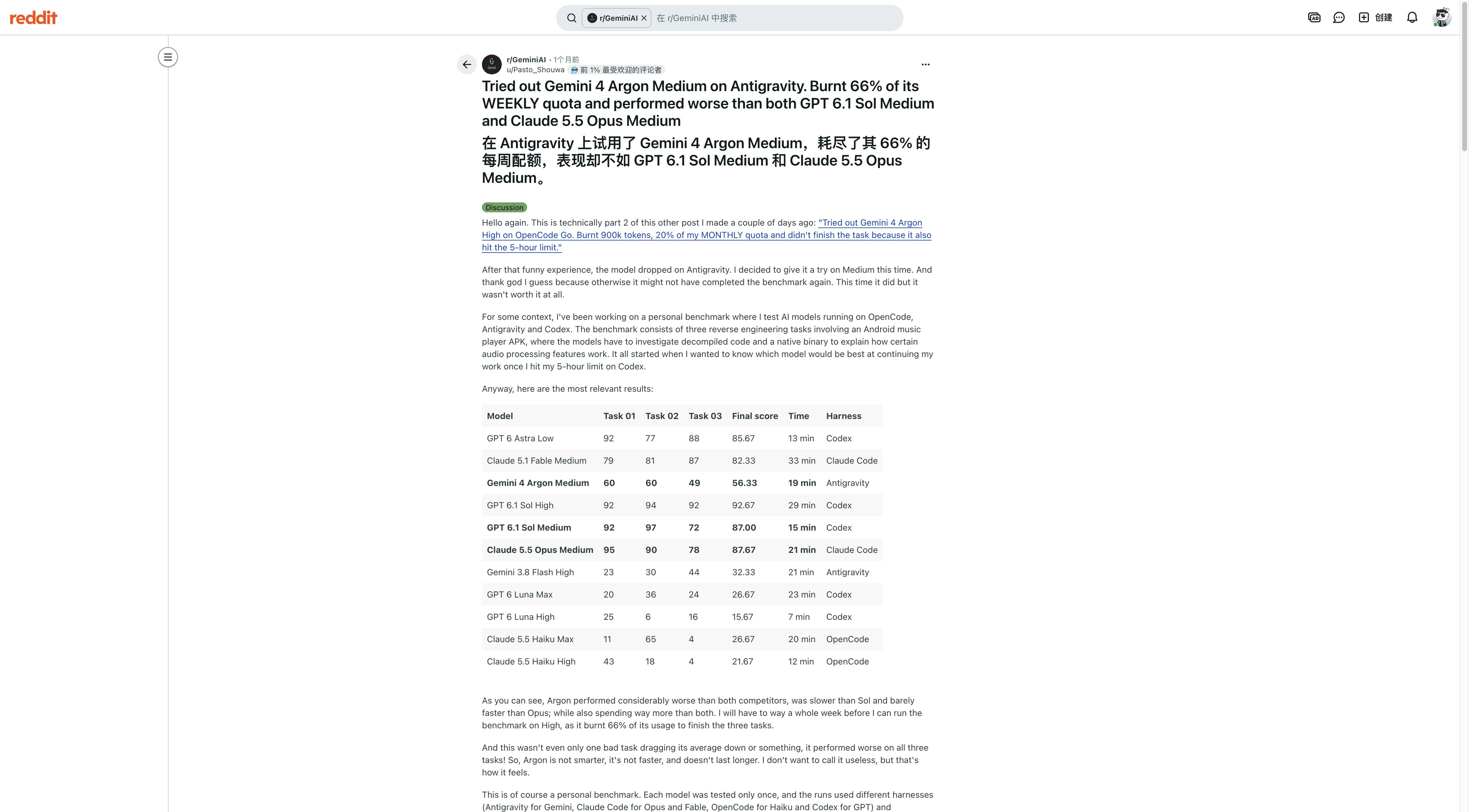
Pasto_Shouwa reports a three-task personal benchmark and names the different harnesses. Original Reddit discussion
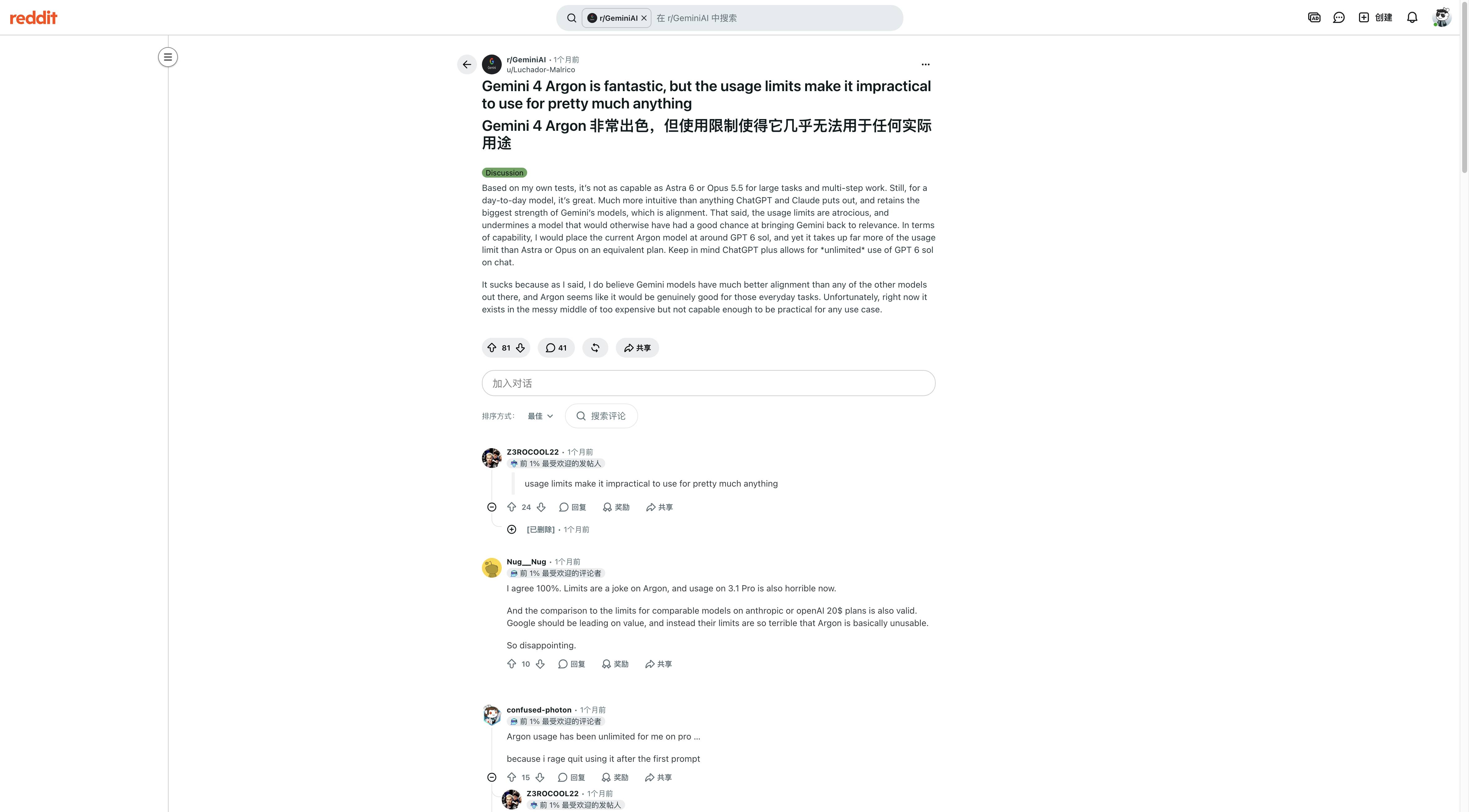
A Reddit discussion where subscribers describe different Argon usage limits; anecdotal and plan-specific. Original Reddit discussion
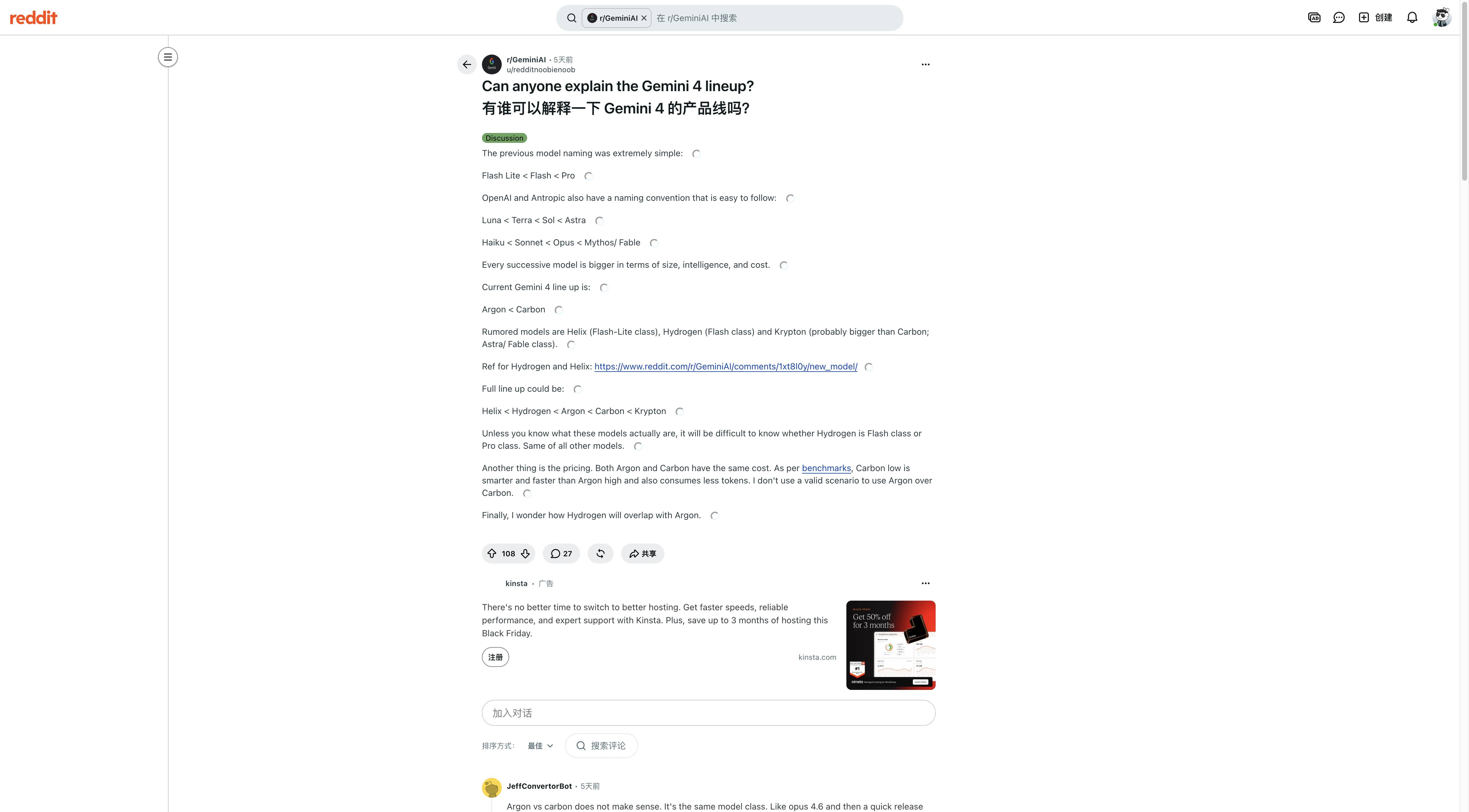
A Gemini lineup discussion where commenters question what Argon and Carbon names mean. Original Reddit discussion

FAQ
Is Gemini 4 Argon good?
It is a strong candidate for complex, reviewable coding and knowledge tasks. Public evidence is workload-specific, so test it on your own task before making it a default.
What is the Gemini 4 Argon context window?
Google documents a combined input-output context window of up to 1 million tokens for Gemini API. Product surfaces may impose different limits.
Does Argon outperform Gemini 4 Carbon?
Not in every current benchmark. Artificial Analysis Index v5.0.1 lists Argon High at 50 and Carbon High at 60; task cost and latency also vary by setting.
Why do people say Argon uses too much quota?
Reddit users report different experiences across Gemini app, Antigravity and API workflows. Their accounts are anecdotal and do not define official plan limits.
How should I test Argon for my work?
Use a representative task with the same prompt, tools and success criteria across models; track completion, retries, time and token cost.
Are Gemini 4 Argon benchmark claims independently verified?
Some independent benchmarks exist, including Artificial Analysis Index v5.0.1. Google’s named engineering cases are vendor reports, and neither source predicts every individual workflow.